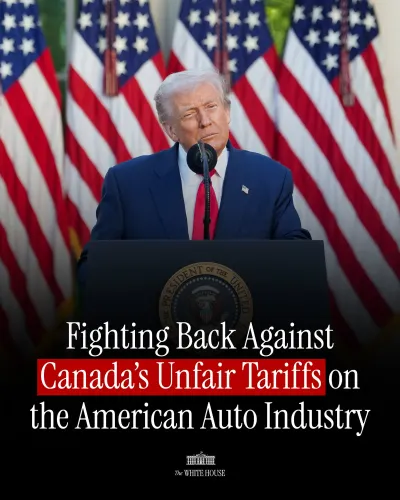
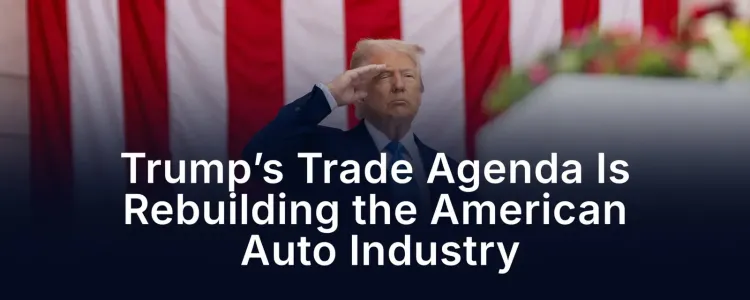
White House Says Trump Trade Agenda Is Reviving U.S. Auto Industry
Synopsis
The White House declared on 20 August 2026 that President Trump's trade agenda — built on Section 232 tariffs and the USMCA's 75-percent regional content rules — is rebuilding the American auto industry, putting Detroit-sector employment and production data under immediate scrutiny.
Key Takeaways
The White House officially claimed on 20 August 2026 that Trump's trade agenda is rebuilding the American auto industry .
The USMCA , effective 2020 , raised vehicle regional content requirements to 75 percent , pressuring automakers to source more parts within North America.
Section 232 tariffs on steel and aluminum, imposed in 2018 , were designed to lower input costs for domestic auto parts suppliers.
Major U.S. automakers — General Motors , Ford , and Stellantis — are the primary employers whose payrolls will test the administration's 'rebuilding' claim.
Successive U.S. administrations have retained core elements of Trump-era trade tools, signalling bipartisan entrenchment of the tariff-and-content approach.
Indian auto component exporters supplying global OEMs face direct exposure to U.S. sourcing rule shifts driven by this policy framework.
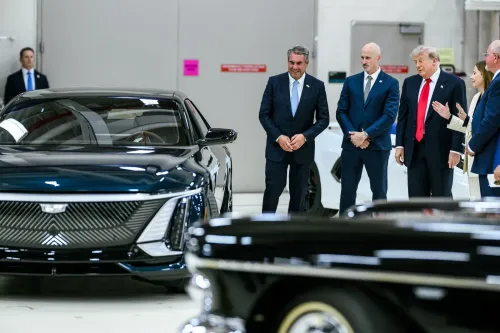
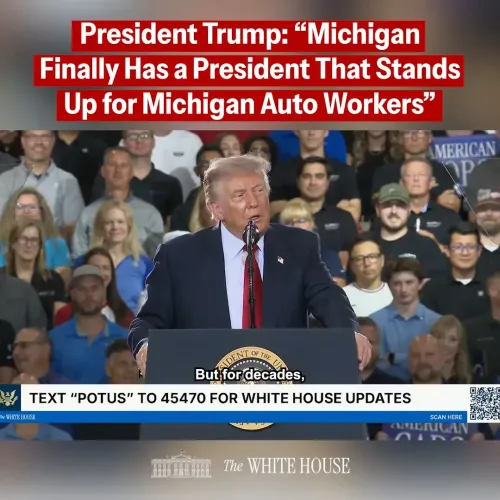
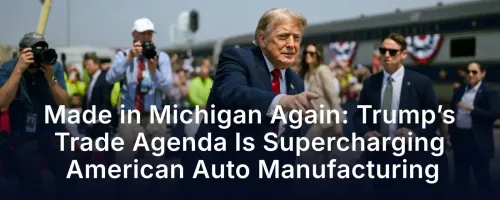
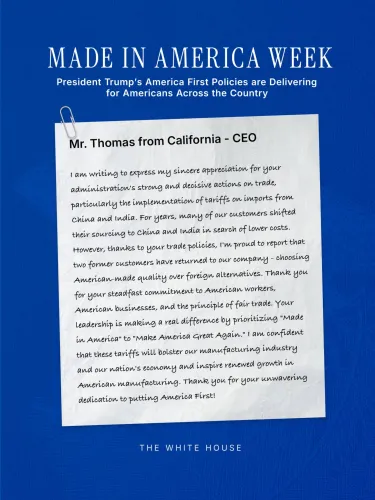
A claim with billion-dollar stakes landed on the White House's official channel on Thursday, 20 August 2026: President Donald Trump's trade agenda is, in the administration's own words, rebuilding the American auto industry. The assertion frames years of tariffs and treaty renegotiations as a manufacturing revival — and puts the spotlight squarely on a sector that has long been the economic spine of the American Midwest.
From NAFTA's Wreckage to USMCA's Rules
The policy lineage behind this claim stretches back to 2018, when the Trump administration moved on two fronts simultaneously. First, it imposed sweeping tariffs on steel and aluminum imports under Section 232 of the Trade Expansion Act, citing national security — a move that directly benefited domestic auto parts suppliers dependent on American steel. Second, it tore up NAFTA and replaced it with the United States-Mexico-Canada Agreement (USMCA), which took effect in 2020.
The USMCA is not a cosmetic rebrand. It raised the regional content threshold for vehicles to 75 percent — up from NAFTA's 62.5 percent — and introduced new labor-value rules requiring a significant share of auto work to be performed by workers earning at least $16 per hour. The design was explicit: make it harder and more expensive to assemble cars cheaply in Mexico and ship them north duty-free.
What 'Rebuilding' Means for Detroit and Beyond
The stakes are not abstract. General Motors, Ford, and Stellantis — the Detroit Three — collectively employ hundreds of thousands of workers across Michigan, Ohio, Indiana, and Kentucky. For auto workers and their unions, the combination of tariff pressure on foreign competitors and tighter North American content rules was pitched as a floor under domestic employment.
Whether the floor held — and whether the White House's 'rebuilding' claim is borne out by production and payroll data — is precisely what analysts will now scrutinise. Quarterly figures from the Bureau of Labor Statistics on U.S. auto manufacturing employment and output will serve as the empirical test of the administration's assertion.
A Trade Doctrine That Outlasted Its Author
What makes this moment politically significant is the durability of Trump's trade toolkit. Successive administrations retained the Section 232 steel tariffs in modified form and kept the USMCA framework intact — a tacit acknowledgement that the bilateral, tariff-forward approach had become structural U.S. trade policy, not a one-term experiment. The White House's latest claim is therefore not just a victory lap; it is a bid to cement the narrative that economic nationalism in trade delivers measurable industrial results.
The auto industry will be watching the numbers. So will India, whose own export-oriented auto components sector — supplying parts to global OEMs — is directly exposed to shifts in U.S. sourcing rules and tariff regimes.
Point of View
Both of which have proven stickier across administrations than critics predicted. For India, the subtext is consequential: a U.S. policy environment that rewards domestic sourcing over global supply chains structurally disadvantages Indian auto component exporters who depend on American OEM contracts. The broader pattern suggests that 'America First' trade doctrine is no longer a Trump-specific posture but an enduring feature of U.S. industrial policy.
NationPress
21 Aug 2026
Frequently Asked Questions
What is Trump's trade agenda for the auto industry?
President Trump's auto trade agenda centres on two pillars: Section 232 tariffs on imported steel and aluminum, which lower costs for domestic parts suppliers, and the USMCA's 75-percent regional content rule, which requires automakers to source the bulk of vehicle components from within North America to qualify for zero tariffs.
What is USMCA and how does it affect car manufacturing?
The USMCA — United States-Mexico-Canada Agreement — replaced NAFTA in 2020 and tightened automotive rules of origin to 75 percent regional content. It also introduced a labor-value requirement mandating that a significant share of auto work be done by workers earning at least $16 per hour, pushing production back toward the U.S. and Canada.
How do U.S. auto tariffs affect India?
India's auto components sector exports parts to global original equipment manufacturers (OEMs) that supply the U.S. market. Stricter U.S. sourcing rules and tariff pressure on non-North American inputs can reduce demand for Indian-made components, making this a policy development Indian exporters track closely.
Which U.S. car companies benefit from Trump's trade policy?
The primary beneficiaries are the Detroit Three — General Motors, Ford, and Stellantis — along with their domestic supplier networks in Midwest states such as Michigan, Ohio, Indiana, and Kentucky, where auto manufacturing employment is concentrated.
What data will confirm whether the U.S. auto industry is actually being rebuilt?
Quarterly auto manufacturing employment and production figures from the U.S. Bureau of Labor Statistics are the key metrics analysts will use to verify the White House's 'rebuilding' claim. Rules-of-origin compliance data under USMCA will also indicate whether vehicle content is genuinely shifting back to North America.