White House Signals US-Philippines Ties With Flag Post
Synopsis
The White House posted a US and Philippines flag image on November 18, 2026, underscoring the two nations' 1951 Mutual Defense Treaty alliance and their deepening security cooperation under EDCA amid rising Indo-Pacific tensions.
Key Takeaways
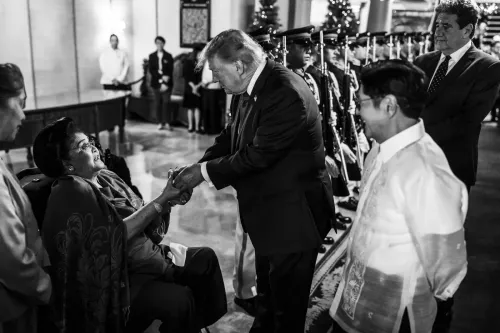
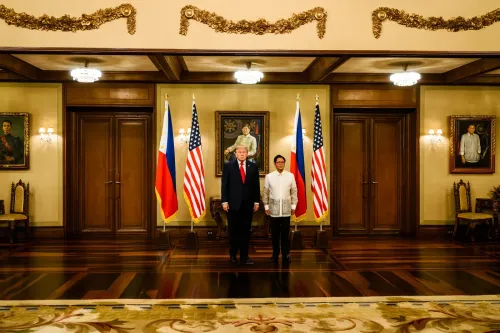
The White House posted a US-Philippines flag-and-handshake image on November 18, 2026 .
The Mutual Defense Treaty of 1951 is the legal bedrock of US-Philippines security ties, committing both to mutual defence against external attack.
The Enhanced Defense Cooperation Agreement (EDCA) , signed in 2014 , expanded US military access to Philippine facilities.
The Philippines' location near the South China Sea and Taiwan Strait makes it a linchpin of Washington's Indo-Pacific strategy.
Such White House social-media signals have historically preceded joint-exercise announcements, basing updates, or high-level bilateral meetings.
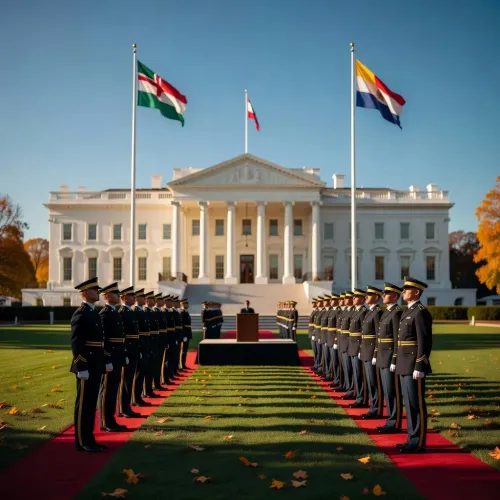
Two flags. One handshake emoji. The White House posted a brief but pointed image to X on Wednesday, November 18, 2026, pairing the American and Philippine flags — a symbolic gesture that, in the charged theatre of Indo-Pacific diplomacy, rarely travels alone.
A 75-Year Alliance in Two Emojis
The US-Philippines relationship is one of the oldest formal security partnerships in Asia. The Mutual Defense Treaty of 1951 binds both nations to come to each other's aid in the event of an external armed attack — a commitment that has taken on renewed urgency as tensions in the South China Sea and around the Taiwan Strait have sharpened over the past decade.
That foundational treaty was reinforced in 2014 when both governments signed the Enhanced Defense Cooperation Agreement (EDCA), which expanded US military access to agreed Philippine facilities. EDCA has since become the operational backbone of joint exercises, rotational troop deployments, and basing logistics across the Philippine archipelago.
Why a Flag Post From the White House Gets Watched Closely
Official White House social media accounts do not post flag pairings casually. Such signals have historically accompanied high-level bilateral meetings, joint military exercise announcements, or expansions of basing agreements. The Philippines sits at a geographic crossroads — its northern islands lie within striking distance of the Taiwan Strait, and its western coastline faces the disputed waters of the South China Sea, where Chinese maritime activity has repeatedly drawn international concern.
Washington's Indo-Pacific strategy places treaty allies like Manila at its centre. Any White House communication reinforcing that alignment — however brief — lands with strategic weight in both capitals, and in Beijing.
What Manila and Washington Are Both Watching
Observers will now look for follow-on announcements: new joint patrol schedules, fresh EDCA site activations, or a readout from a bilateral leaders' call. The post's linked image, though its specific contents cannot be independently confirmed at this stage, adds a visual layer that typically signals something more than routine diplomacy is in motion.
For India and other Indo-Pacific partners, the US reaffirmation of its Philippine alliance is part of a larger geometry — one that includes the Quad, AUKUS, and a web of bilateral security arrangements designed to shape the region's balance of power for decades.
The handshake emoji between two flags is small. The stakes it represents are anything but.
Point of View
High-visibility signal in the grammar of Indo-Pacific alliance management — a reminder to allies, adversaries, and fence-sitters that Washington's treaty commitments to Manila remain active. It fits a consistent pattern of using symbolic public communications to reinforce deterrence without formal policy announcements. For the Philippines, whose government has navigated careful hedging between Washington and Beijing, a White House amplification strengthens its diplomatic hand. For India, watching the architecture of US alliances in the region matters directly — every link in that chain affects the broader balance that New Delhi also depends on.
NationPress
18 Nov 2026
Frequently Asked Questions
What is the US-Philippines Mutual Defense Treaty?
The Mutual Defense Treaty, signed in 1951 , is a bilateral security agreement committing the United States and the Philippines to support each other if either faces an external armed attack. It remains the legal foundation of their alliance.
What is the Enhanced Defense Cooperation Agreement (EDCA)?
EDCA, signed in 2014 , expanded US military access to agreed locations within the Philippines, allowing rotational troop deployments and pre-positioning of equipment. It strengthened the operational side of the 1951 treaty.
Why does the Philippines matter to US Indo-Pacific strategy?
The Philippines occupies a critical geographic position near the South China Sea and the Taiwan Strait — two of the most strategically sensitive waterways in the world. US basing access there is central to Washington's ability to respond rapidly to regional crises.
What does a White House flag post on X typically signal?
White House flag-pairing posts on official social media have historically accompanied high-level bilateral meetings, joint military exercise announcements, or new defence cooperation agreements. They are rarely purely ceremonial.
How does the US-Philippines alliance affect India?
India, as a Quad member alongside the US, Australia, and Japan, has a direct interest in the health of US alliances across the Indo-Pacific. A strong US-Philippines security relationship reinforces the broader multilateral architecture that India also relies on to balance Chinese influence in the region.