White House Touts Trump's Latin America Policy Record
Synopsis
The White House on 23 June 2026 shared a conservative media article claiming Donald Trump achieved eight major policy wins across Latin America over seven years, spotlighting sanctions on Venezuela, the USMCA trade deal, and migration agreements with Mexico as centrepieces of his hemispheric record.
Key Takeaways
The White House on 23 June 2026 promoted an article claiming Trump scored eight wins across Latin America over seven years.
Key first-term actions include the USMCA trade deal signed in 2018 , replacing NAFTA with updated labour and digital provisions.
In January 2019 , the US recognised Juan Guaido as Venezuela's interim president and imposed maximum-pressure sanctions on the Maduro government.
The administration reversed Obama -era Cuba openings, tightening travel and remittance rules and reinforcing the embargo.
US regional strategy is framed against growing Chinese and Russian economic and diplomatic influence across Latin America .
Analysts are watching for follow-on policy moves and potential US engagement in the next Summit of the Americas .
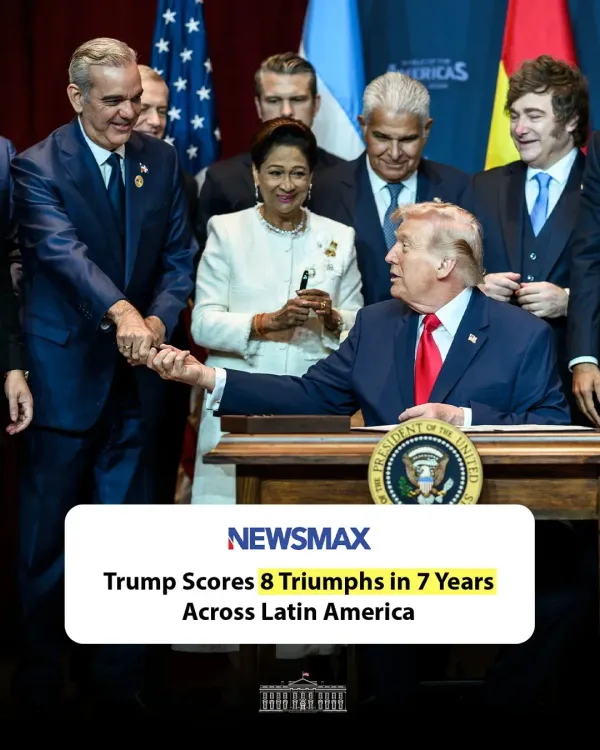
The White House, the official communications account of the Executive Office of the President of the United States, on Tuesday, 23 June 2026, shared a link to a conservative media article claiming Donald Trump had secured eight major policy wins across Latin America over a seven-year span.
Context
The post, shared from the verified White House X account, promoted an article headlined 'Trump Scores 8 Triumphs in 7 Years Across Latin America.' The White House did not elaborate on the specific wins referenced but amplified the framing of a sustained regional success story.
The seven-year window cited would span both of Trump's presidential terms, covering a period of intensive US engagement — and pressure — across Mexico, Venezuela, Cuba, and other nations in the Western Hemisphere.
Policy Backdrop
Trump's first term established the template for his Latin America approach: bilateral leverage over multilateral diplomacy. In 2018, his administration threatened steep tariffs on Mexican goods to extract expanded migration enforcement and asylum cooperation agreements from Mexico City.
In January 2019, the administration recognised Juan Guaido as Venezuela's interim president and launched a maximum-pressure sanctions campaign against the Maduro government — a posture that reshaped hemispheric alignments. Separately, the USMCA trade agreement, signed in 2018 to replace NAFTA, updated labour, automotive, and digital trade provisions with Mexico and Canada, and was presented as a signature economic achievement.
The administration also reversed Obama-era openings toward Cuba, tightening travel and remittance rules and reinforcing the longstanding embargo — a move that pleased Cuban-American political constituencies in Florida.
Stakeholders and Impact
US border communities, Venezuelan opposition groups, Mexican exporters, and Caribbean governments have all been directly affected by the policy choices the White House is now characterising as triumphs. For the Venezuelan opposition, US recognition and sanctions provided international legitimacy but have not yet dislodged the Maduro regime.
For Mexico, migration cooperation came at the cost of significant domestic political pressure, while the USMCA framework provided Mexican exporters with updated — if more demanding — trade rules. Critics of the approach have long argued that maximum-pressure tactics produced mixed results on democracy promotion while deepening economic hardship for ordinary citizens in targeted countries.
The broader regional competition with China and Russia — both of which have expanded economic and diplomatic footprints across Latin America — forms the strategic backdrop against which the White House is framing these claimed successes.
What's Next
The White House's decision to amplify this framing in June 2026 signals an intent to consolidate the Latin America policy narrative ahead of any further regional engagement. Analysts will watch for follow-on policy statements and whether the administration participates in the next Summit of the Americas process as a forum to institutionalise these claimed gains.
With China's regional influence continuing to expand through infrastructure investment and trade agreements, the administration faces pressure to translate rhetorical wins into durable institutional arrangements across the hemisphere.
Point of View
Lending the scorecard a competitive subtext beyond domestic politics. For India and other emerging-market observers, the episode underscores how great-power competition is increasingly being contested in the Global South, with Latin America as a key theatre. The framing also previews the rhetorical architecture the administration is likely to deploy in any upcoming multilateral forum on Western Hemisphere affairs.
NationPress
22 Sept 2026
Frequently Asked Questions
What are Trump's claimed wins in Latin America?
The White House promoted an article citing eight policy triumphs across Latin America over seven years, though the specific wins were not detailed in the post itself. Known first-term actions include the USMCA trade deal, Venezuela sanctions, and Cuba policy reversals.
What is the USMCA trade deal?
The USMCA is a 2018 trade agreement negotiated by the Trump administration to replace NAFTA, updating labour standards, automotive rules, and digital trade provisions with Mexico and Canada.
What did Trump do about Venezuela?
In January 2019, the Trump administration recognised Juan Guaido as Venezuela's interim president and launched a maximum-pressure sanctions campaign targeting the Maduro government's oil revenues and financial system.
How did Trump handle US-Mexico migration policy?
The Trump administration threatened tariffs on Mexican goods in 2018 to compel Mexico to expand migration enforcement and enter asylum cooperation agreements, significantly increasing the number of asylum seekers returned to Mexican territory.
Why is Latin America important to US foreign policy in 2026?
Latin America is a key arena of US competition with China and Russia, both of which have expanded trade, investment, and diplomatic ties across the region, making hemispheric policy a front in broader great-power rivalry.