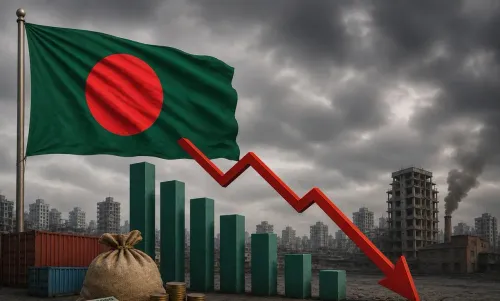
Yunus govt accused of siphoning 12,678 crore BDT into Swiss banks

Synopsis
Swiss National Bank data showing a 41% surge in Bangladeshi deposits — to 834.1 million Swiss francs, or roughly 12,678 crore BDT — has become the centrepiece of accusations against the former Yunus government in Bangladesh. Critics allege the spike reflects unprecedented capital flight under his watch, though the figures remain unverified as standalone proof of wrongdoing.
Key Takeaways
Bangladeshi deposits in Swiss banks rose approximately 41 per cent in a single year, reaching 834.1 million Swiss francs in 2025 .
At a conversion rate of 1 Swiss franc to 152 BDT , this equals approximately 12,678 crore Bangladeshi taka .
The 2025 figure is the highest since 2021 and the second-highest in the past decade, according to the Swiss National Bank annual report.
Some estimates in public debate place total capital outflow from Bangladesh in a single year as high as 200,000 crore BDT , though these figures are unverified.
Critics argue the one-and-a-half-year Yunus administration tenure marked an unprecedented peak in capital flight; calls for independent investigation are growing.
The allegations are sourced from an article in Bangladesh's Asian Age newspaper and represent critics' views, not confirmed findings.
The former government of Muhammad Yunus in Bangladesh is facing mounting accusations of large-scale financial misconduct, with critics alleging that money was channelled into Swiss bank accounts and offshore tax havens including the Cayman Islands and the British Virgin Islands, according to an article published in Bangladesh's Asian Age newspaper. The allegations centre on a sharp spike in Swiss banking deposits linked to Bangladeshi nationals during the period the Yunus administration was in power.
The Swiss Bank Data at the Centre of the Controversy
According to figures cited in the Asian Age report, Bangladeshi deposits in Swiss banks rose by approximately 41 per cent in a single year, climbing to 834.1 million Swiss francs in 2025 from around 590 million Swiss francs in 2024. The article attributes this surge to the period when the Yunus-led administration was in office, characterising it as a 'puppet administration of the Washington administration.'
These figures, the report notes, are drawn from the annual report of the Swiss National Bank. At prevailing exchange rates — pegged at 1 Swiss franc to 152 Bangladeshi taka (BDT) — the total is estimated at approximately 12,678 crore BDT. The 2025 level reportedly marks the highest Bangladeshi deposits in Swiss banks since 2021, and the second-highest over the past decade.
A Narrow Window Into a Broader Problem, Critics Say
Analysts and critics quoted in the article caution that Swiss banking data represents only a partial view of global capital flows. Studies on illicit financial movements suggest that substantial sums are routed to multiple international jurisdictions beyond Switzerland, including the United States, United Kingdom, Canada, Australia, Singapore, Hong Kong, the United Arab Emirates, and Malaysia, in addition to offshore centres such as the Cayman Islands and the British Virgin Islands.
On this basis, some estimates cited in public debate place the total capital outflow from Bangladesh within a single year as high as 200,000 crore BDT. The article itself acknowledges that such figures 'remain subject to verification and methodological scrutiny' and are frequently invoked to illustrate the perceived scale of the challenge rather than as confirmed totals.
Political and Accountability Dimensions
Critics, according to the Asian Age report, argue that the approximately one-and-a-half-year tenure of the Yunus administration represents an unprecedented peak in capital flight and institutional strain. They are calling for rigorous investigation, transparent accounting, and systematic historical documentation of this period.
Notably, the language used in the source article — including the phrase 'puppet administration of the Washington administration' — reflects a sharply partisan framing. These characterisations represent the views of critics cited in the report and are not independently verified claims.
What Happens Next
The debate, as the Asian Age piece observes, is ultimately a broader national struggle over narrative, accountability, and economic sovereignty in Bangladesh. Whether formal investigations will follow remains to be seen, but the scale of the allegations — and the invocation of Swiss National Bank data — has intensified calls for an independent audit of capital flows during the Yunus period. The outcome of that political pressure will likely shape Bangladesh's financial governance discourse in the months ahead.
Point of View
On its own, prove government-directed siphoning. The Asian Age article conflates a statistical trend with a political allegation, and the characterisation of Yunus as a 'puppet of Washington' signals an ideological framing that demands editorial caution. Bangladesh's accountability debate is legitimate and urgent, but grounding it in unverified aggregate data risks undermining the very credibility that genuine financial reform demands.
NationPress
20 Sept 2026
Frequently Asked Questions
What are the allegations against the Muhammad Yunus government in Bangladesh?
Critics, as reported by Bangladesh's Asian Age newspaper, allege that the former Yunus government facilitated large-scale capital flight, with money reportedly channelled into Swiss bank accounts and offshore tax havens including the Cayman Islands and the British Virgin Islands. The allegations are based on a 41% surge in Bangladeshi deposits in Swiss banks during the period the administration was in office.
What does the Swiss National Bank data show about Bangladeshi deposits?
According to the Swiss National Bank's annual report, Bangladeshi deposits in Swiss banks rose to 834.1 million Swiss francs in 2025, up from approximately 590 million Swiss francs in 2024 — an increase of roughly 41 per cent. This is the highest level since 2021 and the second-highest in the past decade.
How much is 834.1 million Swiss francs in Bangladeshi taka?
At a conversion rate of 1 Swiss franc to 152 Bangladeshi taka (BDT), 834.1 million Swiss francs is estimated at approximately 12,678 crore BDT, according to the figures cited in the Asian Age article.
Are the corruption allegations against the Yunus government verified?
The allegations are not independently verified. The Asian Age article itself acknowledges that the broader capital flight estimates — some as high as 200,000 crore BDT — 'remain subject to verification and methodological scrutiny.' Swiss bank deposit data reflects aggregate flows by Bangladeshi nationals and does not, by itself, confirm government-directed wrongdoing.
What are critics demanding in response to these allegations?
Critics cited in the report are calling for rigorous independent investigation, transparent accounting, and systematic historical documentation of financial flows during the Yunus administration's approximately one-and-a-half-year tenure. No formal probe has been announced as of the date of publication.