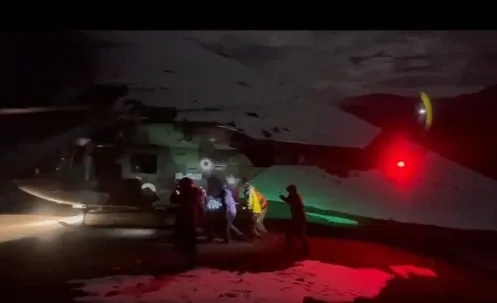
Two Indian Army soldiers killed as vehicle plunges into gorge at Namika La Pass

Synopsis
Two Indian Army soldiers died on 4 November after their military vehicle skidded into a gorge at Namika La Pass — 3,700 metres above sea level on the Kargil-Leh Highway. It underscores the deadly non-combat risks facing troops on Ladakh's high-altitude roads, where steep gradients and unpredictable weather claim lives year-round.
Key Takeaways
Two Indian Army soldiers — the driver and co-driver of a heavy-duty military vehicle — were killed on 4 November 2026 .
The vehicle skidded off the road and fell into a deep gorge near Namika La Pass on NH-01 (Kargil-Leh National Highway) at approximately 1:30 pm .
Both soldiers died on the spot; bodies were shifted to CHC Chiktan for postmortem.
A case has been registered at Police Station Wakha under the Bharatiya Nyaya Sanhita (BNS) ; investigation is ongoing.
Namika La Pass sits at 3,700 metres (12,139 feet) in the Zanskar Range, roughly 105 km from Leh and 54 km from Kargil .
Two Indian Army soldiers were killed on Wednesday, 4 November 2026, after their heavy-duty military vehicle skidded off the road and plunged into a deep gorge near Namika La Pass on National Highway-01 — the Kargil-Leh National Highway — in Ladakh. The driver and co-driver, both army personnel, died on the spot, according to officials.
How the Accident Unfolded
The accident occurred at approximately 1:30 pm near Namika La Pass in the Kargil-Leh sector. Officials confirmed that the military vehicle skidded off the road and fell into a deep gorge. Local police and rescue teams reached the site, recovered the bodies, and shifted them to the Community Health Centre (CHC) in Chiktan for medico-legal formalities and postmortem examinations.
Investigation Under Way
A case has been registered at Police Station Wakha under the Bharatiya Nyaya Sanhita (BNS). Officials stated that an investigation into the cause of the accident is currently under way. The exact factors that led to the vehicle losing control — whether road conditions, weather, or mechanical failure — have not yet been determined.
About Namika La Pass
Namika La Pass, locally known as the 'Pillar of the Sky Pass', sits at an elevation of 3,700 metres (12,139 feet) above sea level in the Zanskar Range of Ladakh. It lies along NH-1, roughly 105 km from Leh and 54 km from Kargil, and is one of two major high passes on the route — the other being the higher Fotu La Pass. The pass is known for its sharp curves, steep gradients, and exposure to rapidly changing mountain weather, making it one of the most demanding stretches of road in the region.
The Broader Risk on High-Altitude Roads
The Indian Army operates under some of the most extreme geographical and climatic conditions in the world, with troops deployed across high-altitude plains, deep valleys, and rugged mountain passes ranging from 3,000 metres to over 6,000 metres above sea level. Road accidents on high-altitude national highways in Ladakh are not uncommon, with steep gradients, narrow carriageways, and icy surfaces posing persistent hazards to both military and civilian vehicles. At Siachen Glacier — known as the world's highest battlefield — soldiers hold positions above 5,400 metres (18,000 feet), where temperatures can drop below -40°C. In Eastern Ladakh, the Army maintains significant forward deployments across the Ladakh plateau, including near Pangong Lake and the Galwan Valley, heightening the operational tempo and logistical demands on mountain roads. The deaths at Namika La are a sober reminder of the non-combat dangers faced by personnel serving in these conditions.
Point of View
The mountain terrain itself is as lethal as any adversary. Road accidents on high-altitude NH-01 have claimed military and civilian lives repeatedly, yet infrastructure upgrades on this strategic corridor remain slow. The registration of a case under the BNS is procedurally correct, but the deeper question — why heavy military vehicles continue to operate on sections of the highway that lack crash barriers and adequate road-widening — rarely enters the official conversation. Greater scrutiny of road safety standards on strategic military supply routes is long overdue.
NationPress
5 Nov 2026
Frequently Asked Questions
What happened at Namika La Pass on 4 November 2026?
Two Indian Army soldiers — the driver and co-driver of a heavy-duty military vehicle — were killed when their vehicle skidded off the road and fell into a deep gorge near Namika La Pass on the Kargil-Leh National Highway (NH-01) in Ladakh at approximately 1:30 pm. Both soldiers died on the spot.
Where is Namika La Pass?
Namika La Pass is a high mountain pass at 3,700 metres (12,139 feet) above sea level in the Zanskar Range of Ladakh. It lies on NH-1 (Srinagar-Leh Highway), about 105 km from Leh and 54 km from Kargil, and is locally called the 'Pillar of the Sky Pass'.
What action has been taken after the accident?
A case has been registered at Police Station Wakha under the Bharatiya Nyaya Sanhita (BNS), and an investigation into the cause of the accident is under way. The bodies were recovered by local police and rescue teams and taken to CHC Chiktan for medico-legal formalities and postmortem examinations.
Why are road accidents common in the Kargil-Leh sector?
The Kargil-Leh sector features extreme terrain — sharp curves, steep gradients, narrow roads, and unpredictable weather — making it one of India's most hazardous stretches of highway. Military and civilian vehicles navigating high passes such as Namika La and Fotu La face persistent risks from icy surfaces and limited road infrastructure.
What is the Indian Army's presence in Ladakh?
The Indian Army maintains significant forward deployments across Ladakh, including near Pangong Lake, the Galwan Valley, and at Siachen Glacier — the world's highest battlefield — where soldiers operate at altitudes above 5,400 metres in temperatures that can fall below -40°C, securing both the Line of Actual Control (LAC) and Line of Control (LoC).