Jharkhand CMO: 23.26 Lakh Students Pledge 'Viksit Jharkhand'

Synopsis
On 18 November 2026, Jharkhand's CMO announced that 23.26 lakh students across 31,756 schools took a 'Viksit Jharkhand' pledge during special prayer assemblies, while Abua housing beneficiaries held housewarming ceremonies in multiple districts as part of State Establishment Fortnight.
Key Takeaways
23.26 lakh students across 31,756 schools participated in special prayer assemblies and took the 'Viksit Jharkhand' pledge on 18 November 2026 .
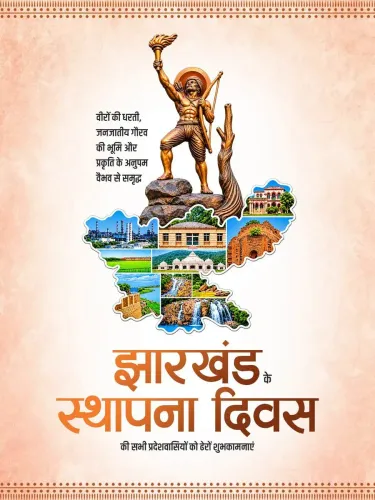
The drive is part of the annual State Establishment Fortnight observed around 15 November , the date Jharkhand was formed in 2000 .
Beneficiaries of the Abua housing scheme performed grih pravesh (housewarming) ceremonies simultaneously across multiple districts.
The government described development schemes as 'gaining momentum' during this fortnight of public outreach.
The combined education-and-housing messaging is part of a broader state strategy to anchor welfare delivery in Jharkhand's tribal and rural communities around formation-day milestones.
Across 31,756 schools in Jharkhand, more than 23.26 lakh students paused their morning routines on Wednesday, 18 November 2026, to take a collective pledge — 'Viksit Jharkhand' ('Developed Jharkhand'). The Chief Minister's Office of Jharkhand announced that the pledge drive, held as part of the ongoing State Establishment Fortnight, is producing what officials called 'a unique confluence of education and development.'
Schools, prayers, and a statehood pledge
Special prayer assemblies were organised simultaneously across all participating government schools, anchoring the fortnight's theme inside the daily rhythms of classroom life. The scale — over two crore young participants — makes it one of the largest single-day student pledge events the state has mounted since its founding. The State Establishment Fortnight runs around 15 November, the date in 2000 when Jharkhand was carved out of Bihar to become India's 28th state, giving its predominantly tribal population a government closer to home.
Abua scheme beneficiaries move into new homes
Beyond the schools, Wednesday also saw housing beneficiaries under the Abua scheme perform grih pravesh (housewarming ceremonies) in multiple districts. The CMO's post described simultaneous house-entries across various districts as development schemes 'gaining momentum' — a deliberate pairing of bricks-and-mortar delivery with the symbolic weight of statehood day. State governments across India have long used formation-day fortnights to accelerate last-mile scheme delivery and amplify the optics of welfare work in tribal and rural belts.
Why statehood week doubles as a delivery deadline
Jharkhand's approach is a well-worn but effective playbook: concentrate visible welfare milestones — school events, housing handovers, scheme launches — in the fortnight flanking the November anniversary, so development feels lived-in rather than administrative. For a state where tribal communities make up roughly a third of the population and where access to quality schooling and permanent housing have historically lagged, the signals carry weight beyond ceremony. The question officials will face in the weeks ahead is whether the momentum from the fortnight translates into measurable district-level delivery — or stays at the level of a pledge and a photograph.
Point of View
Invoking 'Viksit Jharkhand' in classrooms is a pointed message about who the state believes its development story belongs to. The simultaneous Abua handovers signal that the ruling dispensation wants visible ground-level proof of delivery precisely when statehood symbolism peaks. How well the fortnight's momentum holds through the remaining financial year will determine whether this reads as genuine acceleration or well-timed optics.
NationPress
18 Nov 2026
Frequently Asked Questions
What is the 'Viksit Jharkhand' pledge taken by students?
'Viksit Jharkhand' means 'Developed Jharkhand.' During the State Establishment Fortnight, students at government schools across the state took a collective pledge to contribute to the state's development as part of special morning prayer assemblies.
What is Jharkhand's State Establishment Fortnight?
It is an annual two-week observance centred on 15 November , the date Jharkhand was established as a separate state from Bihar in 2000 . The government uses the period for school programmes, scheme launches, and welfare-delivery events.
What is the Abua scheme in Jharkhand?
The Abua scheme is a Jharkhand government housing programme targeting beneficiaries in tribal and rural areas. On 18 November 2026 , multiple districts saw Abua beneficiaries move into newly built homes as part of Establishment Fortnight activities.
How many schools participated in the Jharkhand student pledge drive?
According to the Chief Minister's Office, 31,756 schools held special prayer assemblies and 23.26 lakh (approximately 2.3 million) students participated in the pledge on 18 November 2026 .
When was Jharkhand formed as a state?
Jharkhand was established as India's 28th state on 15 November 2000 , carved out of Bihar to give the region's large tribal population a dedicated state government.