Ahmedabad 149th Rath Yatra 2025: 31,000 cops, AI cams, 100 drones secure 16 km route
Synopsis
For Ahmedabad's 149th Rath Yatra, the city has assembled a security grid that reads more like a military operation: 31,000 personnel, 3,700 CCTV cameras, 100 drones, AI facial recognition of 65,000 flagged individuals, and a dedicated elephant squad — all for a 16.2 km procession with no specific threat on record. The scale signals how India's largest religious gatherings are being reimagined as zero-tolerance security exercises.
Key Takeaways
Ahmedabad's 149th Rath Yatra is scheduled for 15 July 2025 , covering a 16.2 km route from Jamalpur to Saraspur and back, lasting nearly 14 hours .
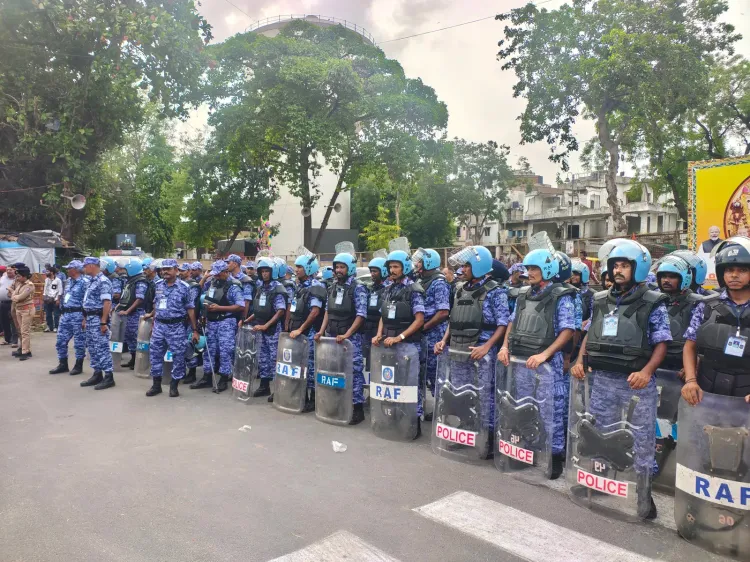
Over 31,000 police, Home Guard and paramilitary personnel — including RAF and BSF companies — have been deployed.
More than 3,700 CCTV cameras , 100 drones , AI-powered crowd monitoring and a facial recognition database of 65,000 flagged individuals form the technology backbone.
A dedicated 'Gajraj Squad' will move ahead of all 18 elephants to suppress DJs, fireworks and excessive noise, following an elephant-agitation incident last year.
More than 1,000 community programmes were held over one-and-a-half months , including Hindu-Muslim cricket and volleyball tournaments and a blood drive yielding 900 units .
Around 90 people detained under PASA and preventive action taken against nearly 5,000 individuals ahead of the event.
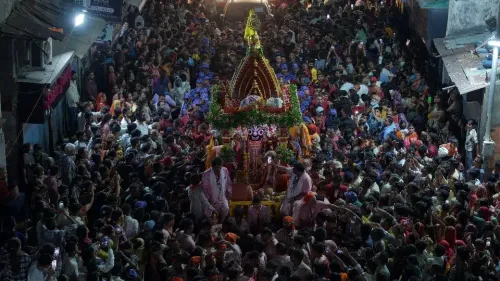
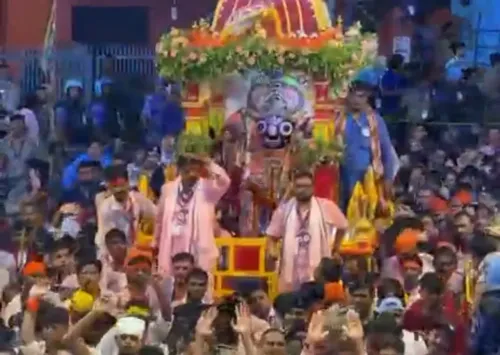
Ahmedabad has deployed one of its largest-ever security operations for the 149th Rath Yatra of Lord Jagannath on Thursday, 15 July 2025, mobilising over 31,000 police and paramilitary personnel alongside AI-powered surveillance, facial recognition, 100 drones and months of community outreach — all to protect what officials are calling a 'zero-risk' celebration. The procession, regarded as India's second-largest Rath Yatra after Puri, is expected to draw lakhs of devotees from across Gujarat and the country.
The Route and Procession
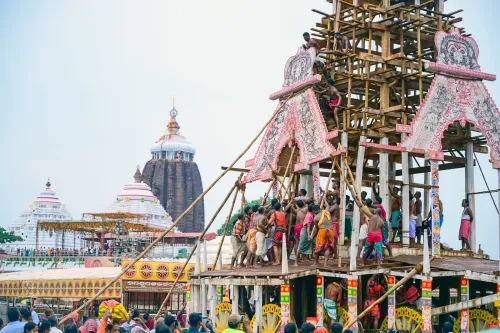
The procession begins at 7 am from the 400-year-old Jagannath Temple in the Jamalpur area, traversing a traditional 16.2 km route through the old city before reaching Saraspur for Lord Jagannath's ceremonial 'mamera' (maternal visit). The return journey passes through Kalupur, Prem Darwaza, Tambu Chowki, Delhi Chakla and Shahpur, with the procession expected to conclude at the temple by approximately 8:30 pm — nearly 14 hours after it departs.
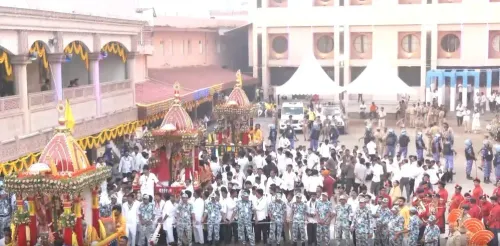
The procession will feature the three chariots of Lord Jagannath, Balabhadra and Subhadra, 18 elephants, 103 trucks, around 30 akhadas and 18 bhajan mandalis.
Security Deployment: Scale and Structure
Joint Commissioner of Police (Crime) Sharad Singhal said the city police had adopted a zero-risk approach despite there being no specific intelligence input suggesting any threat. 'We have made the entire security arrangement with a zero-risk approach. Around 30,000 police personnel, Home Guards and supporting forces have been deployed on the ground, while technology, AI-based surveillance and continuous monitoring will work alongside them. We have been preparing for nearly one-and-a-half months,' Singhal said.
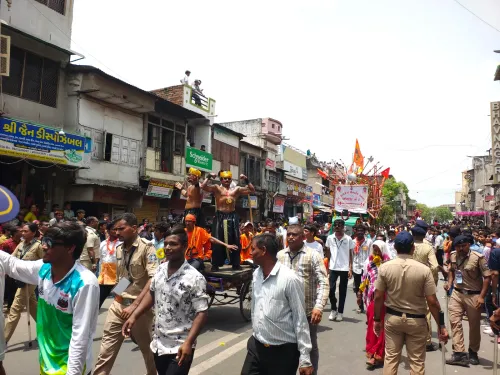
The full deployment includes approximately 30,000 police and Home Guard personnel, nearly 3,000 State Reserve Police personnel, and around 1,000 paramilitary troops drawn from five companies of the Rapid Action Force (RAF) and four companies of the Border Security Force (BSF). Three Chetak Commando hit teams have been stationed at strategic points for immediate emergency response.
More than 250 rooftop observation points have been established along the route, with over 250 D-points set up inside neighbourhoods — each patrolled by teams extending up to 300 metres from the procession corridor. The Crime Branch will manage moving security alongside the chariots, while local police handle static deployment across roads, narrow lanes and residential pols.
Technology at the Core
Police have installed more than 3,700 CCTV cameras along the route, all feeding into a central command centre. AI-powered software monitors crowd density in real time and flags congestion points for crowd diversion. Authorities have uploaded photographs of nearly 65,000 known pickpockets, anti-social elements and individuals with criminal records into a facial recognition database that will automatically alert police if any such person is detected.
Officers deployed within crowds will carry body-worn cameras, while aerial coverage will be provided by approximately 100 drones monitoring the route and adjoining areas up to half a kilometre on either side. Two anti-drone guns have been deployed to neutralise any unauthorised aerial intrusions. 12 control rooms — including one at Tambu Chowki — will enable continuous monitoring. GPS devices in police vehicles and trucks, combined with GIS mapping, allow officers to track every vehicle in real time through digital dashboards. Dedicated cyber monitoring teams are also scanning social media platforms and the dark web for rumours and misleading content, with AI-based tools deployed for real-time detection.
Elephant Safety: Lessons from Last Year
Special attention has been paid to elephant management following an incident last year in which one of the animals became agitated. Deputy Commissioner of Police (Zone 3) Rupal Solanki said lessons from that experience had directly shaped this year's arrangements.
'Last time there was the elephant-related issue. This year we have restricted DJs whenever the elephants pass. People have also been requested not to blow whistles. We have formed a dedicated 'Gajraj Squad' that will move ahead of the elephants to ensure DJs are stopped. Neon-coloured objects that could disturb the elephants will also be removed, while young volunteers will remain ahead of the procession to coordinate communication,' Solanki said.
All 18 elephants will be monitored using specialised equipment capable of detecting excessive sound levels, and police personnel have been instructed not to use whistles near the animals.
Community Outreach and Preventive Action
Over the past one-and-a-half months, Ahmedabad City Police organised more than 1,000 community programmes — including peace committee meetings, interactions with religious leaders, women's meetings and targeted outreach to young people. A blood donation drive collected around 900 units of blood, while an Ekta Cup cricket tournament featuring 16 Hindu-Muslim teams and volleyball tournaments involving 12 Hindu-Muslim teams were organised to strengthen communal harmony ahead of the festival.
On the preventive policing front, around 90 people have been detained under the Prevention of Anti-Social Activities Act (PASA), 17 externment cases registered, 24 Arms Act cases and 31 NDPS Act cases booked, and preventive action taken against nearly 5,000 individuals. Police have also confirmed that coordination with the Anti-Terrorism Squad (ATS) following recent arrests of suspected terror-linked accused had not revealed any specific threat to the Rath Yatra. Four LED screens installed outside the Jagannath Temple will broadcast live coverage via Doordarshan's feed, easing crowd pressure near the temple. As the procession moves through the city, Ahmedabad's administration is betting that an unprecedented convergence of technology, manpower and community trust will deliver a safe celebration for lakhs of devotees.
Point of View
000 personnel and AI surveillance for a procession with no specific threat input — reflects a broader shift in how Indian authorities approach large religious gatherings: precaution has become performance. The elephant management protocol, born from last year's incident, is a rare example of institutional learning translating directly into operational change. What stands out, however, is the community outreach dimension: 1,000-plus programmes, inter-faith sports tournaments and peace meetings suggest police are treating social cohesion as a security variable, not an afterthought. Whether this model scales to smaller cities — where resources and political will are thinner — remains the harder question.
NationPress
14 Oct 2026
Frequently Asked Questions
What is the route of the Ahmedabad Rath Yatra 2025?
The 149th Rath Yatra begins at 7 am from the 400-year-old Jagannath Temple in Jamalpur, follows a 16.2 km route through the old city to Saraspur for the 'mamera' ceremony, and returns via Kalupur, Prem Darwaza, Tambu Chowki, Delhi Chakla and Shahpur, concluding at the temple around 8:30 pm.
How many police personnel are deployed for the Ahmedabad Rath Yatra?
Over 31,000 personnel have been deployed, including Ahmedabad City Police, Home Guards, nearly 3,000 State Reserve Police, and around 1,000 paramilitary troops from five RAF companies and four BSF companies. Three Chetak Commando hit teams are also stationed at strategic points.
What technology is being used to secure the Rath Yatra?
Authorities have deployed more than 3,700 CCTV cameras, approximately 100 drones, AI-powered crowd monitoring software, a facial recognition database of 65,000 flagged individuals, body-worn cameras, GPS and GIS vehicle tracking, 12 control rooms, and cyber teams monitoring social media and the dark web.
What is the 'Gajraj Squad' and why was it formed?
The Gajraj Squad is a dedicated police unit that moves 100-150 metres ahead of the 18 elephants in the procession to ensure DJs are switched off, fireworks stopped and neon objects removed before the animals pass. It was formed after an elephant became agitated during last year's Rath Yatra.
Is there a specific security threat to the Ahmedabad Rath Yatra 2025?
Senior police officials have confirmed there is no specific intelligence input indicating any threat to the procession. Coordination with the Anti-Terrorism Squad following recent arrests of suspected terror-linked accused also did not reveal a specific threat, though full security protocols remain in place as a precaution.