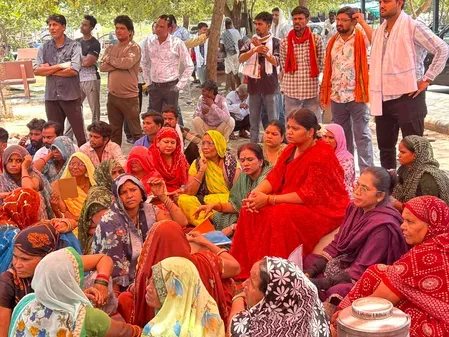
Kota maternal deaths: 4 women die this month at Medical College hospitals

Synopsis
Four women have died after childbirth at Kota Medical College-affiliated hospitals in October 2026 alone — the latest being Reshu from Baran district, who developed kidney failure after her baby died in the womb. This follows a May 2026 cluster in which five women died and 12 developed kidney failure post-Caesarean, raising urgent questions about whether anything has actually changed at these facilities.
Key Takeaways
Four maternal deaths have been reported at Kota Medical College -affiliated hospitals in October 2026 .
Reshu , a resident of Harota Bhil village, Baran district , died in the early hours of Tuesday, 28 October after her kidneys reportedly failed following childbirth complications at JK Lon Hospital and New Medical College Hospital .
Shabnam Bano , 26 , from Chhabra, Baran district , died on Saturday night at JK Lon Hospital after a Caesarean delivery; her family has alleged medical negligence including a 12-hour surgery delay .
In May 2026 , 5 women died and 12 developed kidney failure following Caesarean deliveries at the same hospital cluster between 5–7 May .
Reshu's family alleged ambulance staff demanded payment to transport her body, a charge they say violates free government ambulance norms.
An investigation into the circumstances of Reshu's death is reportedly underway.
A fourth maternal death has been recorded this month at government hospitals linked to Kota Medical College, Rajasthan, as Reshu, a resident of Harota Bhil village in Baran district, died in the early hours of Tuesday, 28 October 2026 while receiving treatment at the super-speciality wing of New Medical College Hospital, Kota. The death has deepened alarm over the state of maternal healthcare at one of Rajasthan's largest public hospital clusters.
How Reshu's case unfolded
Reshu, daughter of Dhul Singh, was first admitted to JK Lon Hospital for childbirth. According to her family, the baby died in the womb during delivery. Her condition worsened over subsequent days, and she was transferred to New Medical College Hospital for higher care.
Her sister recounted that Reshu had shown brief signs of recovery — she was reportedly able to speak and walk to the restroom at one stage. However, she subsequently stopped urinating and developed acute abdominal pain. Doctors reportedly told the family her kidneys had failed. She died late Monday night, extending into the early hours of Tuesday. Police conducted a post-mortem examination and handed the body over to her family.
The family also alleged that ambulance staff demanded payment to transport the body, despite their poor financial condition, arguing that government ambulance services should be provided free of charge.
The Shabnam Bano case: family alleges negligence
One of the other recent deaths involved Shabnam Bano, 26, a resident of Chhabra in Baran district, who died at JK Lon Hospital on Saturday night. Her family has alleged medical negligence.
According to her brother Sarfaraz, Shabnam was admitted to a government hospital in Baran on 22 October. On 23 October, she was asked to stop eating and drinking ahead of surgery, but the procedure was reportedly delayed for nearly 12 hours. An intravenous drip administered at around 7 pm was followed by what the family described as seizures.
She was subsequently referred to Kota, where she delivered a baby girl through a Caesarean section at JK Lon Hospital at around 11:30 pm. Her blood pressure reportedly dropped during surgery and she was placed on a ventilator, but did not survive.
JK Lon Hospital Superintendent Dr Nirmala Sharma said Shabnam had arrived at the hospital in a coma on the night of 23 October. According to Dr Sharma, the baby's heart rate was fluctuating and the family had been kept informed of the seriousness of the situation. The medical team succeeded in delivering the baby through surgery but could not save the mother, she said.
A recurring pattern: May 2026 cluster deaths
This is not the first time Kota's public hospitals have faced a cluster of maternal deaths. In May 2026, 12 women reportedly developed kidney failure following Caesarean deliveries performed between 5 May and 7 May. Five of them — Payal, Jyoti, Priya, Pinky, and Shirin — died on 5 May, 7 May, 9 May, 10 May, and 17 May, respectively. The remaining seven required prolonged treatment and dialysis; though later discharged, they reportedly continued on regular dialysis.
The recurrence of complications — particularly kidney failure following Caesarean procedures — has raised questions about surgical protocols, anaesthesia practices, and post-operative monitoring at these facilities.
Wider concern over maternal safety at Kota hospitals
With four maternal deaths recorded in October alone at hospitals affiliated with Kota Medical College, public health advocates and opposition leaders have renewed calls for an independent inquiry into standards of care at these institutions. An investigation into the circumstances surrounding Reshu's death is currently underway, according to reports.
The pattern of deaths — spanning multiple months, involving kidney failure, delayed surgeries, and allegations of negligence — points to systemic concerns that go beyond any single case. Whether the Rajasthan government will order a formal audit of obstetric care at Kota's government hospitals remains to be seen.
Point of View
Raising questions about both referral pathways and the condition in which patients arrive. The allegations of a 12-hour surgical delay in Shabnam Bano's case, if verified, would represent a systemic failure of triage, not merely individual negligence. Rajasthan's health administration owes the public a transparent, time-bound inquiry — not another round of hospital superintendents issuing holding statements.
NationPress
27 Oct 2026
Frequently Asked Questions
How many maternal deaths have occurred at Kota hospitals in October 2026?
Four women have died this month following childbirth-related complications at hospitals affiliated with Kota Medical College in Rajasthan. The latest death is that of Reshu from Baran district, who died in the early hours of 28 October 2026.
What happened to Reshu, the latest maternal death in Kota?
Reshu, a resident of Harota Bhil village in Baran district, was admitted to JK Lon Hospital for childbirth, where her baby reportedly died in the womb. Her condition deteriorated and she was shifted to New Medical College Hospital, where she died after her kidneys reportedly failed. An investigation is underway.
What are the allegations in the Shabnam Bano case?
Shabnam Bano's family alleges that her surgery was delayed by nearly 12 hours after she was asked to stop eating and drinking in preparation for the procedure. They say she developed seizures after being given an intravenous drip and was then referred to Kota, where she died after a Caesarean delivery. Hospital authorities say she arrived in a coma and that the team managed to save the baby.
Has Kota faced similar maternal death clusters before?
Yes. In May 2026, 12 women developed kidney failure following Caesarean deliveries performed between 5 and 7 May at Kota Medical College-affiliated hospitals. Five of them — Payal, Jyoti, Priya, Pinky, and Shirin — died between 5 and 17 May. Seven others were discharged but reportedly continued on regular dialysis.
What action is being taken after the latest Kota maternal deaths?
An investigation into the circumstances of Reshu's death is reportedly underway. No formal government-ordered audit of obstetric care at Kota's public hospitals had been announced at the time of reporting. The family has also raised a separate complaint about ambulance staff allegedly demanding payment for transporting the body.