6 Dead in Kalahandi Construction Site Collapse: CMO Odisha
Synopsis
The Chief Minister's Office of Odisha named six workers killed in a construction-site accident in Madanpur Rampur, Kalahandi on 26 May 2026. The dead include a father-son pair. Compensation, a magisterial inquiry, and safety audits of ongoing projects in the KBK region are expected to follow.
Key Takeaways
6 workers died in a construction-site accident at Madanpur Rampur, Kalahandi district , western Odisha.
The Chief Minister's Office of Odisha officially released the names and parentage of all six victims on 26 May 2026 .
A father-son pair — Nimai Charan Pal and Akash Pal — are among those killed, highlighting the impact on individual families.
Kalahandi is part of the historically underdeveloped KBK region where accelerated infrastructure construction employs large numbers of local tribal and marginalised-community workers.
Standard follow-up steps include ex-gratia compensation for victim families and a magisterial inquiry into the cause of the accident.
The incident renews focus on occupational safety standards at construction sites in western Odisha.
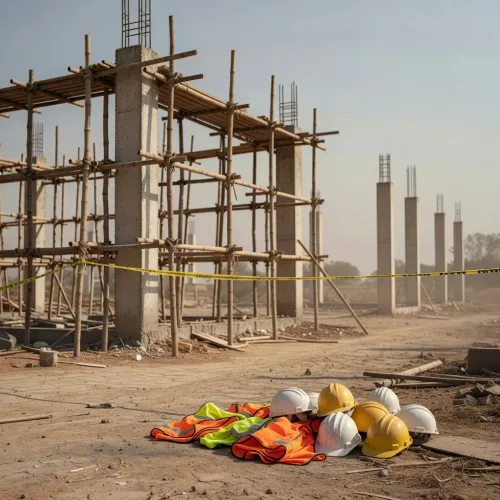
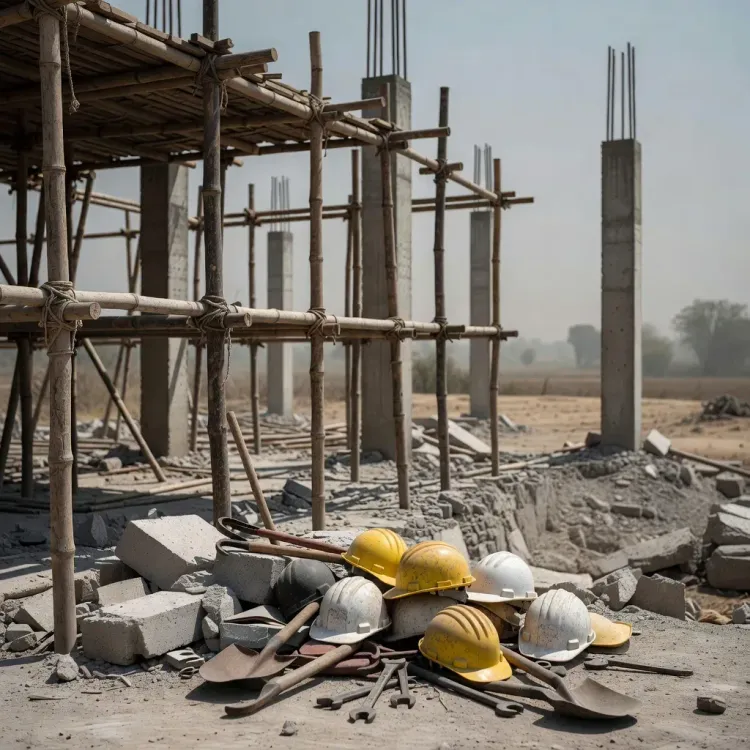
The Chief Minister's Office of Odisha on Tuesday, 26 May 2026 released the identities of six workers killed in a tragic accident at a construction site in Madanpur Rampur, Kalahandi district, confirming the names and parentage of each victim.
The official post named the deceased as: Nimai Charan Pal (son of Gangadhar Pal), Akash Pal (son of Nimai Charan Pal), Adal Majhi (son of Bishnu Majhi), Baikuntha Jal (son of Madhu Jal), Manranjan Hati (son of Dhansagar Hati), and Chhanda Jal (son of Baldev Jal). The CMO described the incident as a 'dukhad durghatana' — a 'tragic accident' — at an under-construction site in the block.
Context
Madanpur Rampur is a block within Kalahandi district in western Odisha, a region historically associated with high poverty, a significant tribal population, and targeted government development interventions. The names of the victims suggest they belong to local communities — including families from the Majhi and Jal communities, who are among the scheduled tribe and scheduled caste groups prevalent in the area. The presence of a father-son pair — Nimai Charan Pal and Akash Pal — among the dead underscores the human toll on individual families.
Policy Backdrop
Odisha has significantly ramped up infrastructure construction across its western districts in recent years, covering roads, irrigation projects, and public buildings under both state and centrally sponsored schemes. Kalahandi, part of the historically underdeveloped KBK (Kalahandi-Bolangir-Koraput) region, has been a focus of targeted investment since the 1990s. Such construction projects routinely employ local labour drawn from tribal and marginalised communities, who often work in conditions with limited occupational safety oversight.
Workplace fatalities at construction sites have prompted periodic calls for stricter enforcement of labour safety norms and mandatory insurance coverage for contract workers engaged on government projects.
Stakeholders and Impact
The six families who lost their breadwinners face immediate economic hardship; in rural Kalahandi, daily-wage construction work is often the primary source of household income. The official identification of victims by the CMO's office is a standard step that enables district administration to initiate relief and compensation processes. Advocates for construction worker rights and tribal welfare organisations are likely to seek clarity on the nature of the project, the contractor involved, and whether statutory safety norms were followed at the site.
What's Next
Authorities are expected to announce ex-gratia compensation for the families of the deceased, in line with established practice following workplace fatalities on government-linked projects in Odisha. A magisterial inquiry into the cause of the accident is standard procedure and will determine whether negligence or structural failure was responsible. Safety audits of other ongoing construction projects in Kalahandi and neighbouring western Odisha districts may follow, particularly given the scale of infrastructure activity in the KBK region. The outcome of any inquiry and the speed of compensation disbursement will be closely watched by local communities and civil society groups working in the area.
Point of View
But it also signals the political sensitivity of worker fatalities in the KBK region — an area whose poverty and underdevelopment have long been a benchmark for Odisha governance. The inclusion of a father-son pair among the dead will amplify public pressure for swift compensation and accountability. With Odisha's western districts at the centre of a major infrastructure push, this incident tests the state's ability to balance development velocity with enforceable safety standards for contract labour. The speed and adequacy of ex-gratia payments and the credibility of any magisterial inquiry will shape how this tragedy registers in the broader political narrative around the ruling dispensation's record in tribal-majority districts.
NationPress
10 Oct 2026
Frequently Asked Questions
Who were the 6 workers killed in the Kalahandi construction site accident?
The six victims named by the CMO Odisha are Nimai Charan Pal, Akash Pal, Adal Majhi, Baikuntha Jal, Manranjan Hati, and Chhanda Jal — all from Madanpur Rampur block in Kalahandi district.
Where did the Kalahandi construction accident happen?
The accident occurred at an under-construction site in Madanpur Rampur, a block within Kalahandi district in western Odisha.
When did the Madanpur Rampur construction site accident occur?
The Chief Minister's Office of Odisha disclosed the victims' identities on 26 May 2026; the exact date of the accident has not been separately specified in the official communication.
Will the families of the Kalahandi accident victims get compensation?
Ex-gratia compensation for victim families is standard practice following workplace fatalities on government-linked projects in Odisha, and is expected to be announced by district or state authorities.
What is the KBK region and why is Kalahandi significant?
KBK stands for Kalahandi-Bolangir-Koraput, a cluster of historically underdeveloped districts in western Odisha with high tribal populations that have been the focus of targeted state and central development programmes since the 1990s.