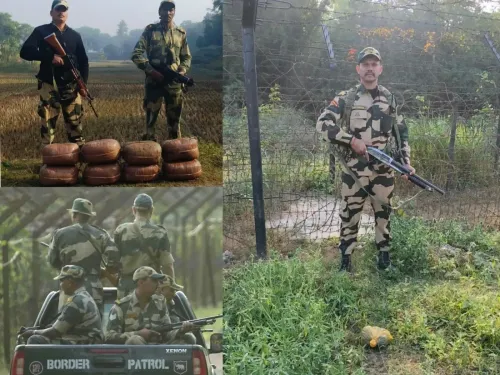
BSF attack in Tripura: 9 arrested after mob assaults personnel at India-Bangladesh border
Synopsis
A mob allegedly incited by a fleeing smuggler's false assault claims attacked BSF personnel near Tripura's India-Bangladesh border, injuring three jawans including a Company Commander and attempting to snatch a rifle. Nine people have been arrested, but the bigger story is the Opposition's allegation that ruling party members are embedded in the very smuggling network that triggered the violence — in a district where two security personnel have previously been killed in similar circumstances.
Key Takeaways
Nine people, including three women , arrested after a mob attacked BSF personnel at Ashabari, Sepahijala district, Tripura on 3 November 2026 .
Three BSF personnel , including a Company Commander , were injured; attackers allegedly attempted to snatch a jawan's rifle and damaged a BSF vehicle.
The attack was reportedly triggered after a detained smuggler falsely claimed he had been assaulted by BSF jawans.
Tripura Chief Minister Manik Saha strongly condemned the attack and confirmed arrests, vowing strict legal action.
Leader of Opposition Jitendra Chaudhury alleged that ruling party workers are involved in cross-border smuggling and accused the government of inaction.
Tripura shares an 856-km border with Bangladesh; previous smuggling-related violence in the same district claimed the lives of a BSF Deputy Commandant and a Tripura Police Sub-Inspector.
Nine people, including three women, have been arrested in connection with a mob attack on Border Security Force (BSF) personnel near the India-Bangladesh international border at Ashabari in Tripura's Sepahijala district, police officials said on Tuesday, 3 November 2026. Three BSF personnel, including a Company Commander, sustained injuries in the assault, which allegedly began after a smuggler claimed he had been beaten by jawans.
How the Attack Unfolded
According to police, BSF personnel on patrol near Ashabari, under Kalamchaura police station, spotted Indian and Bangladeshi smugglers allegedly engaged in illegal cross-border trade on Monday. The jawans apprehended one Indian smuggler; the Bangladeshi smugglers on the other side of the border fence fled the scene.
The detained smuggler allegedly escaped and subsequently told local villagers that BSF personnel had assaulted him. A large mob — comprising both men and women — then gathered at the spot, surrounded a BSF vehicle, and launched a physical attack on the security personnel, leaving three of them injured. The injured personnel were transferred to a government hospital for treatment.
The attackers also allegedly attempted to snatch the rifle of one of the jawans and damaged a BSF vehicle. One attacker was also reportedly injured during the confrontation. To impede the movement of security forces and civilian vehicles, the mob allegedly felled trees to block the road. Senior BSF and police officials rushed to the spot and brought the situation under control, though tension reportedly continued to prevail in the area.
Arrests and Ongoing Search Operation
Police confirmed that nine individuals — three of them women — had been arrested by Tuesday in connection with the attack. An intensive search operation launched on Monday night remained underway to apprehend the remaining accused. Officials did not specify the total number of suspects being sought.
What the Government Said
Tripura Chief Minister Manik Saha, who also holds the Home portfolio, strongly condemned the assault. In posts on his official X account, Saha stated: 'In connection with the assault on BSF personnel at Ashabari, Boxanagar, eight accused persons have been arrested. All those involved will be brought to justice, and strict legal action will be taken against them in accordance with the law. Violence against our security personnel will not be tolerated.'
In a second post, Saha added: 'I strongly condemn the brutal assault on our brave BSF personnel at Ashabari by a group of miscreants. Such acts of violence against our security forces are completely unacceptable and deserve unequivocal condemnation. Any attack on our security personnel is a matter of grave concern and must be dealt with firmly in accordance with the law.' The Chief Minister said concerned authorities had been directed to take 'swift and stringent action' against those responsible.
Opposition Alleges Ruling Party Links to Smuggling
Leader of Opposition Jitendra Chaudhury, a senior Left leader and former minister, also condemned the attack but used the occasion to allege that the state government had failed to act against those involved in cross-border smuggling. 'A section of ruling party workers is involved in the illegal cross-border trade. The authority remained a silent spectator,' Chaudhury said.
He alleged that the involvement of certain ruling party workers in illegal cross-border activities had contributed to the persistence of the problem, and criticised authorities for not taking adequate steps to curb smuggling.
Background: A Volatile Border Belt
The incident is not the first of its kind in Sepahijala district. A few years ago, Deepak Kumar Mandal, Deputy Commandant of the BSF's 145th Battalion, and Tripura Police Sub-Inspector Durga Kumar Hrangkhawl were both allegedly killed by smugglers while attempting to prevent cross-border smuggling in the same district.
Tripura shares an 856-km-long international border with Bangladesh and is surrounded by the neighbouring country on three sides, making it particularly vulnerable to cross-border migration and transnational crime. Most stretches of the frontier have been fenced to prevent smuggling, illegal crossings, and the movement of inimical elements, though enforcement remains challenging in several pockets.
With the search operation ongoing and political tensions rising over the smuggling nexus allegation, the incident is likely to draw further scrutiny from both state and central security agencies in the days ahead.
Point of View
It suggests enforcement corridors are well known and community complicity is not incidental. The Opposition's allegation of ruling party involvement in cross-border trade is serious and specific — it deserves investigation, not just condemnation. Notably, this district has already buried a BSF Deputy Commandant and a police Sub-Inspector in smuggling-related violence. Tripura's 856-km border cannot be secured by arrests alone if the political-criminal interface that allegedly sustains the trade remains unaddressed.
NationPress
3 Nov 2026
Frequently Asked Questions
What happened in the BSF attack at Ashabari in Tripura?
A mob of men and women attacked BSF personnel near the India-Bangladesh international border at Ashabari in Tripura's Sepahijala district on Monday, 3 November 2026, injuring three jawans including a Company Commander. The attack allegedly followed a false claim by a detained smuggler that he had been beaten by BSF personnel.
How many people have been arrested in connection with the Ashabari BSF attack?
Nine people, including three women, had been arrested by Tuesday in connection with the attack. An intensive search operation launched on Monday night remains underway to apprehend the remaining accused.
What did Tripura Chief Minister Manik Saha say about the attack?
Chief Minister Manik Saha strongly condemned the attack in posts on his official X account, confirming arrests and pledging strict legal action. He stated that 'violence against our security personnel will not be tolerated' and directed authorities to take swift and stringent action against those responsible.
Why is the Sepahijala district considered a smuggling hotspot?
Sepahijala district lies along Tripura's 856-km border with Bangladesh, which surrounds the state on three sides and is historically difficult to patrol in full. Previous violence in the same district led to the deaths of BSF Deputy Commandant Deepak Kumar Mandal and Tripura Police Sub-Inspector Durga Kumar Hrangkhawl, both killed while attempting to prevent cross-border smuggling.
What did the Opposition say about the attack?
Leader of Opposition Jitendra Chaudhury condemned the attack but alleged that a section of ruling party workers were involved in illegal cross-border trade and that authorities had acted as 'silent spectators.' He argued that this political-criminal nexus had allowed the smuggling problem to persist in the region.