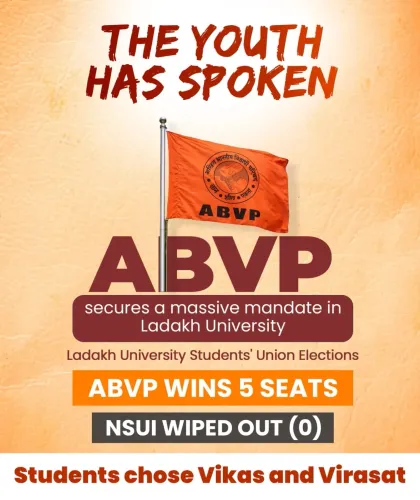
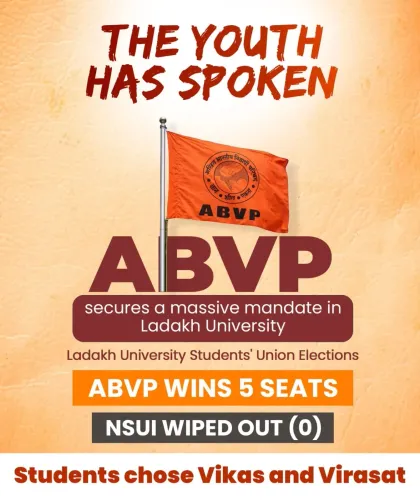
Giriraj Singh hails ABVP's 5-of-8 sweep at Ladakh University
Synopsis
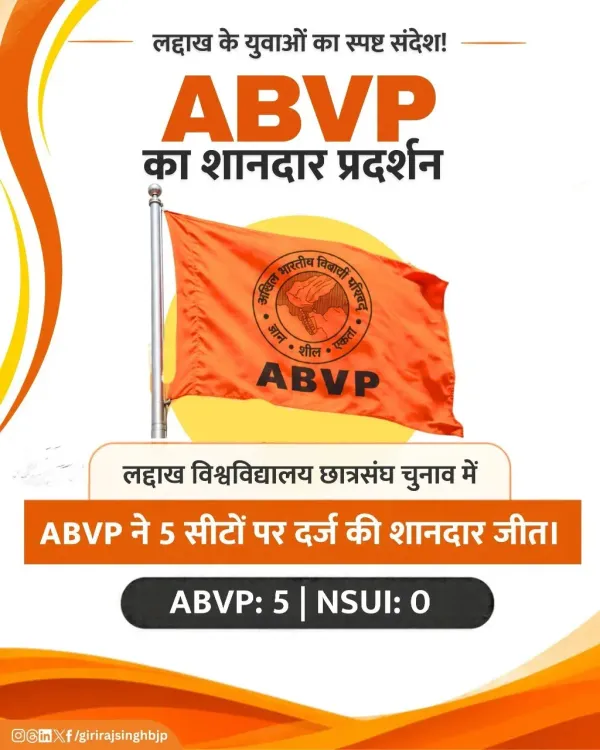
Union Textiles Minister Giriraj Singh praised ABVP for winning 5 of 8 student union posts at the University of Ladakh, calling it a victory for the 'Nation First' resolve of India's youth. The result signals organisational strength in a Union Territory created in 2019.
Key Takeaways
ABVP won 5 out of 8 posts in the University of Ladakh student union elections.
Union Textiles Minister Giriraj Singh congratulated the winners on 5 November 2026 .
Singh framed the result as a victory for the 'Rashtra Pratham' (Nation First) ethos among youth.
Ladakh became a Union Territory in 2019 ; its university is a relatively new institution with symbolic significance.
ABVP is affiliated with the RSS and is India's largest student organisation by membership.
Rival groups NSUI and SFI also contest such elections; their response to this result remains to be seen.
Campus politics in one of India's youngest Union Territories just delivered a verdict. Union Textiles Minister Giriraj Singh on Thursday, 5 November 2026 congratulated the Akhil Bharatiya Vidyarthi Parishad (ABVP) after the student organisation won 5 out of 8 contested posts in the University of Ladakh student union elections, calling the result a triumph of the 'Nation First' resolve being embraced by today's youth.
Posting in Hindi, the minister wrote: 'लद्दाख विश्वविद्यालय में 8 में से 5 पदों पर ABVP का परचम लहराना...' — 'ABVP's flag flying on 5 of 8 posts at Ladakh University is the victory of that 'Rashtra Pratham' (Nation First) resolve which today's youth is embracing.' He extended warm congratulations to all winning candidates and ABVP workers.ABVP's sweep in a Union Territory born in 2019
The significance of the result is sharpened by its geography. Ladakh became a Union Territory — carved out of the erstwhile state of Jammu and Kashmir — in August 2019, and the University of Ladakh was established precisely to anchor higher education in this strategically located, high-altitude region. A student union result there carries symbolic weight beyond ordinary campus politics: it is one of the earliest measurable indicators of organised student sentiment in a territory still building its civic institutions.
ABVP, affiliated with the Rashtriya Swayamsevak Sangh (RSS), is India's largest student organisation by membership and regularly contests elections at universities across the country. Political observers consistently read its wins — particularly in newer or contested institutional spaces — as a sign of organisational depth rather than mere electoral arithmetic.
What a 5-of-8 tally actually signals
Winning a majority of posts in any student union election is substantive: it means ABVP controls the direction of student body decisions, representations to university administration, and the cultural calendar on campus. The 63 per cent strike rate — five posts from eight — is a commanding margin by any student-election standard. Senior BJP leaders citing such results is itself a pattern: student union outcomes are increasingly flagged as evidence of generational political alignment, particularly in regions where the party and its affiliates are expanding institutional presence.
Rival student organisations — including the National Students' Union of India (NSUI), aligned with the Congress, and the Students' Federation of India (SFI) — routinely contest these elections; their response to this particular result in Ladakh will be a signal worth watching.
Point of View
Making ABVP's early organisational foothold there more consequential than a comparable win at an older university. For the BJP's broader political architecture, student bodies serve as a feeder pipeline for party cadre and local leadership — meaning this 5-of-8 result in Ladakh is not just a headline, it is a foundation being quietly laid.
NationPress
5 Nov 2026
Frequently Asked Questions
What is ABVP and which party is it affiliated with?
ABVP, or Akhil Bharatiya Vidyarthi Parishad, is India's largest student organisation, affiliated with the Rashtriya Swayamsevak Sangh (RSS), which is ideologically aligned with the BJP. It contests student union elections at universities nationwide.
How many posts did ABVP win at Ladakh University?
ABVP won 5 out of 8 contested posts in the University of Ladakh student union elections, as highlighted by Union Textiles Minister Giriraj Singh on 5 November 2026.
When was the University of Ladakh established?
The University of Ladakh was established to serve higher education needs in Ladakh after it became a Union Territory in August 2019 following its separation from the erstwhile state of Jammu and Kashmir.
What does 'Rashtra Pratham' mean and why did Giriraj Singh use it?
'Rashtra Pratham' means 'Nation First' in Hindi. Giriraj Singh used the phrase to describe what he sees as the guiding ideology behind ABVP's student election campaign and the values being adopted by Indian youth.
Which rival student groups contest elections against ABVP?
The main rival student organisations include the National Students' Union of India (NSUI), linked to the Congress party, and the Students' Federation of India (SFI), associated with Left parties. Both groups regularly contest university student union elections across India.