CM Mohan Yadav: Tribal dignity equals MP's honour
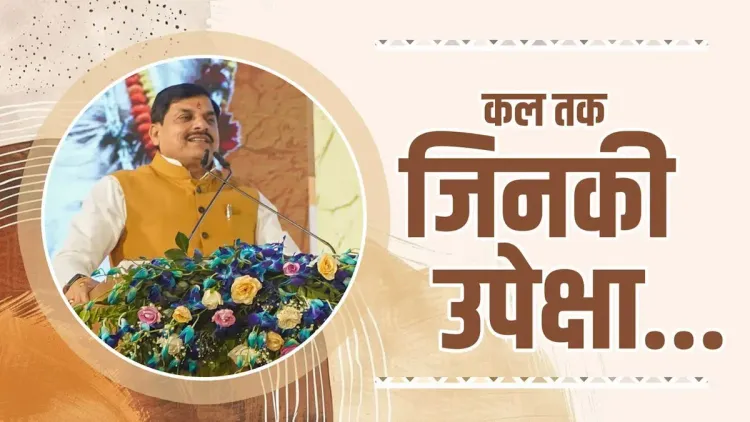
Synopsis
MP Chief Minister Dr. Mohan Yadav declared that the honour of the tribal community equals the honour of Madhya Pradesh, citing tribal children entering IAS, IPS, medicine, and science as proof of BJP's inclusive-development drive under PM Modi.
Key Takeaways
Mohan Yadav posted on 5 November 2026 stating tribal dignity is equal to Madhya Pradesh's honour.
Madhya Pradesh has an ST population exceeding 20 percent , one of the highest among Indian states.
The post aligns with the BJP's Sabka Saath, Sabka Vikas framework championed by PM Narendra Modi since 2014 .
The Vanbandhu Kalyan Yojana and Eklavya Model Residential Schools are the key institutional pillars supporting tribal educational mobility.
CM Yadav specifically cited IAS, IPS, science, sports, medicine, and engineering as fields where tribal youth are advancing.
Tribal children becoming IAS officers, scientists, doctors, and engineers — that is the benchmark Madhya Pradesh Chief Minister Dr. Mohan Yadav set on Thursday, 5 November 2026, framing the professional rise of janjatiya samaj (tribal communities) as a direct measure of the state's own honour.
Posting on X, CM Yadav wrote: 'In accordance with the resolve of our accomplished Prime Minister Shri Narendra Modi, the Bharatiya Janata Party is working to give respect and rights to every section of society. Today, children of the tribal community are also moving ahead by becoming IAS-IPS officers, scientists, players, doctors, and engineers. The honour of the tribal community is, for us, equal to the honour of Madhya Pradesh.'
Why MP's tribal numbers make this more than symbolism
Madhya Pradesh carries one of the largest Scheduled Tribe populations of any Indian state — over 20 percent of its people are ST citizens, spread across Fifth Schedule areas that carry constitutional protections on land and governance. That demographic weight means tribal welfare messaging in the state has stakes that extend well beyond electoral optics: education gaps, forest-dependent livelihoods, and representation in public services have been live policy debates for decades. The BJP's stated framework for this push is Sabka Saath, Sabka Vikas — 'Together with all, development for all' — a phrase Prime Minister Narendra Modi has anchored to inclusive governance since 2014. CM Yadav's post explicitly ties the state's tribal agenda to Modi's 'resolve', signalling alignment between Bhopal and New Delhi on the direction of policy.Eklavya schools and Vanbandhu Yojana: the institutional bet
Two policy pillars underpin the professional-mobility story CM Yadav is telling. The Vanbandhu Kalyan Yojana, launched in 2014, channelled resources into tribal-area infrastructure and livelihoods. Alongside it, the expansion of Eklavya Model Residential Schools — quality boarding schools modelled on the Navodaya network but sited inside tribal blocks — aimed to close the gap between ST children's aspirations and their access to competitive education. The logic is straightforward: a child in a remote tribal belt who makes it to an Eklavya school gets science labs, trained teachers, and a pathway to entrance examinations that were previously accessible only to urban families. When that child clears the UPSC or a medical entrance exam, it validates the institutional investment — and generates the kind of visible role model that changes what the next generation believes is possible.Respect as a political and moral claim
What is notable in CM Yadav's framing is the equation he draws: tribal honour equals the state's honour. That is not merely a welfare pitch — it is a political and moral claim that places ST communities at the centre of Madhya Pradesh's identity, not at its margins. It also raises the accountability bar: if tribal dignity is the benchmark, then data on ST representation in the IAS, IPS, and medical seats becomes a scorecard for the government itself. Rollout updates on tribal education schemes, state budget allocations for ST welfare, and representation numbers in competitive services will be the real test of how far the stated commitment travels from podium to policy file.Point of View
Which raises the political cost of underperforming on ST metrics. The explicit invocation of PM Modi's 'resolve' signals vertical alignment between state and central leadership ahead of any potential review of tribal scheme performance. By listing specific professions — IAS, IPS, doctor, engineer — the CM moves the conversation from vague inclusion rhetoric to measurable outcomes, a shift that could invite sharper scrutiny of actual ST representation data. The message also speaks to a large electoral demographic in a Fifth Schedule state, where community trust is built as much through symbolism as through scheme delivery.
NationPress
5 Nov 2026
Frequently Asked Questions
What did MP CM Mohan Yadav say about tribal communities?
CM Dr. Mohan Yadav stated that the honour of the tribal community is equal to the honour of Madhya Pradesh, and that tribal children are now becoming IAS-IPS officers, scientists, doctors, engineers, and athletes under the BJP's inclusive development drive.
What is the Vanbandhu Kalyan Yojana?
The Vanbandhu Kalyan Yojana is a welfare scheme launched in 2014 to support holistic development of tribal areas in India through investments in infrastructure, livelihoods, and social services.
What are Eklavya Model Residential Schools?
Eklavya Model Residential Schools are quality boarding schools set up inside Scheduled Tribe-dominated blocks to provide tribal children with access to competitive education, science facilities, and trained teachers.
What percentage of Madhya Pradesh's population is Scheduled Tribe?
Over 20 percent of Madhya Pradesh's population belongs to Scheduled Tribe communities, making it one of the states with the highest ST share in India.
What is the BJP's Sabka Saath Sabka Vikas framework?
'Sabka Saath, Sabka Vikas' — meaning 'Together with all, development for all' — is the BJP's stated governance philosophy under PM Narendra Modi, emphasising inclusive development across all social and economic groups including tribal communities.