CM Shivakumar Writes to PM Modi, Flags Karnataka's Key Demands
Synopsis
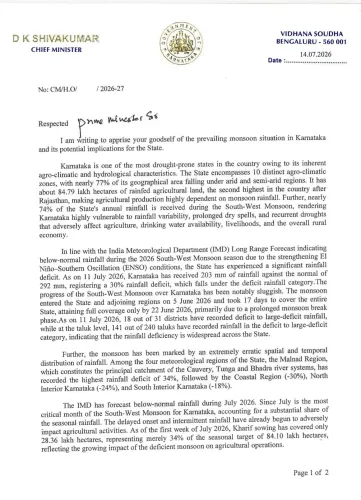
Chief Minister D.K. Shivakumar has written to PM Narendra Modi outlining Karnataka's development priorities — from Mekedatu and drought relief to an AI University in Bengaluru and AIIMS in Raichur — and urging the PM's personal intervention on pending clearances and farm distress.
Key Takeaways
Shivakumar wrote to PM Narendra Modi responding to the PM's Karnataka Rajyotsava letter, using the occasion to table a broad set of state demands.
The letter seeks a special financial package for Bengaluru and Central movement on five water projects: Mekedatu, Kalasa-Banduri, Upper Bhadra, Upper Krishna, and Yettinahole .
Shivakumar flagged pending Jal Jeevan Mission funds , rural development allocations, and drinking water infrastructure needs.
The CM urged urgent drought relief and fair pricing and ethanol policy for sugarcane farmers .
He reiterated his request for an all-party Karnataka delegation to meet the PM on drought and sugarcane issues — indicating a prior request remains unanswered.
The letter supports a proposed AI University in Bengaluru and AIIMS in Raichur , framing both as investments in Karnataka's youth and human capital.
A formal letter from Bengaluru to New Delhi has laid out Karnataka's most pressing development demands in a single, sweeping document. Chief Minister D.K. Shivakumar has written to Prime Minister Narendra Modi responding to the PM's letter on Karnataka Rajyotsava, turning a ceremonial exchange into a pointed policy brief that covers everything from drought-hit sugarcane farmers to a proposed AI university in Bengaluru.
From Mekedatu to AIIMS Raichur: The Infrastructure Wishlist
At the top of the CM's letter sits Bengaluru's infrastructure deficit. Shivakumar has sought a special financial package for the state capital's connectivity needs — a demand the city's rapid growth has made increasingly hard to ignore. Beyond the metropolis, the letter pushes for movement on a clutch of long-pending water projects: Mekedatu on the Cauvery, Kalasa-Banduri linked to the contested Mahadayi river diversion, and the Upper Bhadra, Upper Krishna, and Yettinahole schemes, each carrying its own history of inter-state disputes and Central clearance delays.
Shivakumar has also flagged pending funds under the Jal Jeevan Mission — the Centre's flagship scheme launched in 2019 to deliver tap water to every rural household — alongside broader rural development and drinking water allocations. On the healthcare and education front, the letter seeks Union support for a proposed AI University in Bengaluru and an AIIMS facility in Raichur, two institutions the state argues would anchor long-term human capital development.
Drought Relief and the Sugarcane Farmer's Squeeze
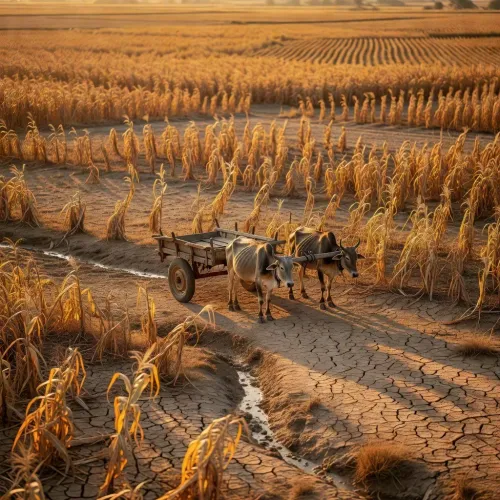
The letter turns urgent when it reaches Karnataka's agricultural belt. Shivakumar has raised the plight of sugarcane farmers, calling for fair pricing, a rationalised ethanol policy, and — most immediately — drought relief for affected regions. The demand is not new; Karnataka has periodically declared drought conditions and sought Central assistance, but the CM's letter frames the need as urgent and time-sensitive.
Reinforcing that urgency, Shivakumar has once again requested that the Prime Minister receive an all-party delegation from Karnataka to discuss the drought situation and sugarcane farmers' demands directly. It is a reiteration — meaning an earlier request has not yet been acted upon — and its repetition signals the state government's frustration with the pace of Central response.
Cooperative Federalism, or the Lack of It?
Running through the letter is a recurring refrain about cooperative federalism. Shivakumar has explicitly reaffirmed Karnataka's commitment to the principle while simultaneously calling for 'fair support and stronger Centre-State cooperation' — a phrase that, in the grammar of Indian intergovernmental relations, is a polite but pointed signal that the state feels it is not getting its due share.
Indian states routinely approach New Delhi through formal letters, budget memoranda, and delegations, particularly on irrigation clearances and urban financial packages. What sets this letter apart is its breadth: in a single document, the Karnataka CM has bundled infrastructure, water rights, farm distress, healthcare, education, and skill development — effectively presenting the full arc of the state's pending agenda with the Union government in one consolidated ask.
The Chief Minister's Office has made clear that the government 'remains committed to Karnataka's all-round progress' and to ensuring 'every region of the State has access to equal opportunities and support.' Whether the Prime Minister's Office responds with equal urgency — particularly on the all-party drought delegation — will be the real measure of where Centre-State relations stand in Karnataka today.
Point of View
It serves a dual purpose: demonstrating administrative seriousness to voters while publicly documenting the Centre's pending responses, which can be deployed politically if relief is delayed. The sheer breadth of the asks — spanning water rights, farm distress, urban infrastructure, and healthcare — reflects how much Central clearance and funding Karnataka depends on, and how fraught that dependence can become when the state and Central governments belong to rival parties. The reiterated request for an all-party delegation is the most telling detail: it signals that the drought situation is severe enough for the CM to seek cross-party cover, and that previous outreach to the PMO has stalled.
NationPress
5 Nov 2026
Frequently Asked Questions
Why did CM Shivakumar write to PM Modi?
CM D.K. Shivakumar wrote to PM Narendra Modi in response to the PM's letter on Karnataka Rajyotsava, using the opportunity to outline the state's key development priorities and seek the Union government's support on several pending issues including water projects, drought relief, and infrastructure funding.
What is the Mekedatu project and why is it significant?
Mekedatu is a proposed dam project on the Cauvery river in Karnataka. It has been a long-pending proposal subject to inter-state water disputes, and Karnataka has repeatedly sought Central clearance for the project, which the CM's letter raises again.
What has Karnataka asked for regarding sugarcane farmers?
CM Shivakumar has asked the Centre for fair pricing for sugarcane farmers, a rationalised ethanol policy, and urgent drought relief for affected farming communities. He has also requested an all-party delegation to meet the PM specifically on these issues.
What is the Jal Jeevan Mission and what is Karnataka's issue with it?
Jal Jeevan Mission is a Central scheme launched in 2019 to provide tap water connections to rural households across India. Karnataka's letter flags pending funds under the scheme that the state says have not yet been released by the Union government.
What new institutions has Karnataka sought Central support for?
Karnataka has sought the Union government's support for two proposed institutions: an AI University in Bengaluru and an AIIMS — All India Institute of Medical Sciences — in Raichur district, both framed as investments in the state's youth and long-term development.