How Can a Nation Thrive When Its Citizens Are Awakened? Acharya Prashant's Insights
Synopsis
On India's 77th Republic Day, Acharya Prashant shares profound insights on the nation's strength stemming from the awakening of its citizens. He emphasizes the importance of inner freedom and the responsibility of every individual in shaping the Republic. Discover how individual greatness can transform the destiny of the nation.
Key Takeaways
The essence of a Republic goes beyond legal frameworks.
Inner awakening of citizens is crucial for national strength.
Rejecting external authority is only the beginning.
The true adversary often resides within us.
Greatness of the nation is tied to the greatness of its individuals.
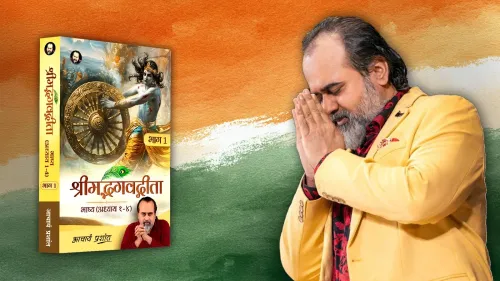
New Delhi, Jan 25 (NationPress) On India's 77th Republic Day, philosopher and author Acharya Prashant emphasized that the essence of a Republic transcends mere legal frameworks, highlighting that a nation's strength is fundamentally tied to the internal awakening of its citizens.
"The notion of a Republic is profound and resonates deeply," he remarked. "It signifies a rejection of monarchies, theocracies, and traditional hierarchies. It embodies a refusal to let any king, tradition, or the past govern us."
However, he warned that dismissing external authorities is only part of the journey.
"The true ruler may reside within us in the form of ego and self," he pointed out. "What governs us may not be an outside tradition, but rather an internal dialogue of unexamined beliefs, biases, and ego."
By ego, he clarified, he did not refer solely to pride but to the typical center of operation for the average person.
He cautioned that this internal adversary is particularly perilous due to its invisibility.
"When ignorance within us takes control, it poses a greater threat than any foreign invader. We may believe we are free, yet the enemy lurks within, ready to undermine our national vitality."
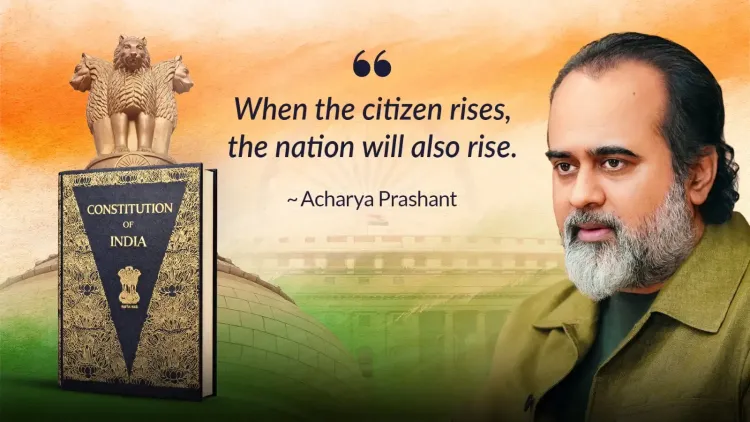
Turning to the Preamble, Acharya Prashant stated, "I often say that these few phrases in the Preamble represent the spiritual core of the Constitution. The Constitution asserts: 'We, the People of India, have resolutely given this Constitution to ourselves.'"
He elaborated, "'We, the People of India' signifies that we decline to let anyone else dominate us. 'We have resolved' indicates that the Constitution springs from our will, not coercion. And 'We give this Constitution to ourselves' reaffirms our autonomy in deciding how we ought to live."
Discussing the link between inner and outer freedom, he stated, "That is why, on the battlefield of Kurukshetra, when Arjuna confronts a significant external conflict, Krishna does not instruct him on external warfare. Arjuna is already knowledgeable about that. Krishna imparts inner wisdom to Arjuna."
He continued, "A person with inner freedom cannot be enslaved from the outside. You cannot declare, 'I refuse to be ruled by outsiders,' while being a captive of your own internal ego."
Acharya Prashant then delved into the foundational principles of the Constitution.
"It is a vital observation that the ordinary ego resists the elevated principles of the Constitution, such as socialism, secularism, fraternity, equality, and liberty. This illustrates that the Constitution's foundation is spiritual," he noted.
"We claim to be a sovereign, socialist, secular, democratic republic. These are noble terms. But can any of these ideals be realized without inner enlightenment?" The ego rejects justice because it insists, "I am the authority, the observer, the jury, and the defender, so I will make the decisions."
Equality is unwelcome because the ego seeks superiority. Fraternity implies a collective humanity that "the ego resists accepting." Even liberty is misconstrued: the ego relishes "my life, my rules, or my way or the highway," yet shuns true freedom.
He added, "Does the ego genuinely desire sovereignty? No, because it must forfeit comfort. Dependence is easy, and the ego enjoys that ease."
Socialism demands equitable distribution, but the ego wishes to hoard wealth. Similarly, the ego believes its views are paramount, leaving secularism as merely a term.
On democracy, he stated, "When the average citizen remains unawakened, democracy deteriorates into mob rule."
He concluded, "Justice, liberty, equality, fraternity: such beautiful concepts. But only our inner illumination can infuse these words with significance. Otherwise, they will remain external principles: lovely but superficial."
Addressing the youth, he asserted, "The nation is not just a territory. The fundamental meaning of a nation is the people residing within it. Therefore, we must elevate ourselves."
He urged, "The quest for greatness cannot rest on the past or a select group of leaders. The ordinary individual must strive for greatness."
Regarding Indian nationalism, Acharya Prashant reflected, "Our nationalism is neither that of Jinnah, Hitler, nor the Balkans. Such nationalism breeds violence. However, our nationalism does not require adversaries. The nationalism enshrined in our Constitution benefits the global community."
In closing, he remarked, "Ultimately, it all hinges on the individual. We require a specific type of human being. The Constitution itself calls for citizens who are virtuous, resilient, elevated, and self-aware."
When Indians achieve greatness, the path to making India great will become effortless.
Point of View
I firmly believe that Acharya Prashant's message resonates deeply in today's context. The essence of a Republic lies not merely in its structure but in the collective awakening of its citizens. His call for introspection and responsibility is vital for the progress of our nation. We must embrace this philosophy to foster unity and strength.
NationPress
28 Sept 2026
Frequently Asked Questions
What is the core message of Acharya Prashant's speech?
Acharya Prashant emphasizes that the true strength of a nation lies in the inner awakening of its citizens, urging individuals to reject ego and tradition.
How does Acharya Prashant define a Republic?
He defines a Republic as a system where individuals are not governed by monarchies or traditions but by their own self-awareness and resolve.
Why is inner freedom important according to Prashant?
Inner freedom is crucial because it empowers individuals to resist external domination and fosters a genuine sense of autonomy.
What role does the youth play in nation-building?
The youth are pivotal as they must strive for greatness, shaping the future of the nation through their actions and awakening.
What are the ideals of the Indian Constitution that Prashant highlights?
Prashant highlights ideals such as socialism, secularism, fraternity, equality, and liberty as foundational to the Republic, requiring inner illumination to be meaningful.