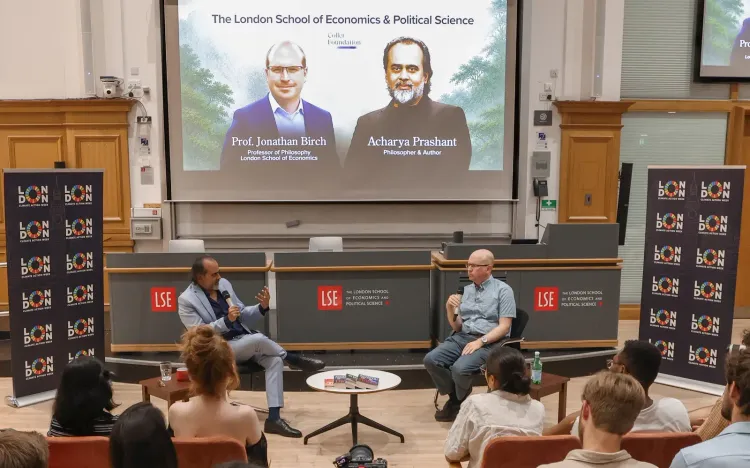
Acharya Prashant and Prof Jonathan Birch debate animal sentience at LSE
Synopsis
At a packed LSE theatre during London Climate Action Week, Acharya Prashant and Professor Jonathan Birch found surprising common ground between Vedanta and cutting-edge sentience science — then diverged sharply on whether laws and technology can ever fix a crisis whose root, Acharya Prashant argued, lies inside human consciousness itself.
Key Takeaways
Acharya Prashant and Professor Jonathan Birch held a public dialogue at the London School of Economics on 1 July during London Climate Action Week .
Professor Birch cited the 2024 New York Declaration on Animal Consciousness , which he helped frame, as evidence that sentience extends well beyond vertebrates.
Acharya Prashant argued that legislation and green technology manage the consequences of human ego rather than addressing its source, using the analogy of a drunk driver .
Both speakers are vegan; Acharya Prashant distinguished between veganism as ideology and veganism as a natural outcome of clear seeing.
Acharya Prashant is ranked in the top twenty of the Watkins 2026 list of most influential living thinkers; his teaching app has crossed five million downloads .
He is next scheduled to speak at University College London , Roehampton University , the Indian High Commission , and with biologist Rupert Sheldrake .
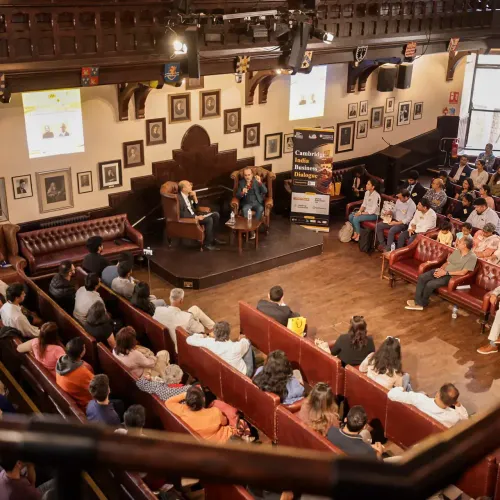
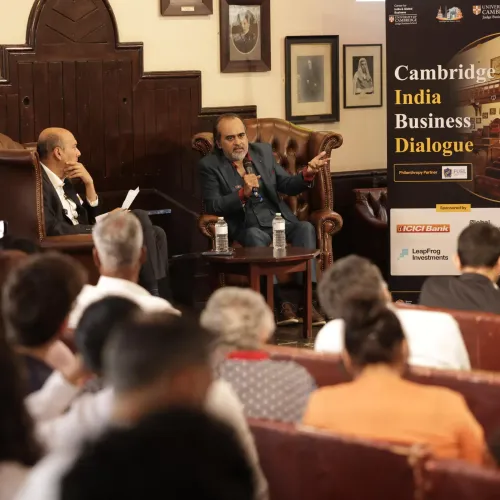
Philosopher Acharya Prashant and Professor Jonathan Birch, Director of LSE's Jeremy Coller Centre for Animal Sentience, held a wide-ranging public dialogue on animal consciousness and ecological responsibility at the London School of Economics (LSE) on Friday, 1 July. The Hong Kong Theatre was packed to capacity, with students, researchers, faculty and members of the public filling every seat — and breaking into sustained applause multiple times through the evening.
The Event and Its Setting
Titled 'Animal Consciousness and the Environment: Insights from Science and Vedanta', the dialogue was held as part of London Climate Action Week and introduced by Dr Eva Read, a faculty member in animal welfare science at LSE, who described it as a rare cross-cultural meeting point between Western philosophy of mind and Indian philosophical tradition.
Dr Read noted that Professor Birch had led the 2021 review of evidence for sentience in cephalopods and decapod crustaceans — work that directly shaped the UK's Animal Welfare (Sentience) Act — and that his recent book on risk and precaution in questions of sentience across humans, animals and artificial intelligence had been praised by the journal Nature. She introduced Acharya Prashant as ranked in the top twenty of the Watkins 2026 list of the world's most influential living thinkers, with his teaching-based app crossing five million downloads.
Key Arguments: Science Meets Vedanta
Professor Birch opened by pointing to a convergence between recent scientific findings on animal consciousness and positions long held in Indian philosophical traditions. He cited the 2024 New York Declaration on Animal Consciousness, which he helped frame, as evidence that realistic scientific support for sentience now extends well beyond vertebrates.
Acharya Prashant responded that the obstacle has never been a shortage of scientific proof. 'The man who talked of the speaking tree and feeling oceans was not doing something special,' he said. 'This man was just free of exploitative intent, and then it was obvious.'
The conversation also engaged Jeremy Bentham's formulation that the morally relevant question is not whether a being can reason, but whether it can suffer. Acharya Prashant called the line beautiful but pressed further, asking why the human ego is so invested in drawing a boundary between sentient and insentient at all.
The Drunk Driver Analogy
The sharpest and most applauded exchange of the evening centred on an analogy Acharya Prashant returned to repeatedly: that of a drunk driver. He argued that contemporary responses to crises — from animal cruelty to climate change — resemble a society that reacts to a drunk driver not by addressing the drunkenness, but by engineering better roads, softer dividers, more advanced safety technology and a faster ambulance response, while leaving the driver's condition untouched.
'We are prepared to do everything except look at the state of the driver,' he said, to a wave of applause that swept through the packed theatre. 'Human beings are that driver, and that is the one thing and the only thing that we need to change.'
When an audience member pressed him on whether this implied change could only come slowly, one person at a time, Acharya Prashant clarified that he was not arguing against regulation or technology. He compared laws and green technologies to bamboo fences used to protect young saplings in London's Richmond Park. 'The crutches are needed precisely because the legs are not yet strong enough,' he said, adding that their necessity should be measured by how quickly they become redundant, not treated as a permanent solution.
On Animal Welfare Law, Veganism and AI
Much of the dialogue examined whether animal welfare legislation can deliver lasting change on its own. Acharya Prashant contended that legislation has expanded steadily over nearly two centuries without a corresponding fall in species extinction rates or per capita meat consumption, and argued that the lawmaker and the lawbreaker are effectively the same person — the human ego that frames protective law is also the consumer the law is meant to restrain. Professor Birch countered that while laws alone cannot resolve every problem, they remain among the best practical tools for limiting cruelty, even as he agreed that cultivating compassion directly would be the more ideal route.
Both speakers described themselves as vegan, but Acharya Prashant drew a distinction between veganism as a deliberate ideological stance and veganism as something that arises naturally once a person sees clearly. 'I never embraced veganism as an ideology or as a set of actions, do's and don'ts,' he said. 'My veganism is a natural offshoot of what I see, what I understand, and what I continue to observe on a daily basis.'
On artificial intelligence, Professor Birch said current chatbots create a powerful illusion of consciousness but that no reliable test for machine consciousness yet exists. Acharya Prashant suggested the more useful question was not whether a machine could become conscious, but whether it could ever gain the capacity to examine and step outside its own design — in the way human self-inquiry allows a person to look at the constructed nature of the ego.
After the Dialogue: What Acharya Prashant Said
Speaking after the event, Acharya Prashant said the discussion had moved beyond data and policy into the nature of the self that seeks to solve problems in the first place. 'Far from being the problem solver, what if the self is a problem creator,' he said, 'even in its instances of caregiving and compassion and regulation pertaining to animal welfare.'
He described a dynamic in which measures taken to address crises are themselves extensions of the same ego that created the crisis, calling this 'the ultimate deception leading to the final catastrophe.' On why animal consciousness belongs at the centre of climate conversations, he noted that ninety-nine to ninety-nine point five per cent of biological material is common between humans and the animals being protected, describing the remaining fraction — which includes the human capacity for egoic identity — as 'a design feature that should be better called a design bug, a manufacturing defect.'
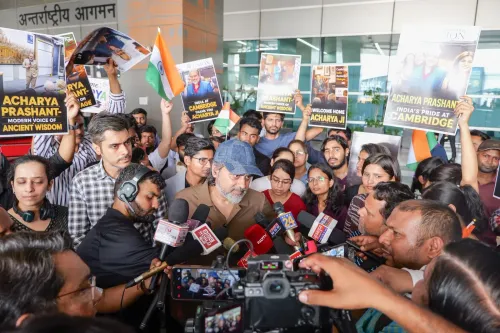
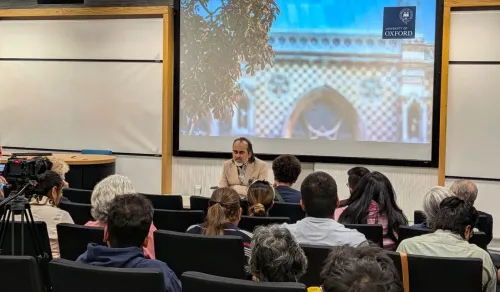
The LSE dialogue is part of Acharya Prashant's ongoing engagements across the United Kingdom, following packed sessions at Cambridge, Oxford and the House of Lords. He is next expected to speak at University College London, Roehampton University London, a public session hosted by the Indian High Commission, and in a standalone conversation with biologist Rupert Sheldrake.
Frequently Asked Questions
What was the Acharya Prashant and Professor Jonathan Birch dialogue at LSE about?
The dialogue, titled 'Animal Consciousness and the Environment: Insights from Science and Vedanta,' explored the philosophical foundations of animal sentience, the limits of animal welfare legislation, veganism, and the ethics of consumption. It was held at the London School of Economics on 1 July as part of London Climate Action Week.
Who is Professor Jonathan Birch and why does his work matter?
Professor Jonathan Birch is Director of LSE's Jeremy Coller Centre for Animal Sentience. He led the 2021 review of evidence for sentience in cephalopods and decapod crustaceans that shaped the UK's Animal Welfare (Sentience) Act, and he co-framed the 2024 New York Declaration on Animal Consciousness, which found scientific support for sentience extending well beyond vertebrates.
What was Acharya Prashant's 'drunk driver' argument?
Acharya Prashant argued that society's response to crises like animal cruelty and climate change resembles reacting to a drunk driver by building better roads and faster ambulances rather than addressing the driver's condition. He contended that laws and green technologies manage the consequences of human desire without confronting their source in human consciousness.
Did Acharya Prashant reject regulation and technology entirely?
No. He clarified that he was not arguing against regulation or technology, comparing them to bamboo fences that protect young saplings. He said such measures remain necessary as long as the ego persists, but their value should be measured by how quickly they become redundant rather than treated as permanent solutions.
What are Acharya Prashant's upcoming engagements in the UK?
Following the LSE event, Acharya Prashant is expected to speak at University College London, Roehampton University London, a public session hosted by the Indian High Commission, and in a standalone conversation with Cambridge-trained biologist Rupert Sheldrake.