AI in policing: Experts at e-Governance Conference push preventive model
Synopsis
At the 29th National e-Governance Conference in Jaipur, senior police officials and experts made the case for AI as a 'force multiplier' in Indian law enforcement — but also sounded a clear warning: unregulated deployment risks algorithmic bias, and India must build sovereign, indigenous AI before scaling up.
Key Takeaways
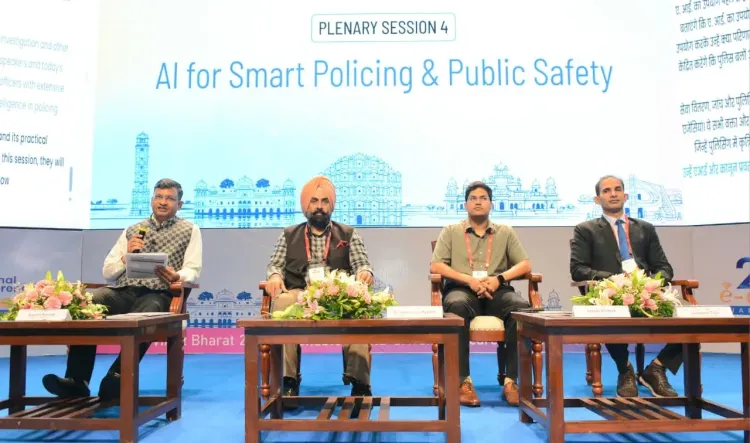
The 29th National Conference on e-Governance held a plenary on 'AI for Smart Policing and Public Safety' in Jaipur on 3 July 2025 .
BPR&D Additional DGP Gopesh Agrawal described AI as a 'force multiplier' for police, not a replacement for personnel.
BPR&D Jaipur Director Amandeep Kapoor highlighted tools including CCTNS 2.0 , e-Sakshya , Agentic AI , edge-based LLMs , and dark web monitoring .
Eluru SP Kommi Kishore warned against rapid, unregulated AI deployment, citing risks of algorithmic bias in investigations.
CDTI Director Salman Taj called for Data Fusion Centres to consolidate siloed policing data and strengthen AI data sovereignty .
Experts agreed India must develop sovereign, responsible, and indigenous AI for secure law enforcement implementation.
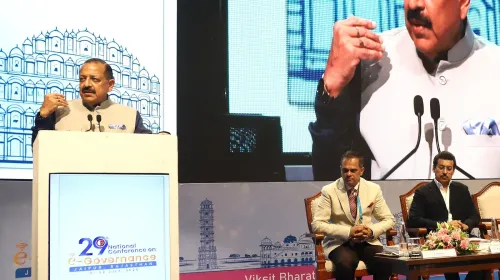
Artificial Intelligence is reshaping law enforcement across India, shifting policing from a reactive posture to a preventive one — enabling faster emergency response and stronger crime deterrence, experts said at the 29th National Conference on e-Governance in Jaipur on 3 July 2025. The plenary session, titled 'AI for Smart Policing and Public Safety', was held on the second day of the conference at the Rajasthan International Centre.
Key Developments at the Session
The session was chaired by Gopesh Agrawal, Additional Director General of Police at the Bureau of Police Research and Development (BPR&D). Agrawal underlined that police forces across the country are increasingly deploying AI-powered tools to strengthen both law enforcement and public safety outcomes.
He framed AI not as a substitute for police personnel but as a 'force multiplier' — a technology that amplifies human capability rather than replacing it. This distinction, he argued, is central to responsible adoption within the force.
Emerging Technologies Highlighted
Amandeep Kapoor, Director at BPR&D Jaipur, spotlighted a range of emerging tools now entering the policing ecosystem: blockchain, advanced data computing, Crime and Criminal Tracking Network and Systems (CCTNS) 2.0, the e-Sakshya platform, Agentic AI, edge-based Large Language Models (LLMs), the Mule Hunting app, and dark web monitoring capabilities.
Kapoor stressed that India must prioritise developing sovereign, responsible, and indigenous AI to ensure secure and reliable implementation. He added that BPR&D is actively building training programmes and system infrastructure to support AI adoption across police departments nationwide.
Voices from the Field
Kommi Kishore, Superintendent of Police in Eluru, Andhra Pradesh, told the session that AI literacy has become a professional necessity for police personnel. He cited AI-powered investigative tools — including language translation technologies — as contributors to improved investigations and better conviction rates.
Kishore, however, urged caution. He warned that rapid, unregulated deployment risks introducing algorithmic bias into investigations, and called for a balanced, phased approach. 'The objective of AI in policing should be to make policing proactive, not merely predictive,' he said.
Salman Taj, Director of the Central Detective Training Institute (CDTI) in Hyderabad, pointed to a structural challenge: policing data remains scattered across multiple, siloed platforms, complicating investigations. He advocated the creation of Data Fusion Centres to consolidate information into a unified system, enabling faster and more accurate case resolution. Taj also flagged AI data sovereignty as a critical pillar of responsible law enforcement technology.
Closing and Felicitation
The session concluded with an interactive exchange between experts and conference participants on AI-driven policing and emerging technologies. Vijay Kumar Singh, Additional Director General of Police (Law and Order) of Rajasthan Police, felicitated the speakers with mementos.
The discussions collectively reinforced the growing imperative for AI-based smart policing, secure digital infrastructure, and data-driven investigations as foundational elements of India's evolving public safety framework. With BPR&D accelerating training pipelines and states piloting new tools, the pace of adoption is expected to intensify in the months ahead.
Point of View
Indigenous AI' is strategically sound, but building it requires data governance standards that most state police departments do not yet have. The risk is that the infrastructure of surveillance scales faster than the safeguards around it — a pattern seen in other jurisdictions that rushed AI adoption without accountability frameworks.
NationPress
1 Oct 2026
Frequently Asked Questions
What was discussed at the AI policing session at the National e-Governance Conference in Jaipur?
The session, titled 'AI for Smart Policing and Public Safety', focused on how artificial intelligence is shifting Indian law enforcement from a reactive to a preventive model. Experts discussed tools such as CCTNS 2.0, Agentic AI, edge-based LLMs, dark web monitoring, and the Mule Hunting app, while also flagging risks like algorithmic bias and the need for data sovereignty.
What is BPR&D's role in AI adoption for Indian police?
The Bureau of Police Research and Development (BPR&D) is developing training programmes and system infrastructure to support AI adoption across police departments in India. BPR&D officials at the conference also stressed the need for sovereign, responsible, and indigenous AI to ensure secure implementation.
What is CCTNS 2.0 and why does it matter for policing?
CCTNS 2.0 is an upgraded version of the Crime and Criminal Tracking Network and Systems platform, highlighted at the conference as a key tool for modernising Indian policing. It is part of a broader digital infrastructure push aimed at integrating criminal data for faster, more accurate investigations.
What risks did experts flag about AI in policing?
Eluru Superintendent of Police Kommi Kishore warned that rapid, unregulated AI deployment could introduce algorithmic bias into investigations. Experts broadly called for a balanced, phased adoption approach and emphasised that AI data sovereignty and strong safeguards are essential for responsible use.
What are Data Fusion Centres and why are they being proposed?
Data Fusion Centres are proposed integrated platforms that would consolidate policing data currently scattered across multiple siloed systems. CDTI Director Salman Taj advocated for them at the conference, arguing that unified data access would enable faster and more accurate investigations.