Will AI Triumph Over the Hype to Enhance Lives? Insights from IT Secretary S. Krishnan
Synopsis
In a compelling address at the India AI Impact Summit 2026, Union IT Secretary S. Krishnan emphasized that the true measure of AI's success lies in its ability to deliver transformative solutions. This article explores his insights on how AI can foster real-world improvements across various sectors.
Key Takeaways
AI must deliver tangible improvements to be deemed successful.
Real-world applications are crucial for creating impact.
AI can significantly enhance productivity in various sectors.
Responsible scaling and privacy protection are essential.
Rigorous evaluation is needed to validate AI's effectiveness.
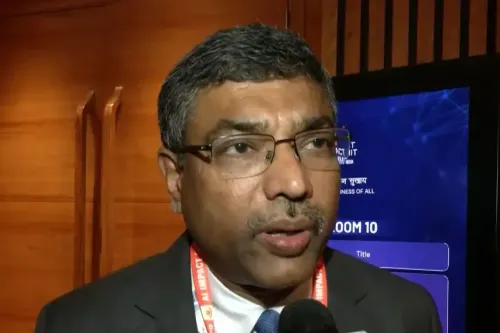
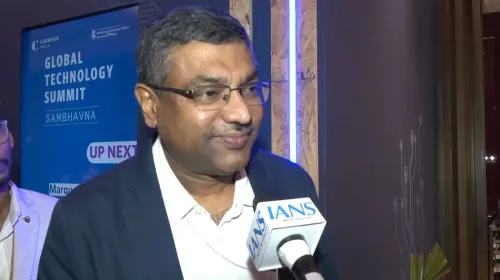
New Delhi, Feb 17 (NationPress) The Union Secretary for Electronics and Information Technology, S. Krishnan, remarked on Tuesday that the future success of artificial intelligence (AI) hinges on its ability to provide solutions that genuinely enhance people's lives.
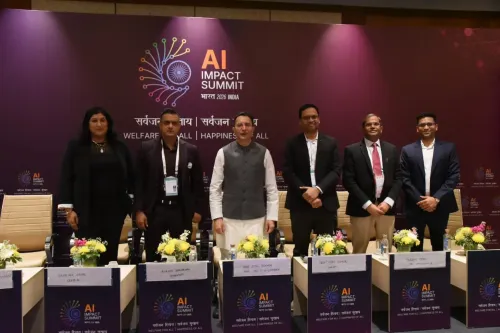
During a session named "From Algorithms to Outcomes: Building AI that Works for People" on the second day of the 'India AI Impact Summit 2026', Krishnan detailed how the India AI Mission is structured to tackle varied needs and real-life issues.
"We are supplying computing power, models, and data for a singular purpose: to create applications that yield real-world impact. A visit to the expo reveals countless startups engaged in sectors like healthcare, agriculture, education, and manufacturing. This is where meaningful impact will arise," he stated to the audience.
He emphasized that there will never be enough teachers, doctors, or judges provided by the government, but stated, "If AI can boost productivity, it can significantly enhance service quality."
Krishnan further elaborated on the importance of identifying effective solutions, scaling them responsibly, safeguarding privacy, and ensuring that public funds lead to measurable outcomes.
The impactful session investigated the twin necessities of people-focused AI and national technological independence.
It spotlighted the need for artificial intelligence systems to translate into observable advancements in public service provision and citizen welfare.
As per the official statement, the dialogue revolved around how computing, models, and data should ultimately culminate in practical applications that elevate productivity, bolster governance, and provide clear advantages to citizens.
Iqbal Singh Dhaliwal, Global Executive Director of The Abdul Latif Jameel Poverty Action Lab (J-PAL), highlighted the significance of thorough evaluation, stating, "If you've spent enough time in development, you've witnessed many so-called solutions come and vanish."
Michael Kremer, J-PAL, University Professor of Economics at the University of Chicago, added, "We are already observing early evidence of impact in areas such as traffic enforcement, automated driving license assessments, health, and education, including personalized adaptive learning that has doubled student learning speed with just one hour per week."
Point of View
The insights shared by Union IT Secretary S. Krishnan at the India AI Impact Summit resonate with the pressing need for artificial intelligence to evolve beyond mere promises. It is crucial that AI systems are developed with a focus on enhancing citizen welfare and public service delivery. The emphasis on scaling effective solutions responsibly captures the essence of integrating technology with social needs.
NationPress
29 Sept 2026
Frequently Asked Questions
What did S. Krishnan say about AI's impact?
S. Krishnan emphasized that the success of AI relies on its ability to deliver solutions that genuinely improve lives.
What sectors are benefiting from AI innovation?
AI is making strides in sectors such as healthcare, agriculture, education, and manufacturing.
How can AI enhance service quality?
AI can boost productivity, thereby significantly improving the quality of services offered.
What is the focus of the India AI Mission?
The India AI Mission is designed to address diverse needs and real-world challenges.
What advice did experts give about AI evaluation?
Experts stressed the importance of rigorous evaluation to ensure meaningful outcomes from AI applications.