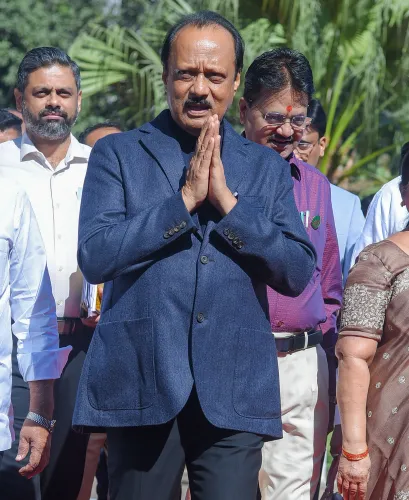
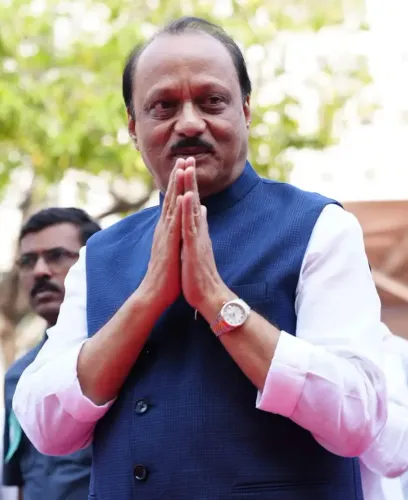
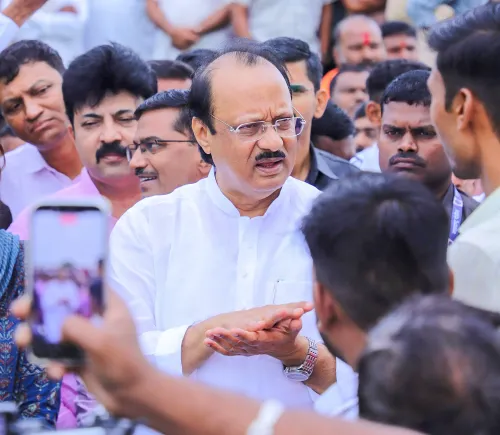
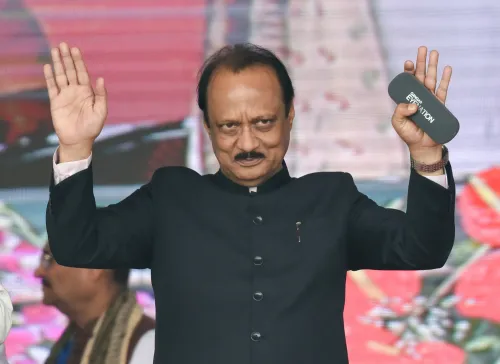
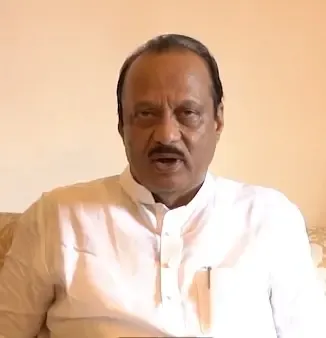
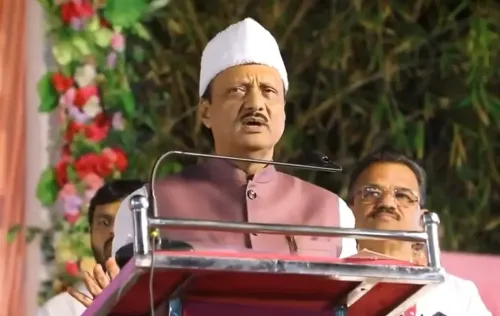
Is Anyone Involved in Terrorism a Threat to the Country and Should They Be Hanged? Ajit Pawar Speaks Out
Synopsis
In a pivotal interview, Ajit Pawar, Maharashtra's Deputy Chief Minister, emphasizes his party's dedication to development while addressing pressing issues, including terrorism and local governance. With the BMC elections looming, his insights reflect the political landscape and the urgency for effective governance. What does this mean for the future of Maharashtra? Read on to find out.
Key Takeaways
Commitment to Development: Ajit Pawar emphasizes the need for inclusive urban development.
Stance on Terrorism: Strict punishment for terrorism is a priority.
Infrastructure Plans: Promises include 500 km of new roads and improved public facilities.
Political Alliances: Local elections see different alliances compared to state elections.
Public Health Focus: Addressing pollution and health issues in urban areas is crucial.
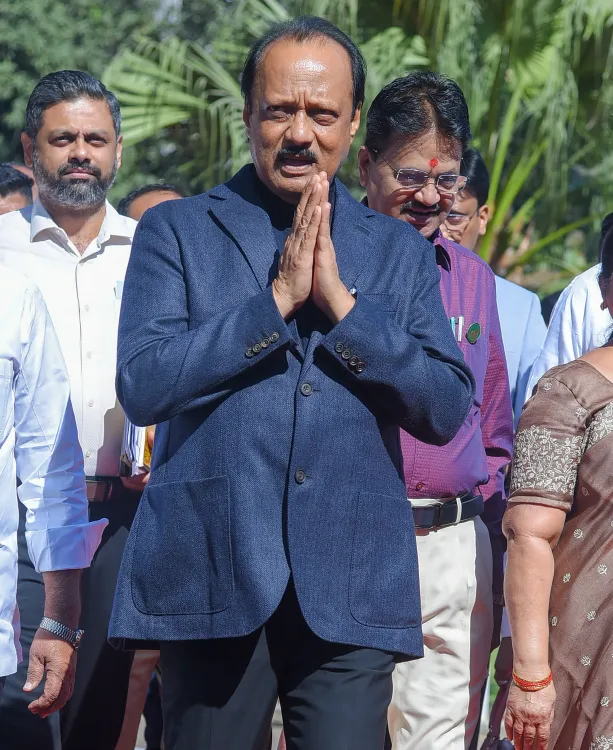
Mumbai, Jan 12 (NationPress) As the Brihanmumbai Municipal Corporation (BMC) elections approach on January 15, 2026, Ajit Pawar, the Maharashtra Deputy Chief Minister and leader of the Nationalist Congress Party (NCP), emphasized that the core mission of his party is development. He detailed the priorities in the party's manifesto while addressing queries about alliances, political shifts, governance, and national matters, asserting that voters ultimately evaluate leaders based on their performance. Additionally, he stated that individuals involved in terrorism should receive the harshest penalties, including capital punishment.
Nearly 1,700 candidates are vying for positions in the 227-ward BMC elections, which are being closely monitored as a significant indicator for future Assembly and Lok Sabha elections in Maharashtra.
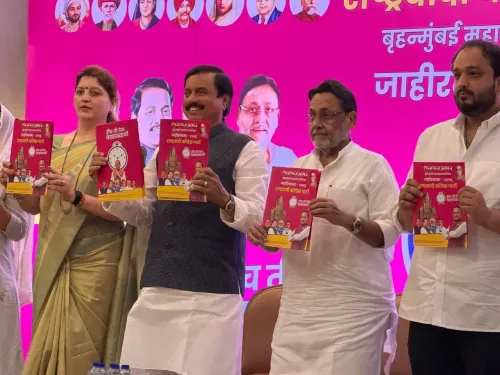
The NCP unveiled its manifesto on Wednesday, promising inclusive development, transparent governance, and significant infrastructure enhancements aimed at transforming Mumbai into a global metropolis. Key initiatives include constructing 500 km of new roads over the next five years, upgrading bridges and flyovers, implementing AI-driven traffic management systems, and establishing new economic hubs in areas such as BKC, Worli, and the eastern suburbs to boost job prospects.
The NCP has entered into a partnership with Sharad Pawar's NCP (SP) for the municipal elections in Pune and Pimpri-Chinchwad, despite existing political differences at both the state and national levels. While the NCP is part of the ruling coalition in both governments, the NCP (SP) stands in opposition.
In an exclusive interview with IANS, Ajit Pawar discussed various topics, including civic administration, infrastructure progress, pollution, political alliances, the possibility of NCP reunification, comments from opposition leaders, and issues surrounding national security and economic challenges.
Here is the complete interview:
IANS: Having held power for many years, what is distinct in this year's manifesto?
Ajit Pawar: The standout feature of our manifesto is our unwavering commitment to enhancing urban living standards. Citizens should have access to clean and sufficient drinking water, daily maintenance of cleanliness, well-maintained roads, and efficient traffic management. Medical services must be accessible and of high quality for everyone.
We are particularly focused on pollution, which poses a serious threat in metropolitan regions like Mumbai. Escalating pollution levels have resulted in public health issues. Our manifesto reflects these concerns clearly. Our goal is not merely to make promises but to ensure effective execution.
IANS: Critics suggest that these services could have been provided earlier given your tenure. What is your response?
Ajit Pawar: I have dedicated nearly 25 years to the Pimpri-Chinchwad Municipal Corporation. My work during this time is verifiable. One should inquire about the development initiatives undertaken there, which earned Pimpri-Chinchwad recognition as one of the best-managed cities. At one point, it was the wealthiest municipal corporation in Asia.
However, the current scenario is starkly different. Outstanding bills totaling approximately Rs 4,000 crore are pending, and municipal bonds have been issued, reflecting a funding shortfall. This complicates the efficient management of civic services. Residents face inadequate water supply, poor road conditions, and service delivery gaps.
Furthermore, job opportunities must be allocated fairly, based on merit and qualifications. Development must be inclusive and sustainable, not selective.
IANS: You refrained from forming alliances with the BJP or Shiv Sena in Pune and Pimpri-Chinchwad, despite state-level collaboration. Why?
Ajit Pawar: Many may not realize that local elections differ from Assembly or Lok Sabha elections. Historically, from 1999 to 2014, we contested local elections independently. This is not a novel approach. Each party has its own cadre and grassroots workers who seek opportunities for their members, leading to independent contests in municipal elections.
IANS: What about the NCP-SP workers? Shouldn’t they also have opportunities?
Ajit Pawar: That's valid. We formed alliances to avoid unnecessary vote division. Our objective is to secure favorable outcomes in the elections, and we believe our strategy will achieve that.
IANS: Is there potential for the two NCP factions to reconcile?
Ajit Pawar: Currently, our primary focus is winning the elections. We are doing everything possible to secure a positive outcome.
IANS: What is your take on the prospect of NCP and NCP-SP unification?
Ajit Pawar: We are one family. In any family, members unite in times of joy and sorrow. If family members choose to align, there is nothing wrong with that.
IANS: In Ambernath, you are allied with Eknath Shinde's Shiv Sena faction. How do you justify this?
Ajit Pawar: Across Maharashtra, you can find numerous such instances. In 29 municipal corporations, alliances vary from region to region. In some areas, Shiv Sena and BJP are united; in others, the two NCP factions collaborate. This is standard during local elections. With only days left before polling, I urge people to focus on real issues such as water supply, cleanliness, quality of work, and overall development.
IANS: Don’t these varying alliances confuse voters?
Ajit Pawar: Not at all; this is entirely normal in local elections. Parliamentary and Assembly elections are distinct. Voters are sufficiently aware to understand these differences. Ultimately, they decide based on who can deliver development and serve their communities best.
IANS: The NCP is perceived as strong in Pimpri-Chinchwad and Pune. Is the alliance with NCP-SP intended to safeguard that stronghold?
Ajit Pawar: That assumption is unfounded.
IANS: You mentioned that leaders are influenced or pressured to switch parties. Who were you referring to?
Ajit Pawar: Such occurrences are common across parties before elections. The media may interpret statements differently, but people across Maharashtra recognize that I speak from experience and truth.
IANS: The Thackeray brothers have reunited. Do you believe this will enhance their political strength and attract voters?
Ajit Pawar: They are certainly making efforts. Traditionally, Shiv Sena (UBT) and MNS had different voter bases. Their coming together may reduce vote division, potentially benefiting them. That is the reality.
IANS: Do you see yourself playing a role in fostering their unity?
Ajit Pawar: I congratulate them. Improved relationships within a family are always positive.
IANS: Do you think Marathi voters will support only the Thackerays?
Ajit Pawar: It doesn’t operate that way. Voters think differently in different elections. The Opposition secured 31 out of 48 seats in Maharashtra during the Lok Sabha elections, but merely five months later, the situation flipped in the Assembly elections, where we won 238 seats and the Opposition dwindled to 85. This clearly indicates that voters have varied perspectives for national, state, and local elections.
IANS: You once remarked that a party accusing you of a Rs 70,000 crore scam is now collaborating with you. What is your comment on that?
Ajit Pawar: At that time, I responded to a question directly. I continue to answer your inquiries honestly.
IANS: Who is responsible for determining the policies of the current Maharashtra government?
Ajit Pawar: Policy decisions are made collectively. Chief Minister Devendra Fadnavis sets the government's policies, Eknath Shinde manages decisions for Shiv Sena, and I oversee the NCP. Each party may express its own views, which is their right.
IANS: There have been reports about establishing detention centers. What is your stance?
Ajit Pawar: No such discussions have occurred. If there had been any proposals, I would have been informed. Since there are none, there is nothing more to say.
IANS: Reports suggest that terrorist activities are escalating in Maharashtra.
Ajit Pawar: Anyone involved in terrorism is a danger to the nation and should receive the utmost punishment, including execution. Terrorism must be unequivocally condemned.
IANS: Waris Pathan mentioned that a ‘Khan-Pathan’ will become the mayor of Mumbai. Do you see any issue with that?
Ajit Pawar: Anyone can become mayor. All Maharashtrians are equal, and any of them can attain such a position.
IANS: Owaisi remarked that a hijab-clad woman will become Prime Minister. What is your response?
Ajit Pawar: Such remarks are often made for publicity. We should concentrate on significant matters like development. The youth is eager for progress, jobs, and infrastructure. Statements that disrupt social harmony or detract from development should not be encouraged.
IANS: You promised free facilities, but leaders like Chandrakant Patil oppose such ideas.
Ajit Pawar: Only the Chief Minister can make state-wide commitments, and the Prime Minister for the nation. I am addressing local bodies, where I've worked for 25 years. If we succeed, we will strive to fulfill our promises.
IANS: NCP, Shiv Sena, and AIMIM united in Parli Municipal Corporation. What is your perspective?
Ajit Pawar: As previously stated, such alliances are typical in local elections throughout Maharashtra. Not every leader is privy to every decision, especially when finalized at the local level.
IANS: Speculations suggest that Supriya Sule may join the BJP.
Ajit Pawar: I'm not an astrologer. Such speculative inquiries often generate unnecessary headlines. I prefer to focus on development leading up to January 15.
IANS: BJP leader K. Annamalai claimed that Mumbai is not a city of Maharashtra.
Ajit Pawar: Mumbai is part of India, and within India, it is in Maharashtra. Mumbai will always be an integral part of Maharashtra. Such statements are made close to elections to garner attention rather than foster development.
IANS: Should Sharad Pawar receive the Bharat Ratna?
Ajit Pawar: That decision lies with the Central government. Sharad Pawar has devoted over 60 years to public service and made numerous significant decisions. Opinions can be expressed regarding that.
IANS: Is your goal always to secure the top position in elections?
Ajit Pawar: Every party aims to perform well and achieve the top spot. There is nothing improper in that.
IANS: Who do you believe people will choose in the January 15 elections?
Ajit Pawar: People observe everything and vote for those who truly serve their interests.
IANS: You referred to ‘Trimurti’ as an obstacle to development in Pune. Who are they?
Ajit Pawar: The residents of Pune are well aware.
IANS: How do you perceive Prime Minister Narendra Modi as a leader?
Ajit Pawar: Prime Minister Modi is performing admirably as a leader. He is propelling the nation towards new heights and striving to establish India as the third-largest economy globally. Everything appears to be going well.
IANS: How are US-imposed tariffs affecting Maharashtra?
Ajit Pawar: Tariffs impact everyone. Promoting ‘Made in India’ products can help mitigate many of these challenges.
IANS: Where do you envision Congress in this election?
Ajit Pawar: The outcomes will reveal the Congress's standing when they are announced.
IANS: How do you evaluate Rahul Gandhi as a leader?
Ajit Pawar: He is making considerable efforts, but success remains elusive. Ultimately, it's up to the people, and in a democracy, the voters decide.
IANS: Hindus are facing persecution in Bangladesh. What is your perspective?
Ajit Pawar: Any form of oppression against anyone is unacceptable. Such actions must cease, and the leaders of both nations need to address this matter.
Point of View
It is crucial to highlight the pressing issues raised by Ajit Pawar. His emphasis on development and the strict stance against terrorism resonates with the current socio-political climate in Maharashtra. The upcoming BMC elections not only reflect local governance dynamics but also set the stage for broader political implications. We must remain informed and engaged as these developments unfold.
NationPress
23 Sept 2026
Frequently Asked Questions
What are Ajit Pawar's main priorities for the upcoming BMC elections?
Ajit Pawar emphasizes development, inclusive governance, and infrastructure improvement as key priorities for the BMC elections.
What stance does Ajit Pawar take on terrorism?
Ajit Pawar asserts that anyone involved in terrorism poses a threat to the nation and should face the strictest punishment, including capital punishment.
How does the NCP plan to address local governance issues?
The NCP plans to focus on clean drinking water, effective traffic management, and pollution control to improve urban living standards.
What is the significance of the NCP's manifesto?
The manifesto outlines the party's commitment to inclusive development and major infrastructure projects aimed at transforming Mumbai into a global city.
What is Ajit Pawar's view on local body elections?
Ajit Pawar believes that local body elections differ significantly from Assembly or Lok Sabha elections, allowing parties to contest independently.