Akhilesh Yadav targets BJP's Gorakhpur fault lines
Synopsis
SP president Akhilesh Yadav on November 4 exposed a deepening BJP power struggle in Gorakhpur, challenging the party's UP state president to declare his own ticket first and reviving four pointed questions about hierarchy that he says the BJP has never answered.
Key Takeaways
Akhilesh Yadav posted on November 4, 2026 , targeting a BJP leader whose own ticket he says is being blocked by neighbours.
He accused the BJP leader of misusing the reverential name 'Ranchhod' (a title of Lord Krishna) as a political insult, calling it a sign of 'limited and socially dangerous' knowledge.
Yadav flagged that the internal BJP battle over dominance in Gorakhpur has now surfaced in public correspondence, no longer confined to Delhi–Lucknow tensions.
He revived four unanswered questions about BJP hierarchy — state vs centre, assembly vs Lok Sabha, state minister vs central minister, state president vs national president.
He dared the BJP state president to announce his own ticket first, closing with the Sanskrit phrase 'Iti dhvastam' — 'thus demolished.'
A power struggle inside Gorakhpur has found its way into writing — and Samajwadi Party president Akhilesh Yadav is making sure nobody misses it. In a pointed post on X on Wednesday, November 4, 2026, Yadav turned a BJP leader's public remarks against them, exposing what he called a deepening internal war within the ruling party over tickets, hierarchy, and supremacy.
The jab at 'Ranchhod' and the limits of BJP's knowledge
Yadav opened with a sharp warning: those whose own ticket cannot be confirmed by their neighbours should stay quiet for the sake of their dignity. He alleged that the criticism directed at him appeared to be inspired by what he called a 'dushmukhi' (a two-faced or malicious voice). The core provocation, as Yadav framed it, was the negative use of the name 'Ranchhod' — one of Lord Krishna's reverential titles — as a political taunt. 'By using 'Ranchhod' — a divine name of Lord Krishna — in a negative sense, they have proved how limited, narrow, and socially dangerous their knowledge is,' Yadav wrote.
The reference is loaded. Ranchhod is a deeply venerated name in Hindu tradition, associated with strategic withdrawal for a greater purpose. Using it as an insult, Yadav argued, betrays both theological ignorance and political pettiness.
The Gorakhpur subtext: who goes straight from Lok Sabha to CM?
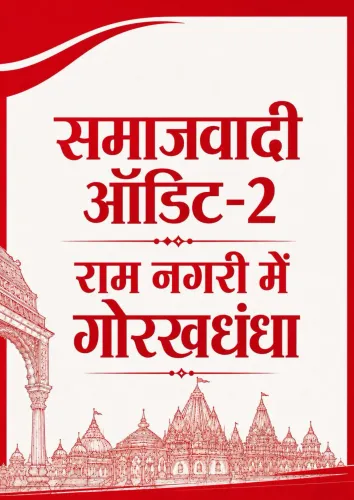
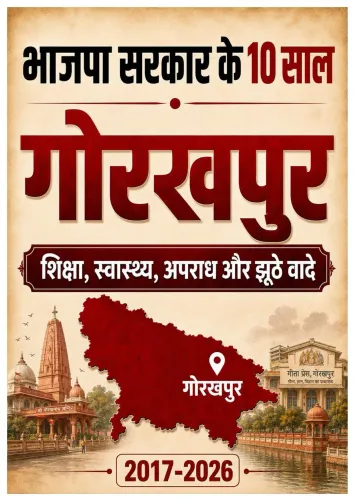
Yadav then zeroed in on a remark about moving directly from a Lok Sabha seat to become Chief Minister. 'The people of Gorakhpur understand this old quarrel,' he wrote — a thinly veiled reference to the long-running tension between Gorakhpur's most prominent BJP figure and the party's central leadership in Delhi. Gorakhpur is the constituency most closely associated with Uttar Pradesh Chief Minister Yogi Adityanath, making the implied target unmistakable to any attentive reader.
'The public of Gorakhpur is watching everything. They are not sitting around with dark glasses on,' Yadav wrote. The dig at selective blindness was deliberate.
Four questions BJP has never answered
The sharpest section of the post was a reprise of four questions Yadav said he had posed before — and which, he noted, have remained unanswered to this day. Translated, they read:
- Is 5 bigger or 7?
- Is the State Assembly bigger or the Lok Sabha?
- Is a state minister bigger or a central minister?
- Is the state president bigger or the national president?
The ticket dare: whose lotus will it be?
Yadav closed with a challenge that was equal parts mockery and ultimatum. Those whose very name is synonymous with 'kamal' (the lotus — also the BJP's election symbol) will find themselves 'longing' for the lotus symbol in internal fights, he said. His demand was concrete: if that is not the case, then the BJP state president, as the highest state party authority, should announce their own ticket first. He signed off with the Sanskrit phrase 'Iti dhvastam!!!' — meaning, roughly, 'thus demolished.'
The rhetorical escalation signals that the Uttar Pradesh pre-poll season has well and truly begun. When the principal opposition leader can list a ruling party's internal fissures in four numbered questions — and dare them to prove him wrong — the pressure is no longer just electoral. It is existential.
Point of View
He localises the damage and invites UP voters to see BJP disunity as their problem, not just a party matter. The four unanswered questions about hierarchy are particularly pointed: they force the BJP either to publicly subordinate the Chief Minister to central authority or to stay silent and confirm the rift. As ticket finalisation looms, that silence could prove the most damaging answer of all.
NationPress
4 Nov 2026
Frequently Asked Questions
What did Akhilesh Yadav say about BJP's Gorakhpur internal fight?
Akhilesh Yadav said the internal BJP battle for dominance in Gorakhpur has now come out into the open in written form, calling it no longer just a Delhi–Lucknow fight but a war within Gorakhpur itself.
Why did Akhilesh Yadav mention 'Ranchhod' in his post?
He alleged a BJP leader used 'Ranchhod' — a reverential name of Lord Krishna — as a political insult, arguing this proved how limited and socially harmful the leader's knowledge is.
What are the four questions Akhilesh Yadav asked about BJP hierarchy?
Yadav asked: Is 5 bigger or 7? Is the state assembly bigger or the Lok Sabha? Is a state minister bigger or a central minister? Is the state president bigger or the national president? — all pointing to contested power centres within the BJP.
Who is Akhilesh Yadav referring to in his Gorakhpur remarks?
While Yadav did not name anyone directly, the references to Gorakhpur, the lotus symbol, and the state presidency are widely read as targeting senior BJP figures associated with that constituency and the party's UP unit.
What does 'Iti dhvastam' mean in Akhilesh Yadav's post?
'Iti dhvastam' is a Sanskrit phrase meaning 'thus demolished' or 'thus destroyed,' which Yadav used as a closing flourish to signal that his argument had conclusively dismantled the BJP leader's position.