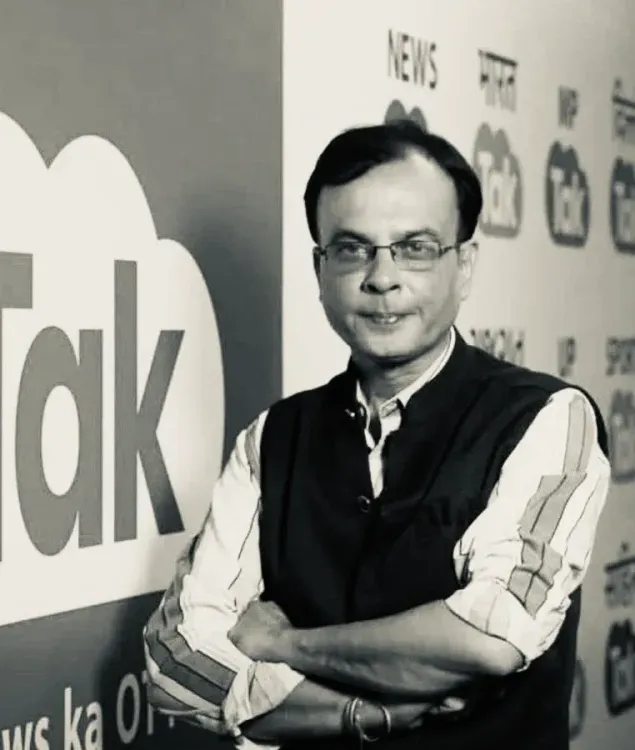
Akhilesh Yadav mourns journalist Amit Tiwari, calls for press welfare
Synopsis
Samajwadi Party president Akhilesh Yadav condoled the sudden death of senior journalist Amit Tiwari on 30 May 2026 and called for formal social security and societal respect for journalists, describing them as indispensable ideological soldiers of democracy.
Key Takeaways
Samajwadi Party president Akhilesh Yadav condoled the sudden death of senior journalist Amit Tiwari on 30 May 2026 .
Yadav described the loss as 'stunning and sorrowful' for journalism and for society.
He argued that untimely deaths of journalists raise urgent questions about the welfare of their dependants.
Yadav called for journalists to be accorded the status of 'ideological soldiers of democracy' with formal social security.
He stressed that financial security for journalists and their families is essential to ensure lifelong, fearless, and impartial reporting.
The post highlights the longstanding absence of a universal welfare framework for working journalists in India .
Samajwadi Party president Akhilesh Yadav on Saturday, 30 May 2026 condoled the sudden death of senior journalist Amit Tiwari, calling it a deeply shocking loss for the world of journalism and for society at large. Yadav used the occasion to make a pointed appeal for institutional social security and dignity for journalists, whom he described as ideological soldiers of democracy.
Context
In his post, Yadav wrote — translated from Hindi — that the 'akasmik nidhan' (sudden passing) of senior journalist Amit Tiwari is 'a stunning, sorrowful piece of news for the world of journalism as well as for all of us.' He offered his condolences and added that untimely death always raises the question of how the responsibilities left behind for dependants will be fulfilled.
Yadav described a working journalist's reality in stark terms: 'A true journalist struggles throughout life for his basic needs and stakes his entire life to protect democracy. He endures every pressure without compromising on his values and principles — but sometimes circumstances overwhelm.' The post does not specify the circumstances or date of Tiwari's death.
Policy Backdrop
Journalists in India, particularly those working for regional, vernacular, and independent outlets, have long operated without robust institutional safety nets. There is no universal national welfare scheme that guarantees health coverage, pension, or family support specifically for working journalists, though some state governments and press bodies operate limited welfare funds.
The demand for formalised social security for journalists has been raised periodically in Parliament and by press freedom organisations. Yadav's post frames this not as a labour issue alone but as a democratic imperative — arguing that journalists can only perform their watchdog role without fear if their livelihoods and families are protected.
Stakeholders and Impact
The immediate stakeholders are working journalists — especially those in smaller towns and regional media — and their families who bear the financial consequences of a journalist's death or incapacitation. Media bodies and journalists' unions have consistently flagged that the absence of social security forces many reporters into financial compromise, which can in turn affect editorial independence.
Yadav's appeal, coming from a prominent Opposition leader and former Uttar Pradesh Chief Minister, lends political weight to the demand. His framing of journalists as 'loktantra ke vaicharik senani' (ideological soldiers of democracy) is an explicit argument for state-backed protection equivalent to that accorded to other public-service roles.
What's Next
The post could prompt responses from journalists' associations, press clubs, and other political leaders. If the issue is taken up in Parliament or in the Uttar Pradesh Legislative Assembly, it could advance debate on a formal welfare framework for media professionals. The broader question Yadav raises — who protects the protectors of democracy — is likely to remain a live issue as long as structural precarity in Indian journalism goes unaddressed.
Point of View
' Yadav positions journalists alongside other protected public-service roles, implicitly challenging the government to legislate formal safeguards. The statement fits a recurring Opposition pattern of using individual tragedies to highlight structural policy gaps, in this case the absence of a national social security net for media professionals. Whether it translates into a legislative push or remains symbolic will depend on whether press bodies and parliamentary allies take it forward.
NationPress
24 Sept 2026
Frequently Asked Questions
Who is Amit Tiwari the journalist?
Amit Tiwari was a senior journalist whose sudden death was mourned by Samajwadi Party president Akhilesh Yadav on 30 May 2026. The specific circumstances of his death were not detailed in Yadav's post.
What did Akhilesh Yadav say about journalist welfare?
Akhilesh Yadav called for journalists to be given the status of 'ideological soldiers of democracy' and demanded formal social security so that they and their families can live with dignity throughout their lives.
Is there a social security scheme for journalists in India?
India does not have a universal national social security scheme for journalists. Some state governments and press bodies run limited welfare funds, but coverage is patchy and there is no comprehensive federal framework.
Why did Akhilesh Yadav post about journalist welfare?
Yadav's post was prompted by the sudden death of senior journalist Amit Tiwari. He used the occasion to highlight the financial precarity faced by journalists and to argue for institutional protections for them and their families.
What is the Samajwadi Party's stance on press freedom?
The Samajwadi Party, led by Akhilesh Yadav, has periodically advocated for press freedom and journalist welfare, framing an independent media as essential to democratic accountability in India.