Akhilesh Yadav Posts Cryptic Verse on Political Cycles
Synopsis
Samajwadi Party president Akhilesh Yadav posted a cryptic Hindi verse on 6 June 2026 invoking the Hindu yuga cycle to warn that no political power is permanent — a thinly veiled message as the 2027 Uttar Pradesh assembly elections approach.
Key Takeaways
Akhilesh Yadav posted a four-line Hindi verse on 6 June 2026 referencing the Hindu cosmic ages of Treta, Dwapara, and Kali Yuga.
The verse's closing lines warn that 'one who has come will not stay' — widely read as a message about political impermanence directed at the ruling establishment.
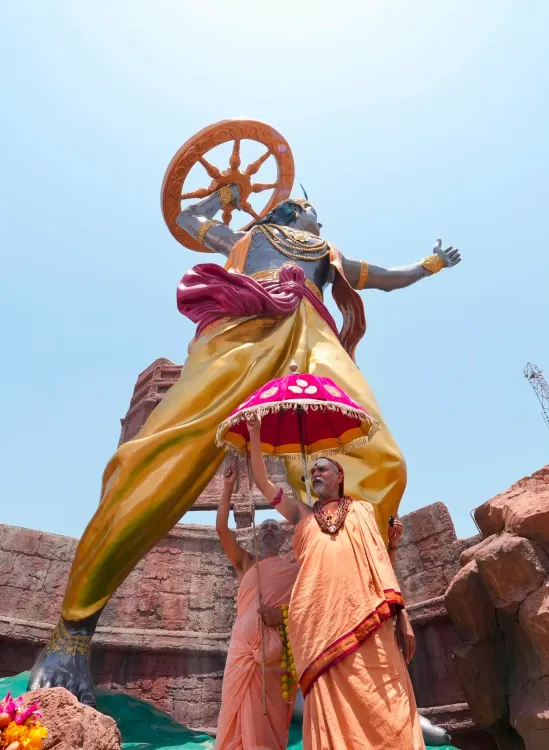
The post was accompanied by 2 images and carried no explicit names, party references, or policy demands.
The Samajwadi Party won 111 seats in the 2022 UP assembly elections , making it the main opposition in the state.
The post comes as political activity intensifies ahead of the 2027 Uttar Pradesh assembly elections .
Samajwadi Party president Akhilesh Yadav posted a four-line Hindi verse on Saturday, 6 June 2026, invoking the Hindu concept of cosmic ages — Treta, Dwapara, and Kali Yuga — in what observers are reading as a pointed political message about the impermanence of power.
Context
The verse, shared with two images, reads: 'त्रेता स्वयं को दोहराएगा / द्वापर भी लौट के आएगा / कलयुग को ये भ्रम रहे न / वो आया है तो न जाएगा' — translated as: 'Treta will repeat itself / Dwapara too shall return / Let Kali Yuga harbour no illusion / That one who has come will not leave.' The final couplet, addressed pointedly to the present age, carries an unmistakable subtext: no political incumbent is permanent.
Akhilesh Yadav has consistently used his social media platforms to frame political narratives through cultural and literary idiom, often bypassing conventional press statements. The post offers no direct name or policy reference, but its timing — with the 2027 Uttar Pradesh assembly elections drawing closer — gives it immediate electoral resonance.
Policy Backdrop
Indian regional leaders have a long tradition of deploying mythological imagery from the Hindu epics and the yuga cycle to signal political transitions. The four yugas — Satya, Treta, Dwapara, and Kali — are understood in popular culture as recurring cosmic epochs, each giving way to the next in an inexorable cycle. By invoking this framework, Yadav draws on a vocabulary deeply familiar to Uttar Pradesh's electorate.
The Samajwadi Party, founded by Mulayam Singh Yadav and rooted in the politics of backward castes and regional identity, won 111 seats in the 2022 Uttar Pradesh assembly elections, consolidating its position as the principal opposition force in the state. The party has since been building alliances and expanding its outreach ahead of the next assembly cycle.
Stakeholders and Impact
The verse is directed at Uttar Pradesh's vast electorate — the state is India's most populous and sends the largest bloc of members to the Lok Sabha, making it a decisive arena in national politics. For SP supporters, the imagery reinforces a narrative of inevitable political change and the return of their party to power.
Opposition parties watching alliance dynamics in UP will parse the post as a signal of Akhilesh Yadav's confidence and intent. The ruling establishment, though unnamed in the verse, is the implied audience of the warning embedded in the final lines.
What's Next
All eyes remain on opposition alliance negotiations and candidate announcements as the 2027 Uttar Pradesh assembly election campaign takes shape. Yadav's use of mythological metaphor suggests the Samajwadi Party intends to frame the coming contest as a historic turning point — a yuga shift — rather than a routine electoral cycle. Whether this poetic salvo translates into organisational momentum will be tested in the months ahead.
Point of View
He positions the Samajwadi Party not merely as an electoral challenger but as an agent of inevitable historical correction. This kind of cultural coding has deep roots in UP's political tradition and tends to resonate more powerfully at the grassroots than policy pronouncements. The post is best understood as an early salvo in what is shaping up to be a high-stakes 2027 campaign narrative.
NationPress
21 Oct 2026
Frequently Asked Questions
What did Akhilesh Yadav post on 6 June 2026?
Akhilesh Yadav posted a four-line Hindi verse invoking the Hindu yuga cycle — Treta, Dwapara, and Kali Yuga — suggesting that no political power lasts forever, in what is widely read as a message ahead of the 2027 Uttar Pradesh elections.
What does the Hindi verse posted by Akhilesh Yadav mean?
The verse translates roughly as: 'Treta will repeat itself, Dwapara too shall return, let Kali Yuga harbour no illusion that one who has come will not leave' — a poetic warning about the impermanence of political incumbency.
Is Akhilesh Yadav referring to the 2027 UP elections?
No direct reference to the 2027 Uttar Pradesh elections was made in the post, but the timing and language are widely interpreted as a signal of the Samajwadi Party's political intent ahead of that contest.
How many seats did Samajwadi Party win in the 2022 UP elections?
The Samajwadi Party won 111 seats in the 2022 Uttar Pradesh assembly elections, establishing itself as the principal opposition party in the state.
Why does Akhilesh Yadav use poetry and mythology in political posts?
Akhilesh Yadav has a well-established pattern of using cultural, literary, and mythological imagery on social media to communicate political messages in a form that resonates deeply with UP's electorate and allows broad interpretation.