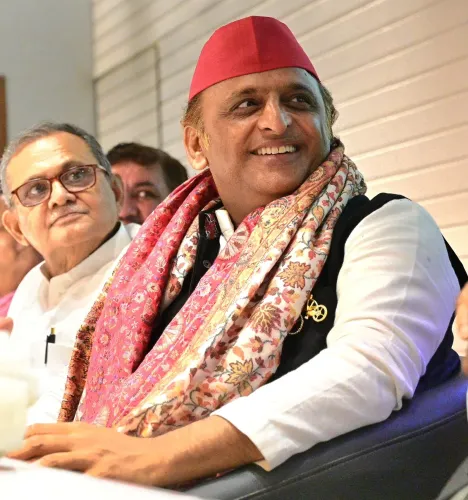
Akhilesh Yadav marks Constitution Pillar Day, vows social justice rule
Synopsis
Samajwadi Party president Akhilesh Yadav on 26 July 2026 observed 'Constitution Pillar Establishment Day', pledging to defend secularism, socialism, and the rights of farmers, labourers, women, and youth, while reiterating the party's resolve to build a fraternal, socially just nation.
Key Takeaways
Akhilesh Yadav and Samajwadi Party members observed Samvidhan-Manastambh Sthapna Diwas on 26 July 2026 .
The gathering took a collective vow to protect the Constitution, democracy, secularism, and socialist principles .
The pledge explicitly covers PDA communities, farmers, labourers, businesspersons, women, and youth .
Yadav reiterated the party's resolve to establish 'samajik nyay ka raj' (rule of social justice) in governance.
The concept of 'Bandhu Rashtra' (fraternal nation) was foregrounded as a guiding ideal for the party's political vision.
The Samajwadi Party , founded in 1992 , has historically anchored its identity in the same constitutional values of socialism and secularism cited in the post.
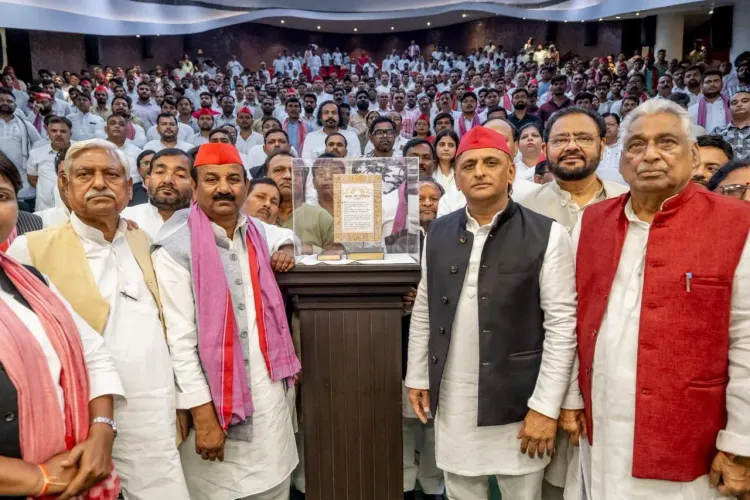
Samajwadi Party president Akhilesh Yadav on Sunday, 26 July 2026, joined party members across Uttar Pradesh in observing what he called 'Samvidhan-Manastambh Sthapna Diwas' (Constitution Pillar Establishment Day), reaffirming the party's pledge to defend constitutional values and deliver social justice.
What was said
Posting on X with three photographs from the occasion, Yadav wrote that participants collectively took a vow to protect the Constitution, democracy, secularism, and socialist principles. In his words, the gathering pledged to 'ensure the rights and entitlements of every PDA member, farmer, labourer, businessperson, woman, and youth' and reiterated the resolve to bring about 'samajik nyay ka raj' — a rule of social justice — and build a 'Bandhu Rashtra', a fraternal nation.
The post was written in Hindi and shared in the mid-afternoon, suggesting the event had concluded by that point. No specific venue was named in the post.
Context
The Samajwadi Party was founded in 1992 by Mulayam Singh Yadav with socialism, secularism, and social justice as its foundational pillars. These three values mirror the words inserted into the Preamble of the Indian Constitution by the 42nd Constitutional Amendment of 1976, making the party's ideological self-identification closely tied to constitutional language.
Akhilesh Yadav served as Chief Minister of Uttar Pradesh from 2012 to 2017, during which the party implemented welfare programmes targeting farmers, women, youth, and minority communities. As Lok Sabha MP and national party president, he has continued to use constitutional symbolism as a central plank of the party's public messaging.
Policy backdrop
Opposition parties across India have periodically held public events to reassert commitment to the constitutional values of secularism, socialism, and social justice, particularly amid national debates over the direction of governance. The Samajwadi Party has consistently positioned itself as a guardian of these principles in Uttar Pradesh, the country's most populous state and a critical electoral battleground.
The reference to 'PDA' — a term the Samajwadi Party has used in recent political cycles to describe a coalition of backward classes, Dalits, and minorities — signals the party's continued effort to consolidate a broad, multi-community voter base. The phrase 'Bandhu Rashtra' (fraternal nation) appears to articulate a vision of inter-community solidarity, though its precise policy content was not elaborated in the post.
Stakeholders and impact
The groups explicitly named in Yadav's pledge — farmers, labourers, businesspersons, women, and youth — together constitute a sweeping cross-section of Uttar Pradesh's population of over 24 crore. The deliberate breadth of the list reflects the party's strategy of expanding beyond its traditional base while retaining its core socialist identity.
For PDA communities in particular, such public reaffirmations serve as visible markers of political commitment ahead of electoral cycles. Civil society groups focused on constitutional rights and social equity are also likely to take note of the party's renewed emphasis on fraternity as a governing ideal.
What's next
The Samajwadi Party's next steps — including alliance announcements, public programmes, and campaign outreach in Uttar Pradesh — will indicate how this ideological reaffirmation translates into concrete political action. If the party formalises 'Bandhu Rashtra' as a campaign theme, it could signal a new phase in its messaging strategy ahead of the next assembly or parliamentary cycle.
Point of View
Using constitutional symbolism to differentiate the Samajwadi Party from rivals in a crowded opposition landscape. The explicit enumeration of farmers, labourers, women, youth, and PDA communities in a single pledge is a textbook coalition-broadening move, aimed at projecting the party as a pan-social-justice force rather than a narrow caste vehicle. The introduction of 'Bandhu Rashtra' as a framing concept suggests the party is road-testing new vocabulary to articulate its governance alternative. Taken together, these signals point to a party in active pre-electoral mode, seeking to sharpen its ideological contrast ahead of the next major electoral contest in Uttar Pradesh.
NationPress
26 Jul 2026
Frequently Asked Questions
What is Samvidhan-Manastambh Sthapna Diwas?
It is an occasion observed by the Samajwadi Party to reaffirm commitment to the Indian Constitution and its core values of democracy, secularism, and social justice. Akhilesh Yadav marked it on 26 July 2026 with party members.
What did Akhilesh Yadav say on Constitution Pillar Day 2026?
Akhilesh Yadav said participants vowed to protect the Constitution, democracy, secularism, and socialist principles, and to ensure the rights of PDA communities, farmers, labourers, businesspersons, women, and youth, while committing to build a 'Bandhu Rashtra'.
What does 'Bandhu Rashtra' mean in Samajwadi Party politics?
'Bandhu Rashtra' translates roughly as 'fraternal nation' and appears to represent the Samajwadi Party's vision of a society built on inter-community solidarity and mutual respect, though its detailed policy content has not yet been formally elaborated.
Who are the PDA communities Akhilesh Yadav refers to?
The Samajwadi Party has used 'PDA' in recent political discourse to refer to a coalition of backward classes, Dalits, and minorities — communities the party has historically sought to represent and mobilise in Uttar Pradesh.
What is the Samajwadi Party's founding ideology?
The Samajwadi Party was founded in 1992 by Mulayam Singh Yadav on the pillars of socialism, secularism, and social justice — values that mirror the language of the Indian Constitution's Preamble and remain central to the party's identity under Akhilesh Yadav.