Akhilesh Yadav questions UP's trillion-dollar dream amid Re 1/kg potato prices
Synopsis
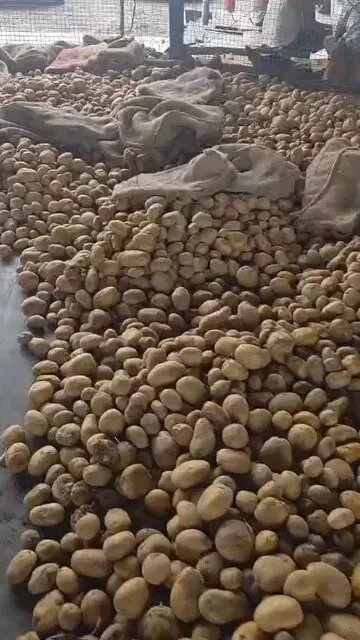
Samajwadi Party president Akhilesh Yadav on August 11, 2026 questioned how Uttar Pradesh can achieve a trillion-dollar economy when potato farmers are reportedly receiving just Re 1 per kilogram, targeting CM Yogi Adityanath in a pointed Hindi post on X.
Key Takeaways
Akhilesh Yadav posted on August 11, 2026 questioning UP's trillion-dollar economy target against a reported potato price of Re 1 per kilogram .
He coined the phrase 'डील की ढील' ('the slack in the deal') to describe the gap between government promises and farmer reality.
Uttar Pradesh is one of India's largest potato-producing states and the Yogi Adityanath government has publicly championed a one-trillion-dollar state economy goal.
Farm-gate price crashes for perishables like potatoes during surplus seasons are a recurring crisis for small and marginal growers in UP.
The Samajwadi Party has made agricultural distress a central plank of its opposition to the BJP-led state government.
No state government response or procurement announcement had been made at the time of posting.
When a farmer sells his potato crop for Re 1 a kilogram, what does a trillion-dollar economy actually mean to him? That is the pointed question Samajwadi Party president Akhilesh Yadav put to Uttar Pradesh Chief Minister Yogi Adityanath on Tuesday, August 11, 2026, in a sharp social-media broadside that cut straight to the contradiction at the heart of the state's growth ambitions.
Posting in Hindi, Yadav wrote: 'क्या किसान को 1 रुपये किलो आलू की क़ीमत देने से बनेगी 1 ट्रिलियन डॉलर की इकोनॉमी' — 'Can a trillion-dollar economy be built by giving the farmer just Re 1 per kilogram for his potatoes?' He labelled the situation 'डील की ढील' — roughly, 'the slack in the deal' — and closed with a sardonic 'Wah re Mukhyamantri ji!' ('Bravo, Chief Minister!'), a staple of opposition rhetoric that lands like a slow clap.
UP's trillion-dollar target meets the potato belt's reality
Uttar Pradesh is India's most populous state and one of its largest potato-producing regions. The Yogi Adityanath government has made the one-trillion-dollar state economy target a flagship aspiration, frequently cited in budget speeches and investor summits. The gap between that macro ambition and the micro reality of farm-gate prices for perishables — potatoes especially — has become a recurring fault line in UP politics. During surplus seasons, potato prices at the mandi level have historically crashed well below the cost of cultivation, leaving small and marginal farmers unable to recover even their input costs. When that floor collapses to Re 1 per kilogram, the arithmetic of prosperity becomes impossible for the grower to square with government headline numbers.SP vs BJP: the agricultural distress argument
Yadav's post is part of a well-established pattern in Samajwadi Party opposition strategy: seize on a concrete, relatable price figure — not an abstract policy failure — and hold it against the ruling BJP's grandest promise. A single number, Re 1 per kg, does more political work than any white paper. It forces the question: who exactly is the trillion-dollar economy being built for? The state government has not yet responded publicly to this specific charge. Eyes will now turn to whether Lucknow announces any procurement support or compensation mechanism for potato growers ahead of the next rabi season — a move that would signal the criticism has drawn political blood. For UP's farmers, the wait for an answer is not academic. It is the difference between a season survived and a season lost.Point of View
Gut-punch number that every rural voter can feel. The Re 1 per kg figure, if it holds up, is devastating precisely because the trillion-dollar aspiration is so large — the contrast does the argument for him. For the BJP, the vulnerability is structural: high-growth narratives always leave a flank open when commodity prices collapse, and UP's potato belt is a bellwether constituency. The real test is whether this sparks a procurement response from Lucknow or remains a rhetorical exchange — the former would confirm the political pressure landed.
NationPress
11 Aug 2026
Frequently Asked Questions
Why is Akhilesh Yadav criticising Yogi Adityanath over potato prices?
Akhilesh Yadav is pointing out the contradiction between the UP government's trillion-dollar economy target and reports of farmers receiving as little as Re 1 per kilogram for their potatoes, arguing that such farm-gate prices expose the hollowness of the growth claim.
What is UP's trillion-dollar economy target?
The Yogi Adityanath government in Uttar Pradesh has set a goal of making the state a one-trillion-dollar economy, a target it has cited in budget documents and investor summits as a long-term development benchmark.
What does 'Deal ki Dhil' mean in Akhilesh Yadav's post?
'डील की ढील' roughly translates to 'the slack in the deal' or 'the loosening of the deal' — Yadav used the phrase to suggest that the government's promises to farmers and investors are not being kept, leaving a dangerous gap between rhetoric and reality.
How bad can potato prices get for UP farmers during a surplus?
During periods of surplus production, potato prices at UP mandis have historically fallen well below the cost of cultivation. A price of Re 1 per kilogram means farmers cannot recover seed, fertiliser, or labour costs, making the season a net loss.
What could the UP government do to address potato price crashes?
State governments typically respond to farm-gate price collapses through procurement at minimum support prices, cold-storage subsidies, or direct compensation schemes. Any such announcement from Lucknow ahead of the rabi season would be a direct response to this political pressure.