MP CM Office Highlights State's Wildlife Conservation Lead

Synopsis
The Chief Minister's Office of Madhya Pradesh celebrated the state's biodiversity and conservation record, reinforcing its standing as India's leading tiger state with 785 tigers counted in the 2022 national estimation — the highest of any state.
Key Takeaways
The Chief Minister's Office of Madhya Pradesh posted on August 11, 2026 , celebrating the state's wildlife conservation leadership.
The 2022 All India Tiger Estimation recorded 785 tigers in Madhya Pradesh — the highest count of any Indian state.
This represents a rise from 526 tigers in 2018 , a near 49 per cent increase over four years.
Key reserves include Kanha , Bandhavgarh , and Panna , all part of the national Project Tiger framework.
Mohan Yadav and the state's forest and environment departments were tagged in the post.
The next national tiger estimation cycle will determine whether the state's count continues to climb.
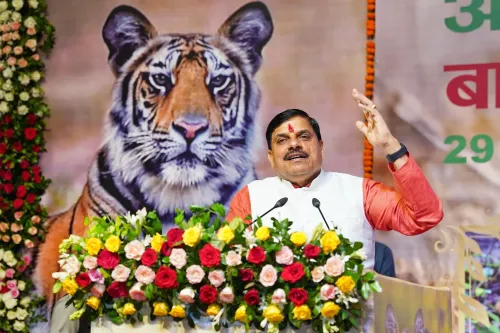
India's tiger capital is making its presence felt again. The Chief Minister's Office of Madhya Pradesh, on Tuesday, August 11, 2026, posted a message celebrating the state's rich biodiversity and positioning Madhya Pradesh as the nation's emerging benchmark for wildlife conservation — tagging Chief Minister Dr. Mohan Yadav and the state's forest and environment departments.
The post, in Hindi, declared: 'Vanya vaibhav, samridh jaiv vividhata aur sashakt sanrakshan' — 'Forest splendour, rich biodiversity, and empowered conservation' — describing Madhya Pradesh as forging a new identity in wildlife protection across the country.
Why 'Tiger State' Is Not Just a Tagline
The claim carries hard numbers behind it. The 2022 All India Tiger Estimation recorded 785 tigers in Madhya Pradesh — the highest count of any state in India and a sharp jump from 526 tigers in 2018. That figure is not a rounding error; it is a 49 per cent increase in four years, and it placed the state firmly ahead of every other tiger-bearing state in the country.
The reserves driving that count are household names in conservation circles: Kanha, Bandhavgarh, and Panna — each a pillar of India's broader Project Tiger framework, the Government of India's flagship programme launched in 1973 that transformed the country's approach to apex-predator protection.
Conservation as Policy, Not Just Pride
For the state government, wildlife numbers serve a dual purpose. A thriving tiger population anchors eco-tourism revenue, drawing visitors to forest lodges and safari circuits that support local livelihoods for forest officials, guides, and hospitality operators. It also keeps Madhya Pradesh aligned with India's national biodiversity commitments — commitments that carry weight in international forums and domestic policy reviews alike.
The broader pattern is consistent: successive tiger censuses have shown Madhya Pradesh holding the top position, and the state's public messaging has tracked those results closely. This post continues that established rhythm — a reminder, to both citizens and policymakers, that the conservation infrastructure built over decades is still producing results.
The next national tiger estimation cycle will be the real test of whether 785 becomes a floor or a ceiling for the state's tiger population. Until those numbers land, Madhya Pradesh is content to let the record speak.
Point of View
The state is pre-emptively reinforcing its leadership narrative ahead of what could be a politically significant data release. The messaging also aligns with India's broader push to project biodiversity gains at multilateral forums, giving the state government a national and international hook beyond domestic optics. Whether the numbers hold or improve will determine how durable this conservation brand proves to be.
NationPress
11 Aug 2026
Frequently Asked Questions
Which state has the most tigers in India?
Madhya Pradesh has the highest tiger population of any Indian state, with 785 tigers recorded in the 2022 All India Tiger Estimation , up from 526 in 2018.
Which tiger reserves are in Madhya Pradesh?
Madhya Pradesh is home to several major tiger reserves including Kanha , Bandhavgarh , and Panna , all operating under the national Project Tiger framework.
What is Project Tiger in India?
Project Tiger is the Government of India's flagship tiger conservation programme, launched in 1973 , designed to protect tiger habitats and grow the national tiger population.
Who is the Chief Minister of Madhya Pradesh?
Dr. Mohan Yadav has been the Chief Minister of Madhya Pradesh since December 2023 and oversees the state's forest and environment departments.
When is the next tiger census in India?
The exact date of the next national tiger estimation cycle has not been officially announced; the previous census was conducted in 2022 , with results typically released on a four-year cycle.