Amit Shah: Bengal Will Again Be India's Cultural Heart
Synopsis
Union Home Minister Amit Shah posted a bilingual Hindi-Bengali message on July 19, 2026, declaring that West Bengal will once again become a central pillar of India's cultural consciousness. The post invokes the legacy of the Bengal Renaissance and signals the BJP's deepening cultural and political outreach in eastern India.
Key Takeaways
Union Home Minister Amit Shah posted on July 19, 2026 , declaring West Bengal will again be a foremost centre of India's cultural consciousness.
The message was written in both Hindi and Bengali , signalling outreach to multiple linguistic audiences simultaneously.
The post invokes the legacy of the 19th-century Bengal Renaissance , which produced figures such as Rabindranath Tagore and shaped modern Indian identity.
The BJP-led central government has promoted regional cultural heritage since 2014 through schemes including PRASAD and Swadesh Darshan .
West Bengal assembly elections are due in 2026 , lending political weight to the timing of the cultural messaging.
No specific event or policy announcement was attached to the post; follow-up actions from the Ministry of Culture will be closely watched.
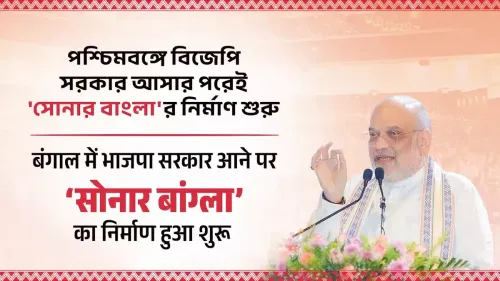
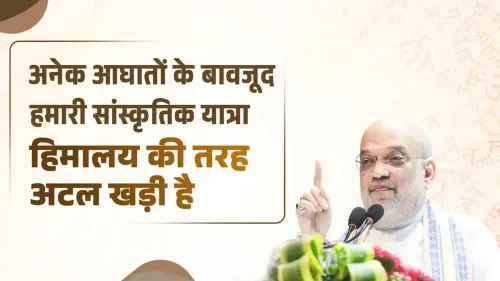
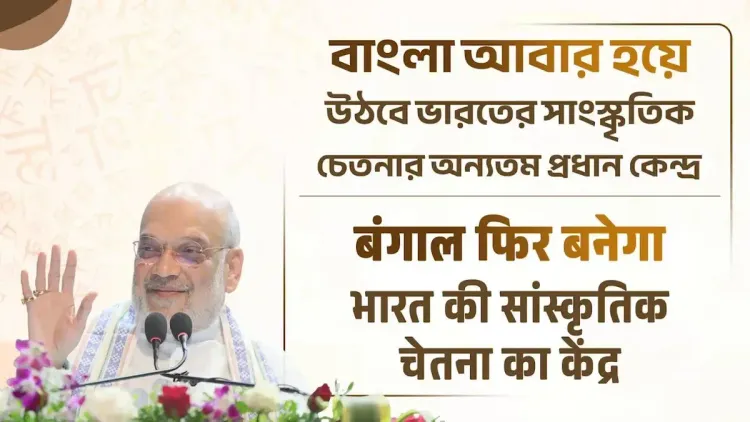
Union Home Minister Amit Shah on Sunday, July 19, 2026, declared that West Bengal will once again become a central pillar of India's cultural consciousness, posting a bilingual message in Hindi and Bengali on X that signals renewed BJP focus on the state's civilisational heritage.
Shah's post read, in Hindi: 'Bengal phir banega Bharat ki sanskritik chetna ka kendra' ('Bengal will again become the centre of India's cultural consciousness'), mirrored in Bengali: 'Bangla abar hoye uthbe Bharater sanskritik chetanar anyatam pradhan kendra' ('Bengal will again become one of the foremost centres of India's cultural consciousness').
Context
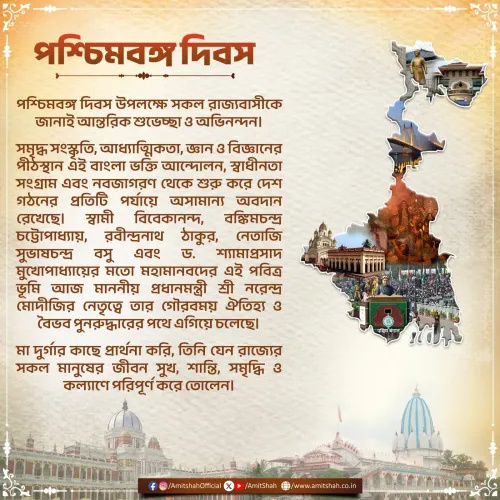
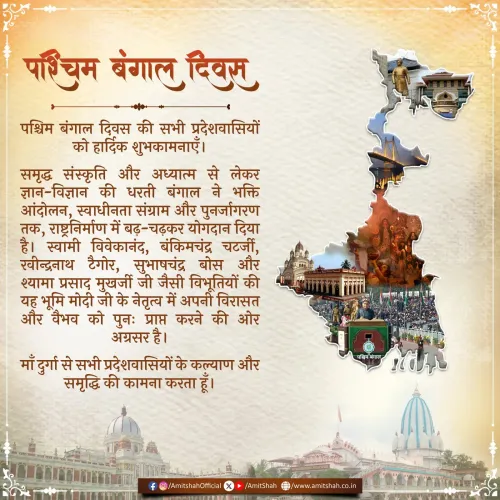
West Bengal occupies a singular place in Indian cultural history. The 19th-century Bengal Renaissance — an intellectual and artistic awakening that produced towering figures such as Rabindranath Tagore — fundamentally shaped modern Indian identity, literature, and anti-colonial thought. Shah's bilingual post, addressed simultaneously to Hindi and Bengali-speaking audiences, invokes that legacy directly.
The choice to write in both languages is itself a political and cultural gesture, signalling outreach to the Bengali-speaking population both within West Bengal and across the country's broader Hindi-speaking belt.
Policy Backdrop
Since 2014, the BJP-led central government has promoted regional cultural heritage through schemes such as PRASAD (Pilgrimage Rejuvenation and Spiritual, Heritage Augmentation Drive) and Swadesh Darshan, which channel funds toward pilgrimage circuits and historically significant sites. West Bengal hosts several sites eligible under these frameworks, including locations tied to Tagore, Ramakrishna Paramahamsa, and Swami Vivekananda.
The Ministry of Culture has in recent years also supported festivals, literary events, and restoration projects in eastern India as part of a broader push to highlight the region's contributions to Indian civilisation.
Stakeholders and Impact
Bengali cultural organisations, literary bodies, and heritage trusts stand to gain visibility — and potentially funding — if Shah's statement is followed by concrete policy announcements. West Bengal's 10 crore-plus residents, many of whom carry a strong attachment to the state's distinct cultural identity, are the primary audience for this message.
The post also resonates with the Bengali diaspora across Assam, Tripura, and urban centres such as Delhi and Mumbai. For the BJP, deepening cultural affinity with Bengali-speaking voters is a strategic priority as the party seeks to consolidate its presence in eastern India.
What's Next
West Bengal assembly elections are due in 2026, making the political timing of such cultural messaging significant. Observers will watch for follow-up announcements from the Ministry of Culture or the Ministry of Home Affairs — such as new heritage corridors, cultural festivals, or funding allocations — that could give institutional weight to Shah's declaration.
If the statement is backed by policy action, it could reshape the BJP's cultural narrative in a state where the ruling Trinamool Congress has long positioned itself as the custodian of Bengali identity. The coming months will reveal whether Sunday's post marks the opening of a sustained cultural campaign or remains a standalone expression of intent.
Point of View
He simultaneously addresses the party's national base and the Bengali-speaking electorate the BJP is actively courting. The invocation of the Bengal Renaissance is deliberate: it positions the BJP as a steward of Bengal's own intellectual and artistic legacy, a space the Trinamool Congress has long claimed as its own. This fits a broader BJP pattern of using civilisational and regional cultural narratives as electoral groundwork, particularly in states with strong linguistic identities. Whether the statement translates into tangible cultural policy will determine its lasting impact beyond the news cycle.
NationPress
20 Jul 2026
Frequently Asked Questions
What did Amit Shah say about Bengal's culture?
Amit Shah posted on July 19, 2026, that West Bengal will again become one of the foremost centres of India's cultural consciousness, writing the message in both Hindi and Bengali.
Why did Amit Shah write in Bengali on X?
Writing in Bengali alongside Hindi signals direct outreach to Bengali-speaking voters in West Bengal and across India, a key constituency the BJP is seeking to deepen ties with ahead of state elections.
What is the Bengal Renaissance that Shah's post alludes to?
The Bengal Renaissance was a 19th- and early 20th-century intellectual and cultural awakening centred in Bengal, associated with figures such as Rabindranath Tagore, Ramakrishna Paramahamsa, and Swami Vivekananda, which profoundly shaped modern Indian identity.
What BJP cultural schemes are relevant to West Bengal?
The central government's PRASAD and Swadesh Darshan schemes fund pilgrimage circuits and heritage sites; West Bengal hosts several locations linked to figures of the Bengal Renaissance that are eligible under these frameworks.
When are West Bengal assembly elections due?
West Bengal assembly elections are due in 2026, making Amit Shah's cultural messaging on July 19, 2026, politically significant in its timing.