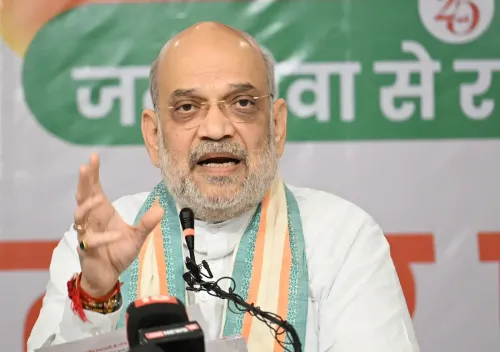
Amit Shah: Indian Culture Stands Firm Like the Himalayas

Synopsis
Union Home Minister Amit Shah declared on X that Indian culture has never been narrow and has embraced innovation, standing resilient through centuries of adversity like the Himalayas. The post reflects a pattern of civilisational messaging by senior BJP leaders on social media.
Key Takeaways
Union Home Minister Amit Shah posted on X on 19 July 2026 in Hindi, asserting the enduring resilience of Indian culture.
Shah stated that Indian culture 'has never been narrow-minded' and has always welcomed innovation and good endeavours.
He compared India's cultural journey to the Himalayas — unwavering despite numerous historical assaults.
The post fits a broader pattern of civilisational messaging by senior BJP leaders on social media platforms.
No specific policy announcement or scheme was attached to the statement; possible follow-up from the Ministry of Culture remains to be seen.
Union Home Minister Amit Shah on Sunday, 19 July 2026, invoked the enduring resilience of Indian civilisation, asserting that the country's cultural journey has remained unshaken through centuries of adversity — much like the Himalayas.
What Shah Said
Posting in Hindi on X, Shah wrote: 'भारतीय संस्कृति कभी संकुचित नहीं रही।' ('Indian culture has never been narrow-minded.')
He added that India has never shied away from innovation and has embraced every good endeavour — and that is precisely why, despite numerous assaults, the country's cultural journey stands unwavering, like the Himalayas.
Context
The post reflects a strand of civilisational messaging that BJP leaders have periodically advanced, framing Indian culture as simultaneously adaptive and continuous. Senior ministers have used social media platforms to articulate this view, often without tying it to a specific policy announcement.
Shah's framing emphasises two qualities: openness to innovation and the capacity to absorb external shocks without losing core identity. The Himalayan metaphor — immovable yet ancient — is a recurring motif in Indian cultural and political rhetoric.
Policy Backdrop
Cultural self-assertion by senior government figures often runs parallel to broader initiatives in heritage preservation, language promotion, and the revival of traditional arts. The Ministry of Culture has in recent years expanded programmes aimed at documenting intangible heritage and promoting classical knowledge systems.
Statements of this nature from senior ministers can signal intent ahead of formal announcements, though Shah's post carries no explicit reference to legislation, funding, or a specific scheme.
Stakeholders and Impact
The message is directed broadly at Indian citizens and resonates particularly with heritage groups, scholars of civilisational studies, and cultural organisations that have long argued for a confident, non-defensive articulation of India's historical identity.
For civil-society groups engaged in cultural preservation, such high-level affirmations can lend visibility to their work and, at times, precede policy or budgetary attention to the sector.
What's Next
Observers will watch for follow-up statements from the Ministry of Culture or allied state-level heritage bodies that may translate this civilisational framing into concrete programmes. Whether the post marks the opening of a broader public campaign around cultural identity — or stands as a standalone reflection — will become clearer in the days ahead.
Point of View
Shah anchors cultural continuity in geography — a rhetorical move that naturalises resilience and sidesteps political contestation. Such messaging, issued without a policy hook, typically functions as ambient ideological signalling, keeping a cultural-nationalist frame active in public discourse between major announcements. Whether it precedes a concrete cultural initiative will be the telling indicator.
NationPress
19 Oct 2026
Frequently Asked Questions
What did Amit Shah say about Indian culture on X?
Amit Shah posted on X on 19 July 2026 saying that Indian culture has never been narrow-minded, has always embraced innovation and good endeavours, and has remained unwavering like the Himalayas despite historical adversities.
What does the Himalayan metaphor mean in Amit Shah's post?
Shah used the Himalayas as a symbol of immovable, ancient strength to describe how Indian culture has stood firm through centuries of external shocks and challenges without losing its core identity.
Is Amit Shah's post linked to a specific policy or scheme?
No specific policy, legislation, or government scheme was mentioned in the post. It is a statement of cultural philosophy, and any follow-up action from the Ministry of Culture remains to be announced.
Why do BJP leaders frequently speak about Indian civilisational resilience?
BJP leaders have periodically framed Indian culture as adaptive yet continuous, a narrative that emphasises civilisational strength and cultural self-confidence. Such messaging forms part of a broader ideological position the party has maintained over several years.
What language did Amit Shah use in this post?
Amit Shah wrote the post entirely in Hindi on X, describing India's cultural journey using the metaphor of the Himalayas to signify enduring resilience.