Amit Shah: Cabinet clears ₹3,907 cr rail projects for Odisha, Jharkhand
Synopsis
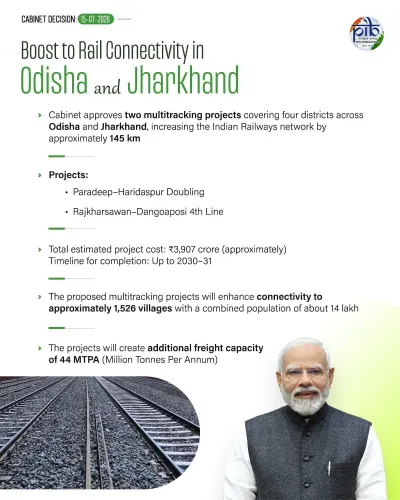
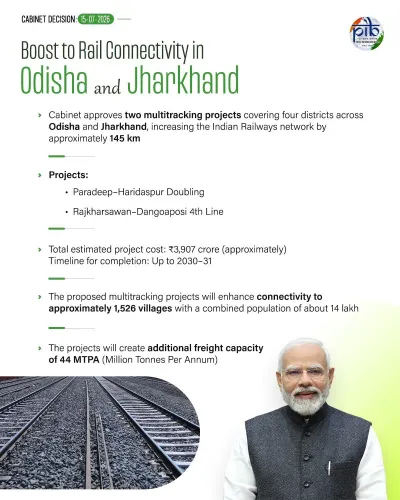
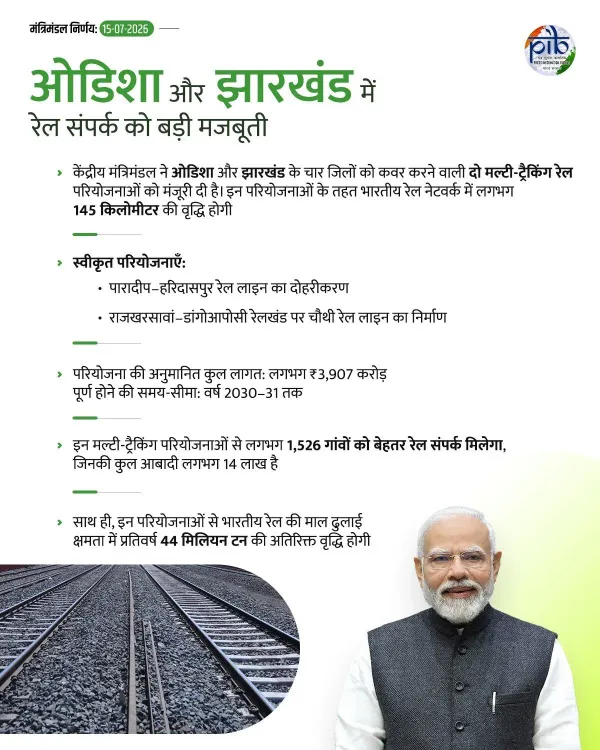
The Union Cabinet cleared two multi-tracking railway projects worth ₹3,907 crore in Odisha and Jharkhand on 15 July 2026. The projects add 145 km of track, connect 1,526 villages and 14 lakh people, and add 44 million tonnes of annual freight capacity, boosting industry, trade, and port logistics in eastern India.
Key Takeaways
The Union Cabinet approved two multi-tracking rail projects on 15 July 2026 covering Odisha and Jharkhand .
Combined project cost is ₹3,907 crore , adding approximately 145 km to the national rail network.
1,526 villages and around 14 lakh people will gain improved rail connectivity.
Annual freight-handling capacity will increase by 44 million tonnes , benefiting mining, industry, and port logistics.
Approvals align with the National Rail Plan 2030 and the PM Gati Shakti integrated infrastructure framework.
Detailed project reports and tender schedules from the Ministry of Railways are expected in the coming months.
Union Home Minister Amit Shah on Wednesday, 15 July 2026, announced that the Union Cabinet approved two multi-tracking railway projects worth ₹3,907 crore covering Odisha and Jharkhand, adding approximately 145 kilometres to the national rail network.
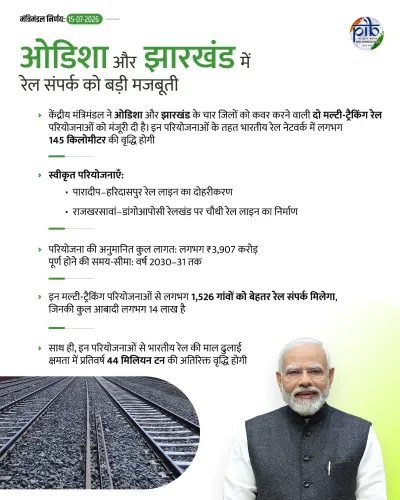
Posting on X, Shah stated that the projects would provide improved rail connectivity to 1,526 villages and around 14 lakh people, while also boosting annual freight-handling capacity by 44 million tonnes. In his words: 'इन परियोजनाओं से 1,526 गांवों और करीब 14 लाख लोगों को बेहतर रेल संपर्क मिलेगा' ('These projects will provide better rail connectivity to 1,526 villages and around 14 lakh people').
Context
Both Odisha and Jharkhand are mineral-rich eastern states whose economies hinge on the efficient movement of coal, iron ore, and other raw materials to ports and industrial centres. Rail infrastructure in these states has historically struggled to keep pace with freight demand, creating bottlenecks that raise logistics costs for industries and delay shipments to coastal ports.
Multi-tracking — adding parallel rail lines alongside existing tracks — is the standard remedy for such congestion, enabling simultaneous passenger and freight movement without mutual delay. The two projects approved on 15 July 2026 extend this approach across a combined stretch of roughly 145 km.
Policy Backdrop
The approvals align with the National Rail Plan 2030, which targets a near-doubling of track length and aims to raise rail's share of total freight movement to 45 per cent by expanding multi-tracking in mineral and port corridors. The plan, released in 2021, identified eastern India as a priority zone given its concentration of mines and the need to link them cost-effectively to ports.
The PM Gati Shakti national master plan, also launched in 2021, provides the integrated multimodal planning framework under which such rail projects are coordinated with road, port, and industrial infrastructure. Cabinet-level clearances of this kind have become a recurring feature of the government's capital expenditure push for Indian Railways, which has received record budgetary allocations across successive years.
Stakeholders and Impact
For the 1,526 villages in the project corridors, improved connectivity translates into faster access to markets, hospitals, and educational institutions — a social-inclusion dividend that policymakers have consistently highlighted alongside the freight argument. Rural communities in Odisha and Jharkhand that currently depend on road transport for inter-district movement stand to benefit most directly.
On the commercial side, mining companies, steel producers, and port logistics operators will gain from the additional 44 million tonnes of annual freight capacity. Port-based transport in particular — moving bulk cargo from inland mineral belts to coastal export terminals — is expected to become faster and cheaper, potentially improving the competitiveness of Indian mineral exports.
What's Next
The Ministry of Railways is expected to release detailed project reports and tender schedules in the coming months, initiating land acquisition and civil-works contracting in both states. Parliamentary committees that oversee railway infrastructure are likely to track implementation progress, including land-acquisition timelines, during the next legislative session.
With eastern India increasingly central to the government's industrial and logistics strategy, these approvals signal continued prioritisation of rail capacity in states that supply raw materials to the broader economy — a pattern that is unlikely to slow as freight demand from the region keeps rising.
Point of View
Where freight bottlenecks have long constrained the mineral and industrial economy of states like Odisha and Jharkhand. By framing the announcement around village connectivity alongside freight tonnage, the government signals a dual mandate — social inclusion and logistics efficiency — that has defined its railway investment narrative since the mid-2010s. The scale of the clearance, nearly ₹4,000 crore in a single cabinet sitting, reflects the accelerated pace of infrastructure decision-making under the PM Gati Shakti framework. Whether project execution matches the pace of approvals will depend on land acquisition and state-level coordination, the perennial chokepoints in eastern-corridor rail expansion.
NationPress
15 Jul 2026
Frequently Asked Questions
What did the Union Cabinet approve for Odisha and Jharkhand railways?
The Union Cabinet approved two multi-tracking railway projects worth ₹3,907 crore in Odisha and Jharkhand on 15 July 2026, adding around 145 km of new rail track to the network.
How many villages will benefit from the new rail projects in Odisha and Jharkhand?
Around 1,526 villages and approximately 14 lakh people are expected to receive improved rail connectivity from the two approved multi-tracking projects.
What is multi-tracking in Indian Railways?
Multi-tracking refers to the addition of extra parallel rail lines alongside existing tracks, allowing freight and passenger trains to run simultaneously without congestion, thereby increasing overall network capacity.
How much additional freight capacity will the new rail projects add?
The two projects are projected to add 44 million tonnes of additional annual freight-handling capacity, benefiting mining companies, steel producers, and port logistics operators.
What is PM Gati Shakti and how does it relate to these rail projects?
PM Gati Shakti is a national master plan launched in 2021 for integrated multimodal infrastructure planning; the newly approved rail projects in Odisha and Jharkhand fall within its framework of coordinating rail, road, and port development in eastern India.