Amit Shah calls Ajit Pawar an 'Encyclopedia' of cooperatives
Synopsis
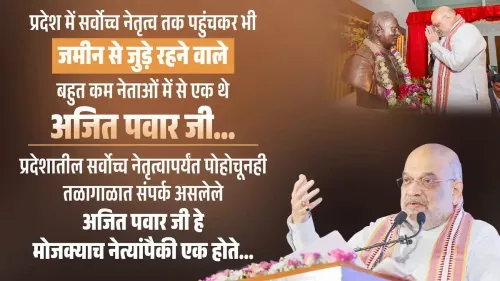
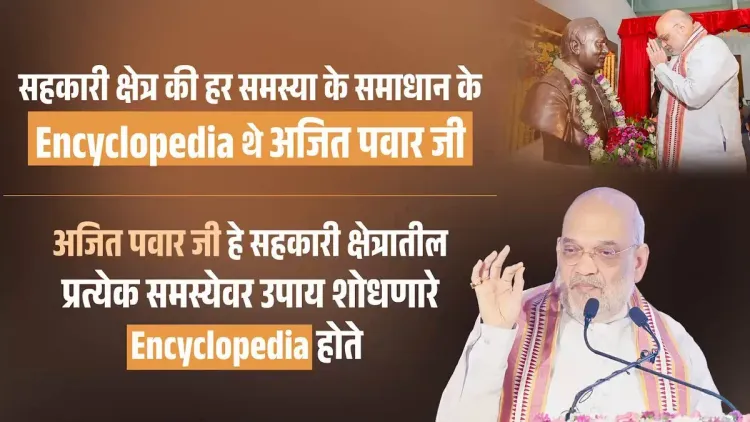
Union Home Minister Amit Shah called NCP leader Ajit Pawar an 'Encyclopedia' of cooperative problem-solving, citing dairy unions, sugar factories, PACS, and district cooperative banks in a bilingual post on 16 November 2026.
Key Takeaways
Union Home Minister Amit Shah posted a tribute to Ajit Pawar on 16 November 2026 , calling him an 'Encyclopedia' of the cooperative sector.
The tribute was written in both Hindi and Marathi , signalling direct outreach to Maharashtra's political and rural audience.
Shah specifically named dairy unions (Dugdh Sangh), PACS, sugar factories, urban cooperative banks, and district cooperative banks as areas of Pawar's expertise.
The Ministry of Cooperation , created in July 2021 under Shah, oversees the same institutions cited in the tribute.
Ajit Pawar's NCP faction is currently aligned with the NDA at the Maharashtra state level, making the Centre-state cooperative reform partnership politically significant.
Maharashtra's cooperative network — one of India's densest — has historically been a key driver of rural political power in the state.
When Union Home Minister Amit Shah reaches for a word to describe someone's command over Maharashtra's vast cooperative web — dairy unions, sugar factories, district banks, PACS — he lands on 'Encyclopedia.' That single word, posted on Monday, 16 November 2026, crystallises the political stature Ajit Pawar has built across decades in the state's rural financial architecture.
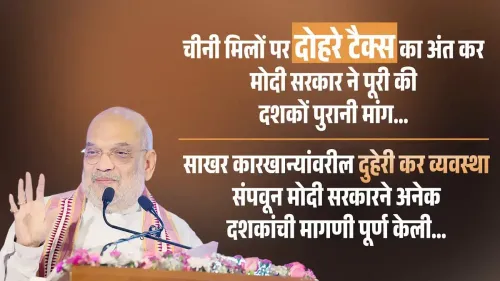
Shah's tribute, written in both Hindi and Marathi, spans the full breadth of Maharashtra's cooperative ecosystem. 'दुग्ध संघ हो, पैक्स हो, चीनी कारखाने हों, नागरिक सहकारी बैंक हो या जिला सहकारी बैंक' — 'Be it dairy unions, PACS, sugar factories, cooperative banks or district cooperative banks' — Ajit Pawar was, Shah wrote, the go-to solver for every problem in the cooperative sector.
Maharashtra's cooperative sector: the network that shapes rural power
To understand why the tribute carries weight, consider what that network actually means. Maharashtra is home to one of India's densest cooperative infrastructures — tens of thousands of Primary Agricultural Credit Societies (PACS), hundreds of sugar cooperatives, urban and district cooperative banks threading rural credit to millions of farmers. Control over this architecture has historically translated directly into political influence at the village, taluka and district level. Ajit Pawar, a senior leader of the Nationalist Congress Party (NCP), spent much of his career immersed in this world — not merely as a politician who spoke about cooperatives, but as one who was embedded in their daily governance. Shah's framing of him as an 'encyclopedia' — someone you consult when every other answer runs dry — signals a recognition of institutional knowledge that transcends party lines.Shah's Ministry of Cooperation and the Maharashtra connection
The tribute also carries a structural dimension. The Ministry of Cooperation, carved out as an independent Union ministry in July 2021 and placed under Shah's direct charge, was explicitly designed to bring focused central policy attention to the very institutions he names in his post — PACS, dairy societies, sugar cooperatives, cooperative banks. The ministry has since pushed computerisation of PACS, model bye-laws, and tighter regulation of multi-state cooperative societies. Maharashtra, with its dominant sugar and dairy cooperatives and its history of cooperative bank governance, sits at the heart of that reform agenda. Praise for Ajit Pawar — who straddles NCP's faction now aligned with the NDA at the state level — underlines that centre-state coordination on cooperative governance has a human face: regional leaders who know these institutions from the inside.What the 'Encyclopedia' label signals politically
Shah is not known for casual superlatives. Calling a regional leader an encyclopedia of cooperative problem-solving is a pointed acknowledgement — that institutional memory matters, that the Centre's reform agenda needs practitioners who have navigated sugar-mill disputes, rural bank crises, and PACS lending bottlenecks on the ground. For the cooperative sector in Maharashtra, the signal from Delhi is clear: this partnership is active, valued, and worth naming in public.Point of View
Not merely a compliment — it frames Ajit Pawar as an indispensable institutional asset at a moment when the Ministry of Cooperation is pushing structural reforms across PACS, sugar co-ops, and rural banks. By praising Pawar publicly and bilingually, Shah reinforces the NDA's investment in Maharashtra's NCP faction as a bridge to the cooperative establishment. The tribute also reflects a broader pattern: the Centre's cooperative reform agenda requires regional strongmen who can deliver on-the-ground compliance, and publicly crediting them is part of that governance strategy.
NationPress
16 Nov 2026
Frequently Asked Questions
Why did Amit Shah call Ajit Pawar an Encyclopedia of cooperatives?
Shah credited Ajit Pawar with deep expertise across Maharashtra's entire cooperative ecosystem — dairy unions, PACS, sugar factories, and cooperative banks — describing him as the definitive problem-solver for every challenge in the sector.
What is the Ministry of Cooperation and why does Amit Shah head it?
The Ministry of Cooperation was created in July 2021 as a standalone Union ministry to give focused policy attention to India's cooperative sector, including PACS, dairy, and sugar societies. Amit Shah was appointed its first minister.
What are PACS in Maharashtra's cooperative sector?
Primary Agricultural Credit Societies (PACS) are village-level cooperative institutions that provide short-term credit and other services to farmers. Maharashtra has one of the largest PACS networks in India.
What is Ajit Pawar's connection to Maharashtra's cooperative sector?
Ajit Pawar, a senior NCP leader, has spent decades involved in the governance of Maharashtra's cooperative institutions, including sugar cooperatives and district cooperative banks, making him a central figure in the state's rural political economy.
What is the political significance of Amit Shah praising Ajit Pawar?
Ajit Pawar's NCP faction is aligned with the NDA at the Maharashtra state level. Shah's public tribute underscores the Centre's close coordination with regional cooperative leaders as part of its broader cooperative sector reform agenda.