Amit Shah: Cooperatives Now Link Villages to Global Markets
Synopsis
Marking five years of the cooperative sector push, Union Home Minister Amit Shah says farmers' produce is now travelling from Indian villages to global markets through cooperatives — a milestone tied to the Ministry of Cooperation formed in July 2021.
Key Takeaways
Union Home Minister Amit Shah posted on July 6, 2026 marking five years of cooperative sector reforms under the hashtag #SahkarSeSamriddhiKe5Saal .
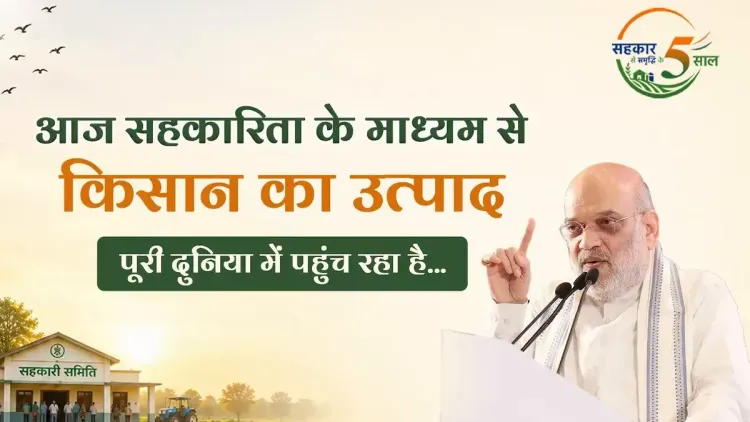
Shah stated that through cooperatives, farmers' produce is now reaching from villages to global markets.
The Ministry of Cooperation was established in July 2021 , making this a significant five-year institutional milestone.
Primary Agricultural Credit Societies (PACS) form the village-level backbone of the cooperative network, supporting credit and marketing for small farmers.
The government's cooperative policy aims to reduce intermediary dependence and increase farmers' share of final market prices.
Upcoming cooperative sector export data and a National Cooperative Policy are key developments to watch.
Union Home Minister and Minister of Cooperation Amit Shah on Monday, July 6, 2026, declared that through the cooperative movement, farmers' produce is now reaching from villages to global markets — marking what he called five years of prosperity through cooperation, under the hashtag #SahkarSeSamriddhiKe5Saal (Five years of prosperity through cooperation).
Context
Shah posted in Hindi: 'Sahkarita ke madhyam se kisanon ka utpad ab gaon se vaishvik baazaron tak pahunch raha hai' — 'Through cooperation, farmers' produce is now reaching from villages to global markets.' The post, accompanied by a video, marks a five-year milestone associated with the government's cooperative sector push.
The Ministry of Cooperation was established in July 2021, making this period a significant institutional landmark. Shah has helmed the ministry since its inception, positioning cooperatives as a cornerstone of the BJP-led government's rural economic agenda.
Policy Backdrop
Before 2021, cooperative sector oversight was distributed across multiple ministries, diluting policy focus. The creation of a dedicated ministry was intended to provide concentrated attention to strengthening and modernising India's cooperative movement, which spans credit, dairy, fisheries, and agricultural marketing.
Primary Agricultural Credit Societies (PACS) — the village-level cooperative institutions — sit at the base of this structure, providing credit and marketing support to small and marginal farmers. Government efforts have focused on computerising and revitalising these societies to improve their reach and efficiency.
The broader policy arc since 2014 has sought to integrate village-level agricultural production into national and eventually international value chains, with cooperatives identified as a key institutional vehicle for this integration.
Stakeholders and Impact
Small and marginal farmers, who constitute the bulk of India's agricultural workforce, are the primary intended beneficiaries of cooperative-led market linkages. By aggregating produce through cooperative structures, individual farmers gain negotiating power and access to markets that would otherwise be beyond their reach.
Cooperative societies across sectors — from dairy federations to farmer-producer organisations — stand to gain from policy and financial support channelled through the dedicated ministry. The government's stated aim is to reduce intermediary dependence and improve the share of final price that reaches the farmer.
What's Next
Observers will watch for the release of cooperative sector export data that could substantiate claims of produce reaching global markets, as well as any parliamentary discussion on the forthcoming National Cooperative Policy. The five-year milestone framing suggests the government may announce further institutional reforms or targets to deepen the cooperative network's role in agricultural exports.
As the government consolidates its cooperative framework, the coming months could see fresh announcements on expanding PACS modernisation, cooperative export hubs, or new international market linkages — each of which would test whether the institutional groundwork laid since 2021 is translating into measurable farmer income gains.
Point of View
Framing the Ministry of Cooperation — a BJP institutional innovation — as a transformative success for rural India. By anchoring the message around global market access for farmers, the government elevates cooperatives from a welfare instrument to a growth story, one that aligns with its broader rural-to-export economic narrative. The timing suggests a coordinated communications push ahead of potential policy announcements, reinforcing the cooperative ministry's place as a signature BJP governance achievement. Whether the narrative is backed by verifiable export and income data will determine how it lands with farmers and opposition alike.
NationPress
6 Jul 2026
Frequently Asked Questions
What is the Ministry of Cooperation and when was it formed?
The Ministry of Cooperation is a dedicated Union ministry formed in July 2021 to strengthen and modernise India's cooperative sector. Amit Shah has served as its minister since inception.
What does #SahkarSeSamriddhiKe5Saal mean?
SahkarSeSamriddhiKe5Saal translates to 'Five years of prosperity through cooperation.' It marks the five-year milestone of the government's focused cooperative sector push since the ministry was established in 2021 .
How do cooperatives help Indian farmers reach global markets?
Cooperative societies aggregate farmers' produce, giving small and marginal farmers collective bargaining power and access to larger national and international markets that individual farmers cannot access on their own.
What are Primary Agricultural Credit Societies (PACS)?
Primary Agricultural Credit Societies (PACS) are village-level cooperative institutions that provide credit and marketing support to farmers. They form the grassroots foundation of India's cooperative network.
What is the National Cooperative Policy India?
The National Cooperative Policy is an anticipated policy framework aimed at providing a long-term roadmap for cooperative sector development in India. Its finalisation and parliamentary discussion are closely watched by the sector.