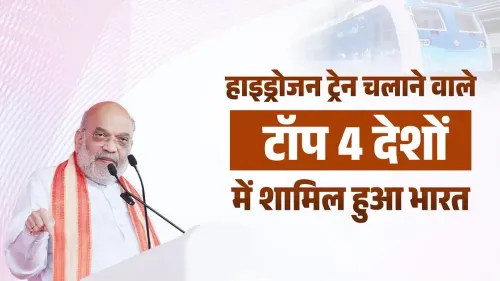
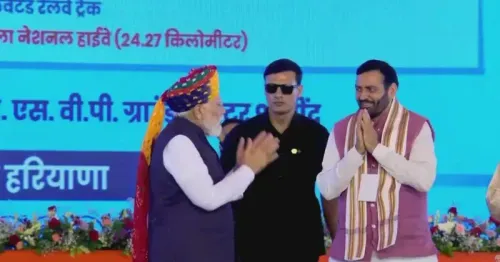
Amit Shah hails India's first hydrogen train flagged off by PM Modi

Synopsis
Union Home Minister Amit Shah has welcomed the launch of India's first hydrogen train, flagged off by PM Narendra Modi on 17 July 2026. The train runs between Jind and Sonipat in Haryana, marking India's entry into zero-carbon rail transport under the National Green Hydrogen Mission.
Key Takeaways
Union Home Minister Amit Shah praised the launch of India's first hydrogen-powered train on 17 July 2026 .
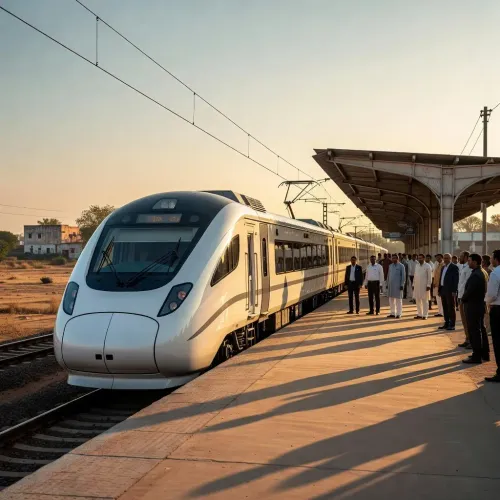
Prime Minister Narendra Modi flagged off the train, which will operate between Jind and Sonipat in Haryana .
The train produces zero carbon emissions , emitting only water vapour, setting a new benchmark for clean rail transport in India.
The launch is part of the National Green Hydrogen Mission , which aims to scale domestic green hydrogen production and adoption.
India joins a select group of nations — including Germany and China — to have operationalised hydrogen train technology.
A successful pilot could trigger expansion to more routes and increased investment in hydrogen refuelling infrastructure at railway stations.
Union Home Minister Amit Shah on Friday, 17 July 2026, lauded the flagging off of India's first hydrogen-powered train by Prime Minister Narendra Modi, calling it a landmark step toward greener mobility. The train will operate between Jind and Sonipat railway stations in Haryana, marking a significant milestone in the country's decarbonisation journey.
Context
Sharing his remarks on X, Shah said the new train 'sets the nation on a new journey towards greener mobility' and described it as 'a testament to India's indigenous engineering prowess.' He added that the development 'sets a new benchmark for zero-carbon-emission transportation and elevates India into the elite league of nations that have mastered this technology.'
The Jind–Sonipat corridor in Haryana has been chosen as the inaugural route for the service, connecting two key towns in the state's rail network. The choice of an existing commuter-heavy corridor underscores Indian Railways' intent to test the technology under real operational conditions.
Policy Backdrop
The hydrogen train launch sits within the broader framework of the National Green Hydrogen Mission, a central government programme aimed at accelerating domestic production and adoption of green hydrogen across sectors including transport. The mission's foundations were laid in the 2021 Union Budget, which first announced the push toward a domestic green hydrogen ecosystem.
Indian Railways has pursued successive decarbonisation steps over recent years, including aggressive electrification targets and pilot projects with alternative fuels. Hydrogen trains represent the next frontier in that trajectory, targeting zero-emission solutions for heavy transport — a segment where battery technology alone has faced range and load limitations.
The initiative also aligns with India's stated commitment to achieving net-zero emissions by 2070 and the Atmanirbhar Bharat framework, which emphasises indigenous development of frontier technologies rather than dependence on imports.
Stakeholders and Impact
Commuters along the Jind–Sonipat route stand to benefit immediately from cleaner, quieter train operations, as hydrogen fuel cells emit only water vapour as a by-product. For Haryana, hosting the country's first such service positions the state as a testbed for next-generation rail infrastructure.
The renewable energy and green hydrogen industry is also closely watching the rollout. A successful operational deployment by Indian Railways — one of the world's largest rail networks — could catalyse demand for domestically produced green hydrogen and spur investment in hydrogen refuelling infrastructure at railway stations.
What's Next
The immediate focus will be on monitoring the performance of the Jind–Sonipat service in terms of reliability, turnaround time, and passenger experience. A successful pilot is expected to inform decisions on expanding hydrogen train services to additional routes across the country.
Policymakers and industry stakeholders will also watch for supplementary budgetary allocations or updated targets under the National Green Hydrogen Mission to support the scaling of hydrogen refuelling infrastructure alongside the expanding fleet. India's entry into the hydrogen train segment places it alongside a handful of nations — including Germany and China — that have operationalised such technology, with domestic manufacturing capability now a stated ambition.
Point of View
Framing a railway milestone as validation of the BJP government's twin pillars of green development and self-reliance. By invoking 'indigenous engineering prowess' and the 'elite league of nations,' the messaging ties the hydrogen train directly to the Atmanirbhar Bharat narrative ahead of what is likely to be a sustained campaign around green infrastructure. The choice of Haryana — a politically significant state — as the launch ground is unlikely to be incidental. For Indian Railways, the real test lies ahead: whether a single-route pilot can be scaled into a commercially viable, domestically manufactured fleet that meaningfully dents the sector's carbon footprint.
NationPress
17 Oct 2026
Frequently Asked Questions
What is India's first hydrogen train and where will it run?
India's first hydrogen-powered train will run between Jind and Sonipat railway stations in Haryana . It was flagged off by Prime Minister Narendra Modi on 17 July 2026 and produces zero carbon emissions, emitting only water vapour.
Who flagged off India's first hydrogen train?
Prime Minister Narendra Modi flagged off India's first hydrogen train on 17 July 2026 . Union Home Minister Amit Shah welcomed the launch on X, calling it a milestone for green mobility.
What is the National Green Hydrogen Mission?
The National Green Hydrogen Mission is a central government programme to accelerate domestic production and use of green hydrogen across sectors including transport. Its foundations were announced in the 2021 Union Budget .
How does a hydrogen train work and why is it considered green?
A hydrogen train uses fuel cells that combine hydrogen and oxygen to generate electricity for its motors, emitting only water vapour as a by-product. This makes it a zero-carbon-emission mode of transport, unlike diesel-powered trains.
Which countries have hydrogen trains before India?
Nations including Germany and China had operationalised hydrogen train technology before India. With the Jind–Sonipat launch, India has joined this select group of countries that have mastered hydrogen-powered rail transport.