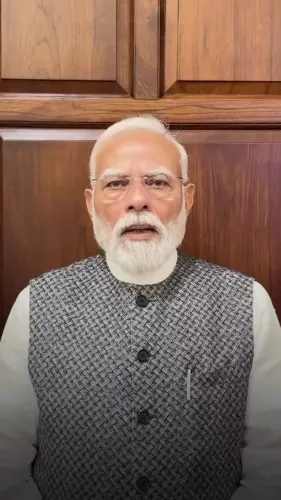
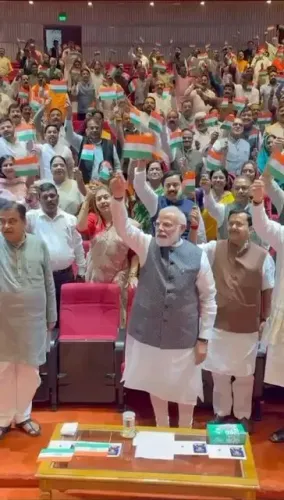
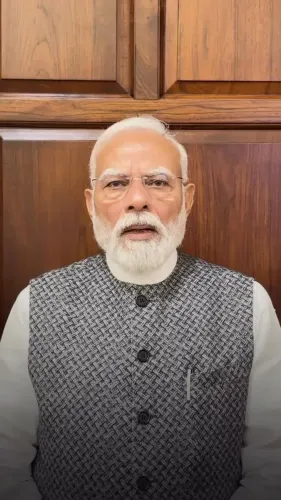
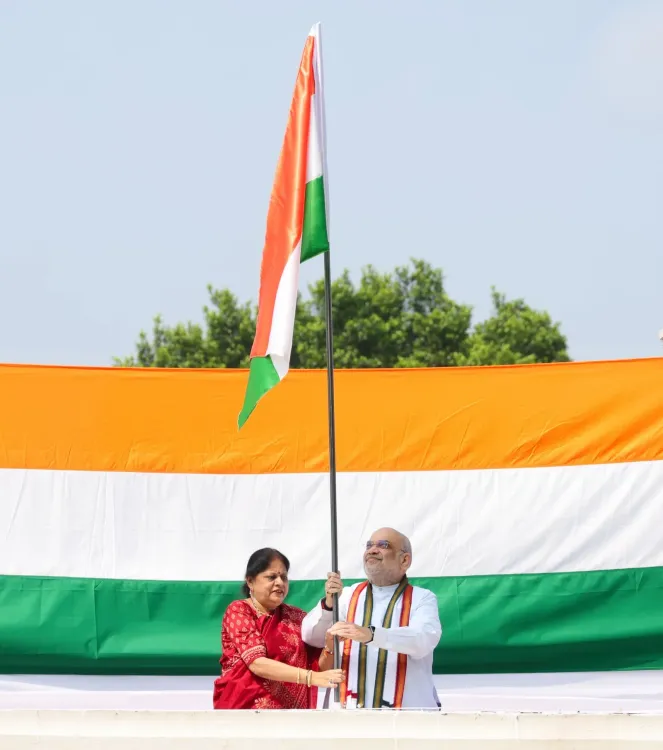
Amit Shah hoists Tiranga at Delhi home under Har Ghar Tiranga
Synopsis
Union Home Minister Amit Shah hoisted the Tricolour at his New Delhi residence on 13 August 2026 under the Har Ghar Tiranga campaign, calling on crores of Indians to join the annual pre-Independence Day patriotism drive launched by PM Modi's government in 2022.
Key Takeaways
Amit Shah hoisted the national flag at his New Delhi residence on 13 August 2026 under the Har Ghar Tiranga campaign.
The campaign was launched in August 2022 by the Ministry of Culture as part of Azadi Ka Amrit Mahotsav , marking 75 years of Indian independence.
Shah credited Prime Minister Narendra Modi 's leadership for the campaign's role in strengthening patriotism and national pride.
The initiative is tied to the 'Ek Bharat, Shreshtha Bharat' theme of national integration, promoted by the central government since 2015 .
The campaign has been repeated annually, encouraging household-level flag hoisting in the days before 15 August .
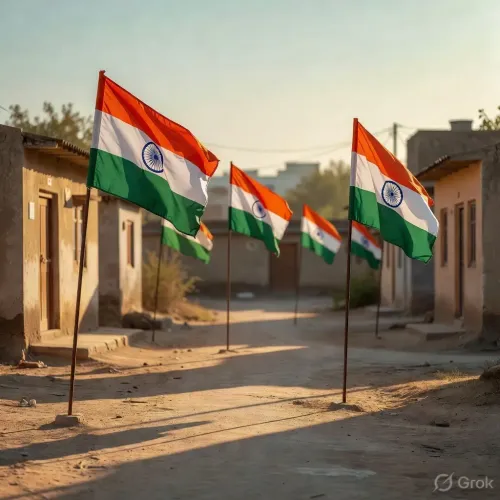
With the tricolour raised at his New Delhi residence on 13 August 2026, Union Home Minister Amit Shah joined crores of Indians in the Har Ghar Tiranga campaign — a mass patriotism drive that has become one of the central government's most visible pre-Independence Day rituals.
Shah posted on X: 'आज नई दिल्ली स्थित अपने आवास पर #HarGharTiranga अभियान के तहत तिरंगा फहराया' — 'Today I hoisted the Tricolour at my New Delhi residence under the Har Ghar Tiranga campaign.' He added that the campaign, launched under Prime Minister Narendra Modi's leadership, is 'further strengthening the feeling of patriotism and pride in the heart of every Indian.'
From Azadi Ka Amrit Mahotsav to an annual tradition
The Har Ghar Tiranga campaign was born in August 2022, when the Ministry of Culture rolled it out as part of Azadi Ka Amrit Mahotsav — the government's umbrella celebration of 75 years of Indian independence. The idea was simple and deliberately democratic: every household, not just government buildings, flies the national flag in the days leading up to 15 August.
What started as a one-time commemorative push has since been repeated annually, evolving into a fixture of the Independence Day calendar. The campaign explicitly links to the 'Ek Bharat, Shreshtha Bharat' (One India, Excellent India) theme of national integration that the central government has promoted since 2015 — a through-line that frames household flag-hoisting not merely as a gesture, but as a statement of unity.
The politics of the flag at the doorstep
Shah's post captures exactly the register the campaign is designed to strike: personal participation by senior leaders, amplified through social media, signalling to citizens that the call to hoist the flag comes from the very top. By framing the drive as something that 'crores of fellow citizens' are joining together, the messaging deliberately blurs the line between a government initiative and a spontaneous national movement.
The campaign has drawn both wide participation and occasional criticism — with some questioning whether mandating or nudging flag display constitutes genuine patriotism or performative nationalism. The government's consistent position is that mass engagement with the tricolour deepens constitutional pride and national cohesion.
Point of View
Broadcast nationally, reinforces the government's message that Har Ghar Tiranga is a citizens' movement rather than a top-down directive. The campaign's annual repetition since 2022 signals a deliberate effort to institutionalise pre-Independence Day flag-hoisting as a social norm. It also keeps the 'Ek Bharat, Shreshtha Bharat' integration narrative alive beyond its original 2015 launch, weaving it into a recurring cultural moment. The long-term bet is that habit, repeated year after year, becomes identity.
NationPress
13 Aug 2026
Frequently Asked Questions
What is the Har Ghar Tiranga campaign?
Har Ghar Tiranga is a government campaign launched in August 2022 by the Ministry of Culture, encouraging every Indian household to hoist the national flag in the days around Independence Day on 15 August. It began as part of Azadi Ka Amrit Mahotsav, marking 75 years of Indian independence.
Why did Amit Shah hoist the Tricolour on 13 August 2026?
Amit Shah hoisted the Tricolour at his New Delhi residence as part of the annual Har Ghar Tiranga campaign, which runs in the lead-up to Independence Day on 15 August. He posted about the act on X to encourage citizens to participate.
When was the Har Ghar Tiranga campaign launched?
The Har Ghar Tiranga campaign was launched in August 2022 by the Ministry of Culture under Prime Minister Narendra Modi's government, as part of the Azadi Ka Amrit Mahotsav celebrations marking 75 years of Indian independence.
What is 'Ek Bharat, Shreshtha Bharat'?
'Ek Bharat, Shreshtha Bharat' — meaning 'One India, Excellent India' — is a national integration theme promoted by the central government since 2015. The Har Ghar Tiranga campaign explicitly links to this theme, framing flag-hoisting as an act of national unity.
Is Har Ghar Tiranga a yearly event?
Yes. Although it began as a one-time initiative for the 75th Independence Day in 2022, the Har Ghar Tiranga campaign has been repeated annually, becoming a regular fixture of the pre-Independence Day calendar with household-level flag-hoisting at its core.