Amit Shah Launches Mission 70 Lakh Tree Drive in Delhi

Synopsis
Union Home Minister Amit Shah on July 7, 2026 launched the Mission 70 Lakh Poudharopan Abhiyan in Delhi, pledging to plant seven million native trees on the Delhi Ridge. He also rolled out 300 electric buses, inaugurated three vehicle depots, and laid the foundation stone for a high-security prison in Narela.
Key Takeaways
Mission 70 Lakh Poudharopan Abhiyan was launched on July 7, 2026 in Delhi by Union Home Minister Amit Shah .
The Delhi Ridge will have invasive and toxic trees replaced with native species including Peepal, Banyan, Neem, and Jamun , each capable of living over 100 years .
The plan includes creation of art-themed forests and rejuvenation of over 70 ponds and water bodies within the Ridge.
300 electric buses were operationally launched along with the e-inauguration of 3 new vehicle depots and an automated vehicle testing station .
The digital foundation stone for a High Security Prison in Narela was laid as part of Delhi's law-and-order modernisation push.
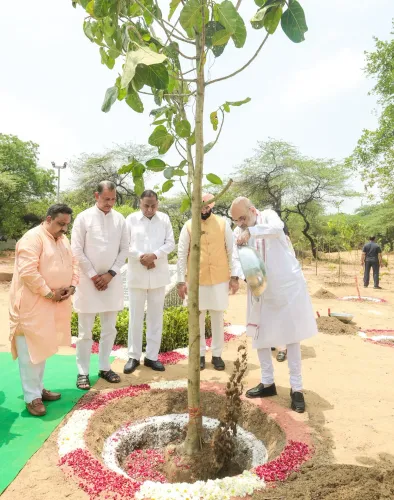
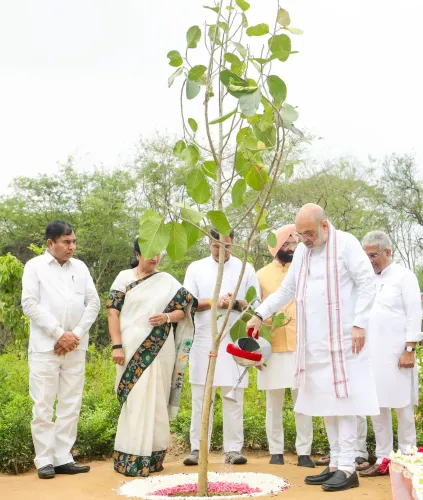
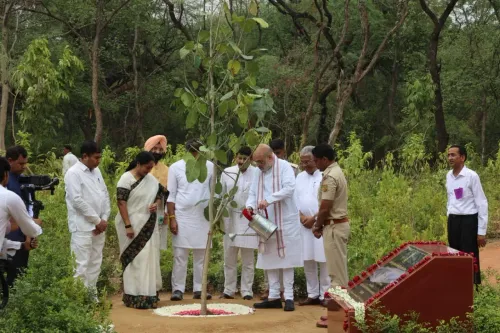
Union Home Minister Amit Shah on Tuesday, July 7, 2026, launched a series of major civic and environmental initiatives in Delhi, anchored by the Mission 70 Lakh Poudharopan Abhiyan — a campaign to plant 70 lakh (seven million) native trees across the national capital.
Context
Addressing the event, Shah announced that the Delhi Ridge — the capital's primary green lung and a northern extension of the ancient Aravalli Range — will undergo ecological restoration by removing invasive and toxic tree species. In their place, long-lived native varieties such as Peepal, Banyan, Neem, and Jamun — trees capable of living over 100 years — will be planted to transform the Ridge into what he described as 'Delhi ka Green Lungs' (Delhi's Green Lungs).
The campaign also envisions the development of art-themed special forests, the rejuvenation of over 70 ponds and water bodies, and the preservation of archaeological structures within the Ridge zone.
Policy Backdrop
The Delhi Ridge has been protected under reserved forest notifications since the 1990s and 2000s, aimed at curbing encroachment and preserving biodiversity in an increasingly urbanised capital. Ecologists have long argued that restoring native canopy cover is critical to addressing Delhi's air pollution and urban heat island effect, making the shift from invasive to indigenous species a policy priority with scientific backing.
The electric bus component of Tuesday's launch builds on the momentum of the FAME-II scheme introduced in 2019, which accelerated electric vehicle deployment across Indian cities to reduce vehicular emissions. Delhi's public transport network has been a focal point of that national push.
Stakeholders and Impact
Shah also inaugurated the operational rollout of 300 electric buses equipped with modern facilities, along with the e-inauguration of 3 newly constructed vehicle depots and an automated vehicle testing station. These additions are expected to directly benefit Delhi's public transport users by expanding fleet capacity and improving service reliability.
In a separate but concurrent development, Shah laid the digital foundation stone (e-shilanayas) for a High Security Prison in Narela, a planned sub-city in northwest Delhi. The facility is intended to modernise the capital's law-and-order infrastructure, though specific capacity figures and an operational timeline have not been officially confirmed.
What's Next
The success of the Mission 70 Lakh campaign will hinge on survival rates of the planted native species over the coming monsoon seasons and measurable improvements in Delhi's air quality indices. Officials and environmentalists are expected to track these metrics closely as benchmarks for the initiative's ecological impact.
Construction milestones for the Narela High Security Prison and the integration of the three new depots into Delhi's public transport network will be the next key indicators of progress on the urban infrastructure front. Together, these initiatives represent a broad central government push to simultaneously address Delhi's environmental, mobility, and security challenges.
Point of View
At a time when the BJP controls both the Centre and the Delhi government. Coupling a large-scale afforestation drive with electric mobility and prison infrastructure in a single event is a deliberate optics strategy — framing urban governance as holistic rather than piecemeal. The focus on restoring the Delhi Ridge with century-old native species also addresses a long-standing ecological demand from courts and environmentalists, giving the initiative bipartisan credibility. Whether the campaign translates into durable ecological gains will depend on post-monsoon survival audits, making implementation accountability the central political test.
NationPress
7 Jul 2026
Frequently Asked Questions
What is Mission 70 Lakh Poudharopan Abhiyan in Delhi?
Mission 70 Lakh Poudharopan Abhiyan is a campaign launched by Union Home Minister Amit Shah on July 7, 2026 to plant 70 lakh (seven million) native trees in Delhi , focusing on restoring the Delhi Ridge with species like Peepal, Banyan, Neem, and Jamun.
What is the Delhi Ridge and why is it important?
The Delhi Ridge is a northern extension of the ancient Aravalli Range and serves as Delhi's primary green cover and biodiversity zone. It has been protected as reserved forest since the 1990s and is considered critical for combating the city's air pollution and urban heat island effect.
How many electric buses were launched in Delhi by Amit Shah?
300 electric buses with modern facilities were operationally launched as part of the same event on July 7, 2026 , alongside the e-inauguration of 3 new vehicle depots and an automated vehicle testing station.
What is the Narela High Security Prison project?
Union Home Minister Amit Shah laid the digital foundation stone ( e-shilanayas ) for a High Security Prison in Narela , a planned sub-city in northwest Delhi, as part of an effort to modernise the capital's law-and-order infrastructure. Specific capacity and timelines have not been officially confirmed.
Which native trees will be planted on the Delhi Ridge?
The restoration plan focuses on planting Peepal, Banyan (Bargad), Neem, and Jamun — all native Indian species capable of living for over 100 years — to replace invasive and toxic tree species currently present on the Ridge.