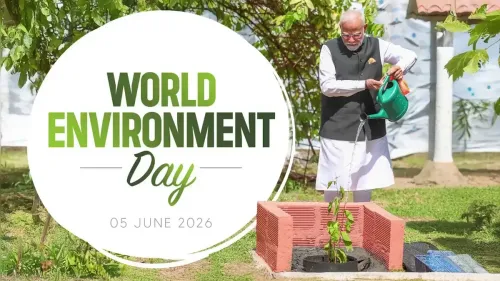
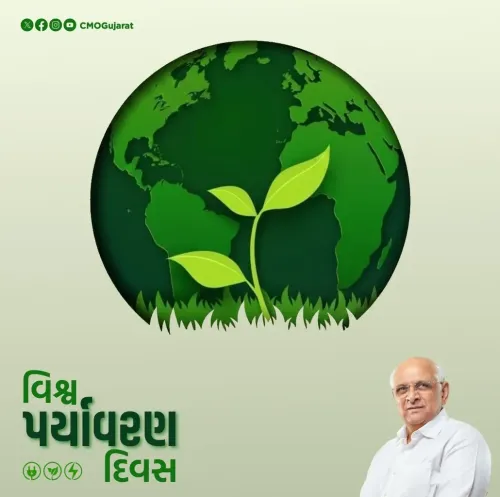
Amit Shah Hails India's Renewable Energy Rise on World Environment Day
Synopsis
Union Home Minister Amit Shah marked World Environment Day on 5 June 2026 by crediting PM Modi with building India's third-largest renewable energy capacity, launching the National Green Hydrogen Mission, and achieving top-three global status in annual forest cover growth.
Key Takeaways
Amit Shah posted World Environment Day greetings on 5 June 2026 , highlighting India's environmental record under PM Modi .
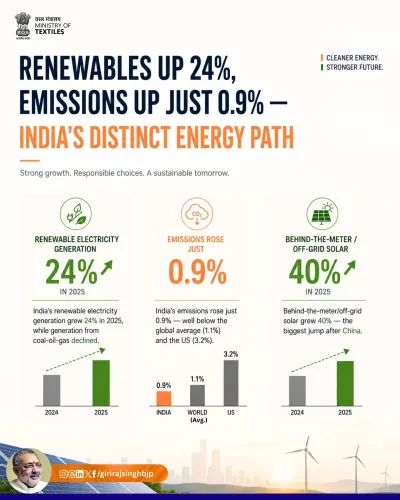
India claims the world's third-largest renewable energy capacity , according to the post.
The National Green Hydrogen Mission was approved in January 2023 with an outlay of Rs 19,744 crore .
India co-founded the International Solar Alliance in 2015 and pledged 500 GW non-fossil fuel capacity by 2030 at COP26 .
India is described as among the top three nations in annual forest cover growth.
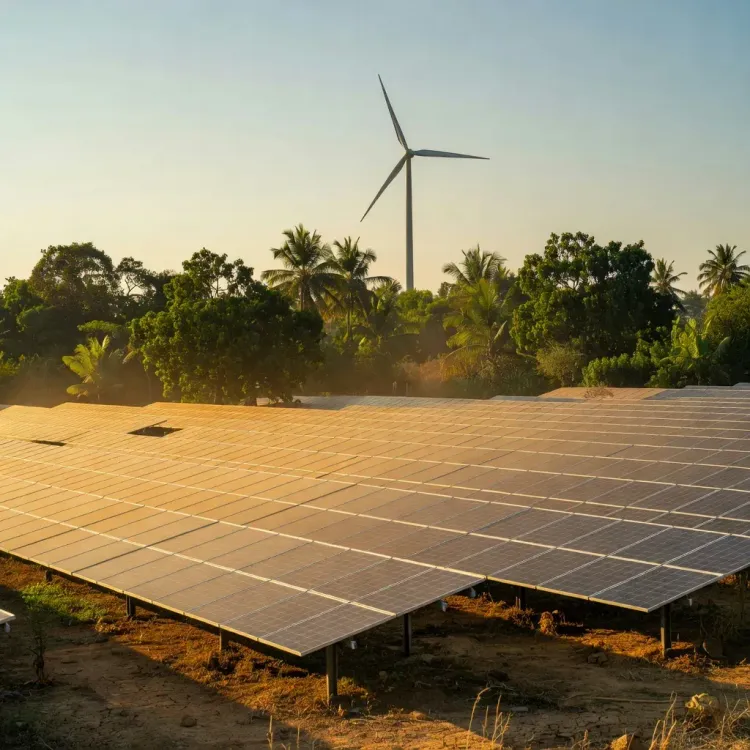
Solar power has been used to electrify millions of homes across rural India .
Union Home Minister Amit Shah extended greetings on World Environment Day on Friday, 5 June 2026, crediting Prime Minister Narendra Modi with transforming environmental protection into a global movement through India's renewable energy expansion, green hydrogen push, and forest cover gains.
Context
World Environment Day, observed annually on 5 June under the United Nations framework, serves as the principal platform for promoting global environmental awareness. This year's greetings from Shah arrive as India positions itself as a leading voice on climate action in multilateral forums including the G20 and BRICS.
In his post, Shah stated that Modi 'made environmental protection a global movement by building world's third-largest renewable energy capacity, National Green Hydrogen Mission and powering millions of homes with solar power,' adding that 'India leads the world as one of the top three nations in annual forest cover growth.'
Policy Backdrop
India's renewable energy ambitions trace back to the co-founding of the International Solar Alliance in 2015, a coalition designed to accelerate solar deployment across sun-rich nations. At COP26 in 2021, Prime Minister Modi announced a net-zero emissions target by 2070 and a commitment to achieve 500 GW of non-fossil fuel capacity by 2030.
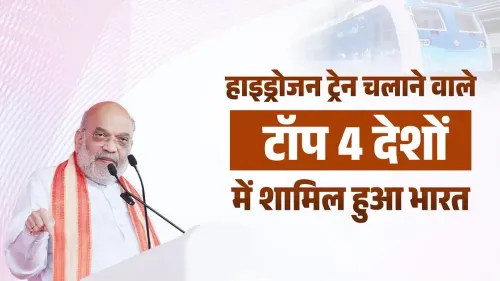
The National Green Hydrogen Mission, approved by the Union Cabinet in January 2023 with an initial outlay of Rs 19,744 crore, aims to scale green hydrogen production across industry and transport as part of India's broader decarbonisation strategy. The mission is seen as a key pillar linking energy security to manufacturing goals under the Atmanirbhar Bharat framework.
Solar power has been central to rural electrification, with rooftop and distributed solar schemes powering households across India that previously lacked reliable grid access. These efforts collectively form a strategy that connects climate commitments to domestic energy and economic priorities.
Stakeholders and Impact
Renewable energy developers and the broader clean-energy industry stand to benefit from continued policy support and public messaging that reinforces India's commitment to its 2030 capacity targets. Rural households, particularly those brought onto the grid through solar schemes, represent the human face of the transition that Shah highlighted.
Forest-dependent communities across India are stakeholders in the afforestation programmes that underpin the government's claim of being among the top nations in annual forest cover growth. Progress on these fronts is tracked through the India State of Forest Report, the next edition of which is awaited by policymakers and environmental groups alike.
What's Next
Pilot projects under the National Green Hydrogen Mission are expected to yield progress reports that will test whether India's green hydrogen ambitions translate into measurable industrial output. Parliamentary discussions on updated renewable purchase obligations are also anticipated ahead of COP31, which will be a key test of India's climate commitments on the global stage.
As India approaches its 2030 non-fossil fuel capacity milestone, the government's ability to sustain momentum across solar, wind, and emerging technologies such as green hydrogen will determine whether the narrative of environmental leadership is matched by verified outcomes.
Point of View
Framing environmental stewardship not as a regulatory burden but as a national achievement under Modi's leadership. By invoking third-largest renewable capacity and top-three forest cover growth in a single post, the messaging seeks to neutralise opposition narratives on pollution and ecological degradation. The reference to the National Green Hydrogen Mission signals that the government wants to be seen as forward-looking on decarbonisation, not merely reactive to global pressure. This pattern of anchoring climate credentials to a personalised leadership narrative is consistent with India's broader diplomatic posture at forums such as the G20 and BRICS.
NationPress
21 Oct 2026
Frequently Asked Questions
What did Amit Shah say on World Environment Day 2026?
Amit Shah posted greetings on 5 June 2026, crediting PM Modi with building India's third-largest renewable energy capacity, launching the National Green Hydrogen Mission, and placing India among the top three nations in annual forest cover growth.
What is the National Green Hydrogen Mission?
The National Green Hydrogen Mission is a Government of India initiative approved in January 2023 with an outlay of Rs 19,744 crore, aimed at scaling green hydrogen production for use in industry and transport as part of India's decarbonisation plan.
What is India's renewable energy target by 2030?
At COP26 in 2021, PM Modi committed India to achieving 500 GW of non-fossil fuel energy capacity by 2030 alongside a net-zero emissions target by 2070.
When was the International Solar Alliance founded?
India co-founded the International Solar Alliance in 2015 to accelerate solar energy deployment across sun-rich countries worldwide.
What is World Environment Day and when is it observed?
World Environment Day is an annual United Nations observance held on 5 June each year to promote global environmental awareness and encourage action on ecological challenges.