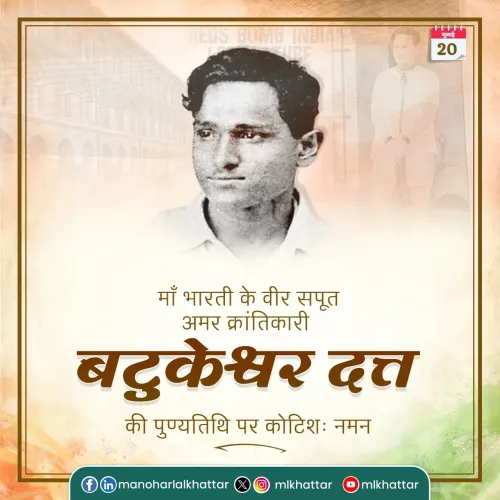
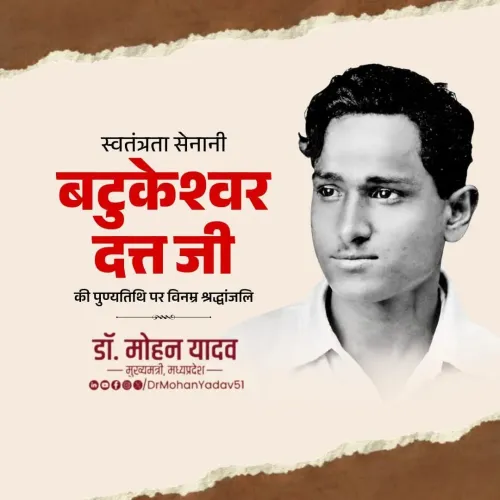
Amit Shah Pays Tribute to Revolutionary Batukeshwar Dutt on Death Anniversary
Synopsis
Union Home Minister Amit Shah on 20 July 2026 paid tribute to revolutionary Batukeshwar Dutt on his death anniversary, recalling the 1929 Central Assembly protest with Bhagat Singh and Dutt's endurance of Kala Pani imprisonment in the fight for Indian independence.
Key Takeaways
Amit Shah paid tribute to Batukeshwar Dutt on his death anniversary on 20 July 2026 .
Dutt and Bhagat Singh threw bombs in the Central Legislative Assembly on 8 April 1929 to protest British repressive laws.
Dutt was sentenced to life transportation and imprisoned at the Cellular Jail (Kala Pani) in the Andaman Islands .
While imprisoned, Dutt fought for the rights of fellow prisoners and participated in hunger strikes against British repression.
Shah invoked Dutt's courage and sacrifice as a lasting source of inspiration for Indian youth .
Official tributes to revolutionary freedom fighters form part of a long-standing government tradition since independence.
Union Home Minister Amit Shah on Monday, 20 July 2026 paid tribute to freedom fighter Batukeshwar Dutt on his death anniversary, honouring the revolutionary's role in India's independence struggle alongside Bhagat Singh.
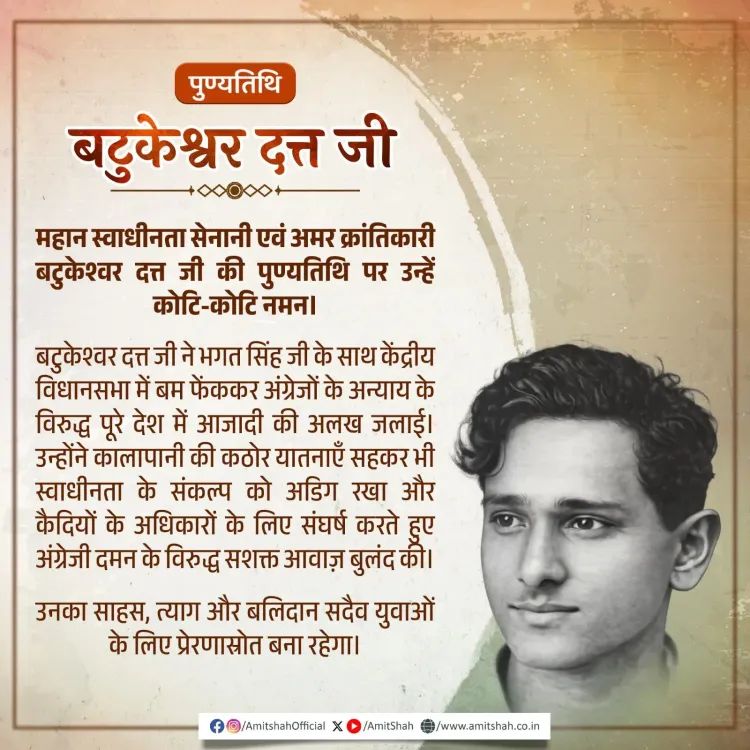
Posting on X, Shah wrote — 'महान स्वाधीनता सेनानी एवं अमर क्रांतिकारी बटुकेश्वर दत्त जी की पुण्यतिथि पर उन्हें कोटि-कोटि नमन' — 'I bow in reverence millions of times to the great freedom fighter and immortal revolutionary Batukeshwar Dutt on his death anniversary.' Shah recalled that Dutt, together with Bhagat Singh, threw bombs inside the Central Legislative Assembly to protest British injustice, igniting the flame of freedom across the country. He further noted that Dutt endured the severe hardships of Kala Pani imprisonment without wavering in his resolve for independence, and raised a powerful voice against British repression while fighting for the rights of fellow prisoners.
Context
Batukeshwar Dutt and Bhagat Singh threw bombs in the Central Legislative Assembly on 8 April 1929 — not to kill, but to make 'the deaf hear,' as their famous slogan declared. The act was a deliberate protest against the Public Safety Bill and the Trade Disputes Bill, which revolutionaries viewed as tools of colonial repression. Both men courted arrest and used their subsequent trial as a public platform to articulate the case for Indian independence.
Following his arrest, Dutt was sentenced to transportation for life and sent to the Cellular Jail in the Andaman Islands — the infamous Kala Pani — where political prisoners endured brutal conditions. While incarcerated, Dutt participated in hunger strikes demanding better treatment for prisoners, a dimension of his activism that Shah specifically highlighted in his post.
Policy Backdrop
Indian governments since independence have maintained a tradition of issuing official tributes to revolutionary-era freedom fighters on their birth and death anniversaries. Figures such as Bhagat Singh, Sukhdev, and Rajguru are commemorated on 23 March each year, with statements from senior constitutional authorities forming a standard part of the observance. Tributes to Dutt, whose contributions are sometimes overshadowed by those of Bhagat Singh despite their shared actions, have gained greater visibility in recent years as part of a broader effort to foreground armed resistance in the national freedom struggle narrative.
The current government has placed emphasis on highlighting revolutionary figures alongside constitutionalist leaders, reflecting a wider policy of recognising diverse streams of the independence movement in educational curricula and public commemorations.
Stakeholders and Impact
Shah's tribute is directed explicitly at Indian youth, with his post concluding that Dutt's courage, sacrifice, and dedication 'will always remain a source of inspiration for young people.' Families of freedom fighters and historical preservation organisations have long advocated for greater mainstream recognition of figures like Dutt, whose post-independence life — marked by poverty and illness before his death — drew far less attention than his revolutionary deeds. Civil society groups focused on colonial-era history are likely to amplify the tribute as part of ongoing efforts to document and memorialise lesser-celebrated revolutionaries.
What's Next
Similar tributes from senior leaders are expected on upcoming revolutionary anniversaries. Observers will watch whether the renewed attention to figures like Batukeshwar Dutt translates into concrete steps — such as updates to school curricula, new memorials, or dedicated commemorative events — that move beyond annual social-media observances. The Cellular Jail National Memorial in Port Blair remains a focal point for such commemorations, and any government announcements tied to the site would carry symbolic weight.
Point of View
Armed-resistance figures in India's official freedom struggle memory — a narrative thread that runs parallel to, and sometimes in tension with, the Gandhian non-violence tradition. By specifically highlighting Dutt's fight for prisoners' rights alongside the famous assembly bomb act, Shah adds a humanitarian dimension to a figure often reduced to a single dramatic episode. The tribute also signals continued political investment in connecting present-day youth to the revolutionary generation, a messaging strategy with clear ideological resonance. Whether such annual posts catalyse institutional change — in curricula, memorials, or welfare for freedom fighter families — remains the more consequential question.
NationPress
21 Jul 2026
Frequently Asked Questions
Who was Batukeshwar Dutt and why is he remembered?
Batukeshwar Dutt was an Indian revolutionary who, along with Bhagat Singh, threw bombs in the Central Legislative Assembly on 8 April 1929 to protest British repressive laws. He is remembered for his act of defiance, his endurance of Kala Pani imprisonment, and his fight for the rights of fellow prisoners.
What did Bhagat Singh and Batukeshwar Dutt do in the Central Assembly in 1929?
On 8 April 1929, Bhagat Singh and Batukeshwar Dutt threw bombs and leaflets inside the Central Legislative Assembly in Delhi to protest the Public Safety Bill and Trade Disputes Bill. The act was designed to make 'the deaf hear' and both men courted arrest to use their trial as a public platform.
What was Kala Pani and why was it feared?
Kala Pani refers to the Cellular Jail on the Andaman Islands, where the British sent political prisoners to serve life sentences in brutal isolation. The name, meaning 'black water,' reflected the terror associated with the sea crossing and the harsh conditions inside the jail. Batukeshwar Dutt was among the freedom fighters imprisoned there.
When is Batukeshwar Dutt's death anniversary observed?
Batukeshwar Dutt passed away on 20 July 1965, and his death anniversary is observed on 20 July each year. Senior political leaders and historical organisations mark the day with tributes to his role in India's independence movement.
Why did Amit Shah pay tribute to Batukeshwar Dutt?
Union Home Minister Amit Shah posted a tribute on X on 20 July 2026 to mark Batukeshwar Dutt's death anniversary, honouring his revolutionary actions, his imprisonment at Kala Pani, and his enduring legacy as an inspiration for Indian youth.