Amit Shah: UCC to roll out across all BJP-ruled states
Synopsis
Union Home Minister Amit Shah declared on 6 November 2026 that the Uniform Civil Code, first enacted in Uttarakhand in 2024, will be implemented across every BJP-governed state, signalling a state-by-state rollout strategy rather than immediate national legislation.
Key Takeaways
Amit Shah pledged on 6 November 2026 that the Uniform Civil Code (UCC) will be introduced in every BJP-ruled state .
Uttarakhand became the first state in independent India to pass a UCC bill, doing so in February 2024 .
The UCC is rooted in Article 44 of the Constitution's Directive Principles, which calls for a common civil code for all citizens.
The BJP's strategy appears to pursue a state-by-state rollout rather than a single national legislative push.
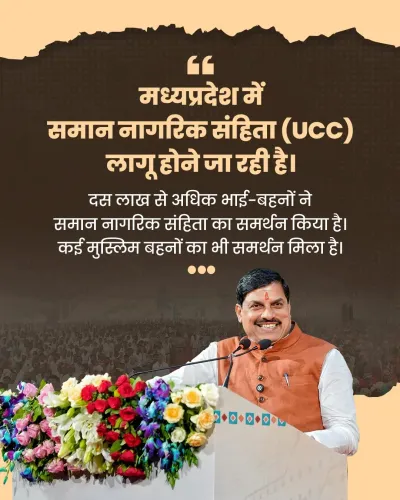
States such as Gujarat and Madhya Pradesh are most closely watched for the next legislative moves.
The expansion is expected to face scrutiny from courts over the balance between legal uniformity and religious personal-law freedoms.
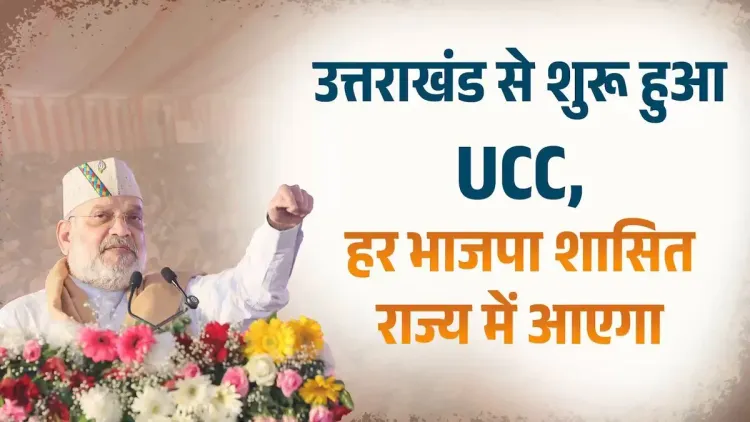
Uttarakhand wrote history by becoming the first state in independent India to enact a Uniform Civil Code — and Union Home Minister Amit Shah has now declared that chapter is only the opening one. On Friday, 6 November 2026, Shah posted a pointed pledge on X: every BJP-governed state will follow where Uttarakhand led.
Translated from Hindi, the post reads: 'Uttarakhand mein sabse pehle lagu hua UCC, har BJP-shasit rajya mein aayega' — 'UCC was first implemented in Uttarakhand; it will come to every BJP-ruled state.' The statement is unambiguous in both intent and direction.
Uttarakhand's landmark UCC bill and what it changed
In February 2024, the Uttarakhand Legislative Assembly passed the Uniform Civil Code Bill — the first state-level UCC legislation in India since independence. The move fulfilled a long-standing BJP manifesto commitment and drew national attention because it sought to replace religion-specific personal laws governing marriage, divorce, inheritance, and adoption with a single uniform framework applicable to all citizens regardless of faith.
The constitutional anchor is Article 44 of the Directive Principles of State Policy, which calls on the state to 'endeavour to secure for the citizens a uniform civil code throughout the territory of India.' The BJP has long argued that realising Article 44 is a matter of legal equality, particularly for women who face unequal treatment under certain religion-based personal laws.
Shah's signal: the Uttarakhand template as a replicable model
Shah's statement reframes Uttarakhand not as an isolated experiment but as a blueprint. Rather than waiting for a national parliamentary consensus — which faces far greater political complexity — the party appears to be pursuing a state-by-state strategy: embed UCC in each BJP-governed state, build a legal and administrative track record, and gradually normalise the reform.
The states most closely watched for the next move include Gujarat and Madhya Pradesh, both long-term BJP strongholds with the legislative machinery to advance such a bill. Any introduction of UCC legislation in these states would likely trigger both intense public debate and court challenges, given the overlap of personal law with fundamental rights.
Women's rights, legal equality, and the political stakes
Supporters of the UCC, including several women's rights organisations, argue that a uniform code removes discriminatory provisions that disadvantage women in matters of divorce and inheritance under various religious personal laws. Critics, particularly from minority communities and opposition parties, raise concerns about cultural autonomy and federalism. The legal battles that follow any new state-level UCC will ultimately test how the courts reconcile Article 44 with religious freedoms guaranteed under Articles 25–28.
What is clear tonight is the political arithmetic: the BJP is making UCC a deliverable, state by state, and Shah's post is as much a party mobilisation signal as it is a governance announcement.
Uttarakhand lit the first lamp — if Shah's pledge holds, several more states may be counting their wicks before this legislative cycle is out.
Point of View
The BJP converts a single state achievement into a national policy narrative ahead of multiple state election cycles. The state-by-state approach is tactically shrewd: it sidesteps the near-impossible task of building a parliamentary supermajority for central UCC legislation while simultaneously demonstrating delivery to the party's core base. Each new state enactment would add legal precedent and administrative data, strengthening the eventual case for a national code. The critical variable will be the courts, whose reading of UCC legislation against Articles 25–28 will shape how far and how fast this template can travel.
NationPress
6 Nov 2026
Frequently Asked Questions
What did Amit Shah say about the Uniform Civil Code on 6 November 2026?
Amit Shah posted on X that the Uniform Civil Code, first implemented in Uttarakhand, will be rolled out in every BJP-ruled state in India.
Which state was the first to implement the Uniform Civil Code in India?
Uttarakhand was the first state to pass a Uniform Civil Code bill, doing so in February 2024, making it the first such legislation in any Indian state since independence.
What is the Uniform Civil Code and what does it do?
The Uniform Civil Code is a proposed common legal framework under Article 44 of the Constitution that would replace religion-based personal laws governing marriage, divorce, inheritance, and adoption with a single set of rules for all citizens.
Which BJP-governed states could introduce UCC next?
Gujarat and Madhya Pradesh are among the BJP-ruled states most closely watched for potential UCC legislation, though no official timelines have been announced.
Will the UCC be introduced as a central law or state by state?
Based on Shah's statement and the BJP's current approach, the party appears to be pursuing a state-by-state strategy, using Uttarakhand's law as a template, rather than seeking immediate central legislation.