Andhra Pradesh Unveils 100-Day Initiative for Water Security
Synopsis
In a significant move towards sustainability, Andhra Pradesh's Chief Minister N. Chandrababu Naidu has launched the 'Jaladhara' initiative, a 100-day action plan aimed at ensuring water security across the state. This comprehensive program seeks to empower farmers and enhance groundwater levels, marking a pivotal step in addressing water scarcity.
Key Takeaways
Jaladhara program launched for water security in Andhra Pradesh.
Focus on groundwater recharge and conservation.
Community involvement is crucial for success.
Significant improvements in groundwater levels reported.
Aim to empower farmers and ensure water access.
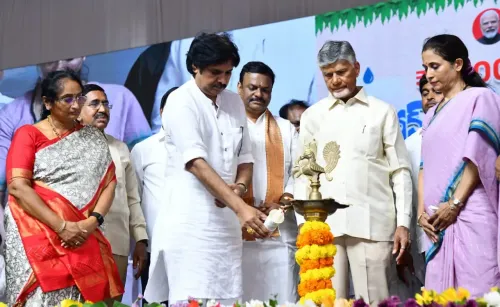
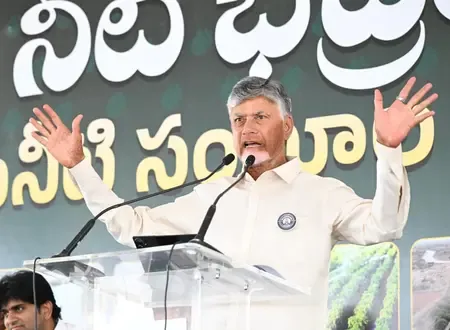
Amaravati, April 6 (NationPress) The Chief Minister of Andhra Pradesh, N. Chandrababu Naidu, has officially introduced the 'Jaladhara' initiative, a comprehensive 100-day action plan aimed at enhancing water security throughout the state.
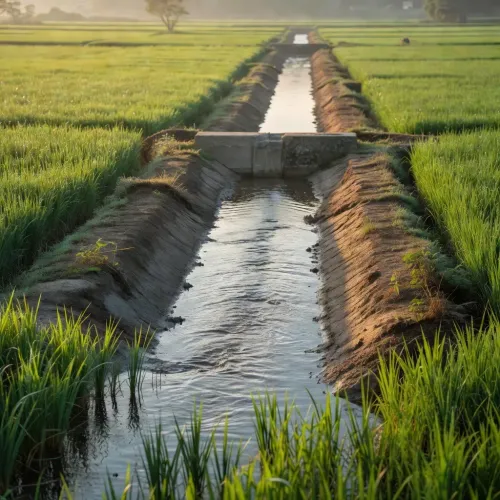
The primary objectives of the Jaladhara initiative include desilting water tanks, repairing canals, recharging groundwater, and conserving water. This program is meticulously crafted to ensure that every acre of land has access to water, instilling confidence in every farmer.
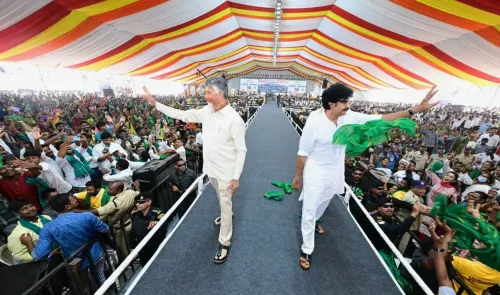
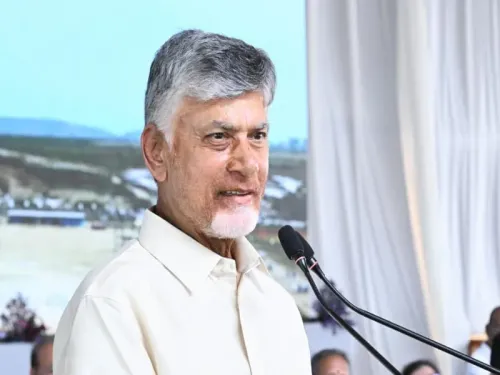
The launch event took place in Yadiki, located in Anantapur district, which is part of the drought-affected Rayalaseema region.
During the event, the Chief Minister highlighted the government's efforts to foster a public movement for water conservation, urging that every individual should take part as a stakeholder in this initiative, which is spearheaded by 60,000 members of local water user associations.
He emphasized the importance of using the earth as a natural reservoir to achieve effective water management.
Naidu called on citizens, government officials, and water user associations to collaborate in raising groundwater levels.
“We must guarantee that groundwater is accessible at a depth of 6 meters before the monsoon, and under 3 meters afterward. Achieving this will eliminate water scarcity in our state,” he asserted.
He also stressed the need to maximize reservoir capacities to ensure optimal water utilization whenever required.
Naidu emphasized the importance of controlling the flow of surface water, storing settled water, and striving to fill reservoirs effectively.
He claimed that the state has made notable advancements through various initiatives including percolation pits, check dams, sprinkler irrigation, and micro-irrigation.
Thanks to these water conservation efforts, groundwater levels have reportedly increased by an impressive 1.92 meters.
In 2024, the groundwater depth in Anantapur district was recorded at 13.36 meters, which has now improved to 11.25 meters after implementing effective water management practices.
“Water is essential for development, industry, welfare, and prosperity. The once-dreaded Anantapur district, which was thought to be turning into a desert, is now thriving in the horticulture sector due to our dedicated water management and conservation efforts,” he remarked.
Addressing the past water shortages in regions like Anantapur, he pointed out that the TDP government had provided crucial input subsidies to support and aid farmers.
“To ensure the effective use of water in Anantapur, we initiated the drip irrigation program. Our government previously offered drip irrigation equipment with subsidies of up to 90%,” he noted.
He recalled that a report on micro-irrigation set a precedent that is now being emulated across the nation.
“Currently, we are the leading state in micro-irrigation with an investment of Rs 1,031 crore. It is owing to drip irrigation that the Rayalaseema region has evolved into a horticultural center. We proudly hold the top position in the nation in horticulture,” he added.
The state’s total water requirement stands at 547 TMCs for the Kharif season, 343 TMCs for the Rabi season, 28 TMCs for industrial purposes, and 158 TMCs for drinking water. Overall, the state needs approximately 1,300 TMCs of water.
Even after the Rabi and Kharif crop seasons, our reservoirs maintain a water storage capacity of 65%,” he concluded.
Point of View
This program could significantly empower farmers and enhance the state's agricultural sustainability.
NationPress
22 Oct 2026
Frequently Asked Questions
What is the Jaladhara program?
The Jaladhara program is a 100-day action initiative launched by Andhra Pradesh's Chief Minister to enhance water security by desilting tanks, repairing canals, recharging groundwater, and promoting conservation efforts.
How does the program aim to improve groundwater levels?
The program encourages community involvement, effective water management practices, and aims to ensure groundwater availability at optimal depths before and after the monsoon season.
What are the key goals of the Jaladhara initiative?
The key goals include desilting water bodies, repairing irrigation canals, promoting groundwater recharge, and ensuring every farmer has access to adequate water resources.
Who is leading the Jaladhara initiative?
The initiative is led by Chief Minister N. Chandrababu Naidu, along with 60,000 members of local water user associations.
What impact has the initiative had so far?
The initiative has reportedly raised groundwater levels significantly, with improvements noted in regions previously suffering from water scarcity.