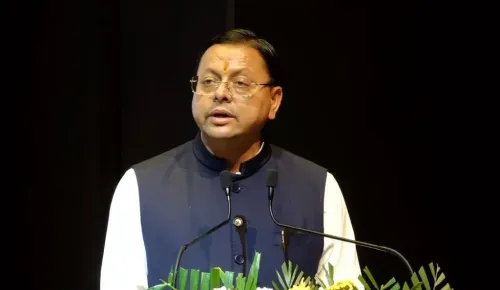
Anurag Thakur Cites IIT, IIM Expansion in Education Push
Synopsis
BJP MP Anurag Thakur highlighted India's higher education surge: IITs up from 16 to 23, IIMs from 13 to 22, universities from 760 to 1,330, women's enrolment at 2.2 crore, and India's Global Innovation Index rank leaping from 81st in 2015 to 38th in 2025.
Key Takeaways
IITs increased from 16 to 23 and IIMs from 13 to 22 under the Modi government's tenure.
Total universities in India have nearly doubled, rising from 760 to 1,330 .
Medical colleges have recorded a 118.6% increase in the same period.
Rural university enrolment grew by 38.3% since 2018-19 , reflecting improved access beyond metros.
Women's enrolment in higher education reached 2.2 crore in 2023-24 .
India climbed from 81st to 38th on the Global Innovation Index between 2015 and 2025 .
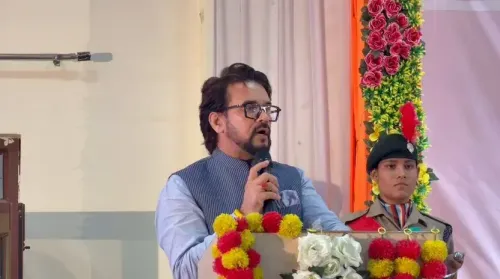
India's higher education landscape has been reshaped by numbers that are hard to ignore — BJP MP Anurag Thakur laid them out in stark detail on Sunday, September 27, 2026, pointing to a decade-long expansion that has added institutions, enrolled millions more women, and vaulted India up a global innovation ranking.
Posting in Hindi, Thakur argued that educational institutions are 'atimahattvapoorn' (of utmost importance) to building a 'Viksit Bharat' — a Developed India — and that collective effort is needed to establish the country as a 'global knowledge superpower.' The post then anchored that vision in a series of official figures attributed to the Modi government's tenure.
IITs from 16 to 23, IIMs from 13 to 22 — the institutional count
The headline numbers: the count of Indian Institutes of Technology (IITs) has grown from 16 to 23, while Indian Institutes of Management (IIMs) have expanded from 13 to 22. The total number of universities, Thakur stated, has surged from 760 to 1,330 — nearly doubling the university network across the country. Medical colleges, he added, have seen a 118.6% increase in the same period.
These expansions trace back to successive Union Budget announcements post-2014, when the central government began sanctioning new IITs and IIMs in states that had historically lacked premier institutions. The National Education Policy 2020 subsequently set a structural framework for quality and access, targeting a higher gross enrolment ratio and multidisciplinary learning environments.
38.3% rural enrolment rise and 2.2 crore women in higher education
Beyond elite institutions, Thakur's post spotlighted access gains at the base of the pyramid. Rural university enrolment has grown by 38.3% since 2018-19, he said, while women's enrolment in higher education reached 2.2 crore in 2023-24 — a figure that, if sustained, would mark one of the largest expansions of female participation in tertiary education in the country's history.
These metrics align with broader government drives to close the gender and geography gap in higher education — connecting students in Tier-2 and Tier-3 towns and rural districts to universities that simply did not exist in their regions a decade ago.
India's Global Innovation Index climb: 81st in 2015 to 38th in 2025
Thakur's sharpest data point may be India's trajectory on the Global Innovation Index (GII), published annually by the World Intellectual Property Organization (WIPO). India ranked 81st among 133 nations in 2015; by 2025, that position had climbed to 38th — a jump of 43 places in a decade. The GII measures inputs like institutions, human capital, and research alongside innovation outputs, making it a composite signal of whether a country's knowledge economy is actually producing results.
The next marker to watch is the forthcoming All India Survey on Higher Education (AISHE) report, which will either validate or complicate these enrolment figures — and parliamentary debates on the education budget for 2026-27 will test whether the expansion pipeline continues at pace.
Forty-three places up a global ranking. Nearly double the university count. Over two crore women in college. The numbers tell a story of scale — the question now is whether quality keeps up with quantity.
Point of View
Education analysts consistently distinguish between institutional proliferation and quality outcomes — faculty vacancies at newer IITs and IIMs, accreditation gaps in new universities, and graduate employment rates remain the harder tests that no ranking fully captures. The forthcoming AISHE report will be the real accountability moment.
NationPress
27 Sept 2026
Frequently Asked Questions
How many IITs and IIMs are there in India now?
According to BJP MP Anurag Thakur's post, India now has 23 IITs and 22 IIMs , up from 16 and 13 respectively before the current central government's tenure.
What is India's rank on the Global Innovation Index in 2025?
India ranked 38th on the Global Innovation Index in 2025, a significant climb from 81st place in 2015, according to figures cited by Anurag Thakur.
How much has women's enrolment in higher education increased in India?
Women's enrolment in higher education in India reached 2.2 crore in 2023-24, as cited in Anurag Thakur's post highlighting the Modi government's education access policies.
What is Viksit Bharat and how does it relate to education?
'Viksit Bharat' — meaning Developed India — is the Modi government's vision for India as a developed nation by 2047. Thakur argues that expanding quality higher education is central to achieving this goal, positioning India as a global knowledge superpower.
How many universities are there in India now compared to 2014?
The total number of universities in India has grown from 760 to 1,330 during the Modi government's tenure, according to figures shared by BJP MP Anurag Thakur.