Anurag Thakur Highlights Education Expansion at Mohali Summit
Synopsis
BJP MP Anurag Thakur addressed the Bharat Uchch Shiksha Shikhar Sammelan-2026 in Mohali, citing the Modi government's expansion of AIIMS from 7 to 23, MBBS seats from 51,000 to over 1.08 lakh, and universities from 450 to over 1,100 since 2014.
Key Takeaways
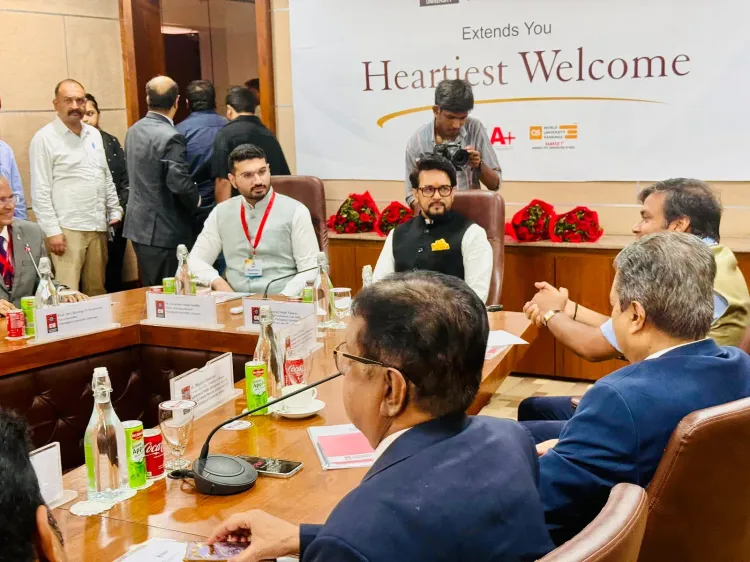
BJP MP Anurag Thakur spoke at the Bharat Uchch Shiksha Shikhar Sammelan-2026 at Chandigarh University, Mohali on June 18, 2026 .
Medical colleges grew from 350 (pre-2014) to 706 , and MBBS seats from roughly 51,000 to over 1.08 lakh .
AIIMS campuses expanded from 7 to 23 ; IITs from 12 to 19 ; IIMs from 16 to 23 .
Total universities rose from 450 in 2014 to more than 1,100 , while PG medical seats grew from 31,000 to over 70,000 .
The expansion aligns with the National Education Policy 2020 targets and the Pradhan Mantri Swasthya Suraksha Yojana .
BJP MP Anurag Thakur addressed the inaugural session of the Bharat Uchch Shiksha Shikhar Sammelan-2026 at Chandigarh University, Mohali, on Thursday, June 18, 2026, citing a sweeping expansion of medical and higher-education infrastructure under the Modi government since 2014. The former Union Minister used the platform to draw a detailed before-and-after comparison of institutional capacity across medical colleges, IITs, IIMs, and universities.
Context
Speaking at the summit, Thakur framed the government's record under the rubric of 'Reform, Perform aur Transform' (Reform, Perform and Transform), a phrase closely associated with Prime Minister Narendra Modi's governance philosophy. He stated that medical colleges had grown from 350 before 2014 to 706 today, while MBBS seats had more than doubled from roughly 51,000 to over 1.08 lakh. Postgraduate medical seats, he added, rose from around 31,000 to over 70,000 in the same period.
On the premier-institution front, Thakur noted that the number of AIIMS campuses expanded from 7 to 23, IITs from 12 to 19, and IIMs from 16 to 23. The total count of universities, he said, climbed from 450 in 2014 to more than 1,100 today.
Policy Backdrop
The expansion of AIIMS campuses beyond the original seven — located in New Delhi, Bhopal, Bhubaneswar, Jodhpur, Patna, Raipur and Rishikesh — was driven largely by the Pradhan Mantri Swasthya Suraksha Yojana (PMSSY), which received substantially scaled funding after 2014 to address regional imbalances in tertiary healthcare and medical education. New IIT campuses were set up through a combination of fresh establishments and upgradation of existing technical institutions.
The National Education Policy 2020, approved by the Union Cabinet, set out targets for raising India's gross enrolment ratio and expanding multidisciplinary and professional-education capacity — providing a policy framework within which many of these seat additions were pursued. The broader objective, as articulated by the government, has been to reduce the dependence of Indian students on foreign medical and technical universities.
Stakeholders and Impact
The most direct beneficiaries of the seat expansion are medical and engineering aspirants: a doubling of MBBS seats to over 1.08 lakh means proportionally more students can pursue domestic medical education without going abroad. State governments are key implementation partners, as many new medical colleges and universities operate under state jurisdiction even when centrally incentivised.
For postgraduate medical aspirants, the rise in PG seats from 31,000 to over 70,000 is particularly significant given long-standing demand-supply mismatches that had made competitive examinations exceptionally difficult. Management and technology sectors similarly benefit from the addition of seven new IIMs and seven new IITs, which have extended access to premium institution-branded education to newer geographies.
What's Next
Parliamentary deliberations on the 2026-27 Union education budget will be closely watched for fresh approvals of additional AIIMS or IIT campuses. State-level compliance reports on National Education Policy 2020 implementation — particularly on multidisciplinary curriculum rollout and faculty recruitment at newer institutions — will determine whether quantitative expansion translates into qualitative outcomes.
The Bharat Uchch Shiksha Shikhar Sammelan-2026 itself is expected to produce a set of recommendations on higher-education governance, which could feed into regulatory changes by the University Grants Commission and the National Medical Commission in the coming months.
Point of View
Using institution-count and seat-count metrics as the most legible proof points of governance delivery. The 'Reform, Perform, Transform' framing is a well-worn Modi-government rhetorical device, but the sheer volume of numbers cited — across medical colleges, AIIMS, IITs, IIMs, and universities — signals an intent to make education infrastructure a first-order electoral and policy credential. The choice of Chandigarh University, Mohali — a prominent private institution in Thakur's home state of Himachal Pradesh's neighbouring Punjab region — also carries regional political resonance. Whether the quantitative expansion translates into quality outcomes remains the central challenge that critics and independent assessors are likely to press on in the months ahead.
NationPress
19 Sept 2026
Frequently Asked Questions
How many AIIMS are there in India in 2026?
According to BJP MP Anurag Thakur's statement at the Bharat Uchch Shiksha Shikhar Sammelan-2026, there are 23 AIIMS in India today, up from 7 in 2014 . The expansion was driven primarily by the Pradhan Mantri Swasthya Suraksha Yojana .
How many medical colleges are there in India in 2026?
Anurag Thakur cited 706 medical colleges in India as of 2026, compared to 350 before 2014 when the Modi government came to power.
How many MBBS seats are available in India now?
As per figures cited by Anurag Thakur at the Mohali education summit , India now has over 1.08 lakh MBBS seats , more than double the roughly 51,000 seats available in 2014.
What is the Bharat Uchch Shiksha Shikhar Sammelan 2026?
The Bharat Uchch Shiksha Shikhar Sammelan-2026 is a national higher-education summit held at Chandigarh University, Mohali . Its inaugural session on June 18, 2026 focused on the development of education infrastructure and reform under the Modi government.
How many IITs and IIMs are there in India in 2026?
According to Anurag Thakur, India has 19 IITs (up from 12 in 2014) and 23 IIMs (up from 16 in 2014), reflecting significant expansion of premier technical and management institutions over the past decade.