Anurag Thakur flags AI plan and Semicon 2.0 to build ViksitBharat
Synopsis
BJP MP Anurag Thakur invokes an AI Workforce Acceleration Plan and a ₹1,27,500 crore Semicon 2.0 mission, calling for engineering colleges to be transformed into enterprise incubators as India races toward its ViksitBharat2047 self-reliance goal.
Key Takeaways
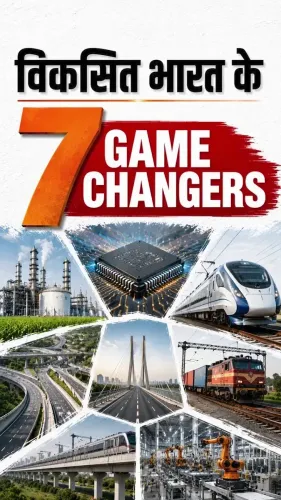
BJP MP Anurag Thakur posted on 3 November 2026 outlining India's technology self-reliance push under #ViksitBharat2047 .
The post cited an AI Workforce Acceleration Plan and a ₹1,27,500 crore Semicon 2.0 mission as the twin policy levers.
Engineering schools are being positioned for transition into enterprise incubators , moving away from a purely academic model.
The push aligns with the National Education Policy 2020 mandate for deeper industry-academia integration at IITs and NITs.
India's original India Semiconductor Mission was launched in 2021 to reduce import dependence; Semicon 2.0 signals a scaled ambition.
The Department of Science and Technology and Ministry of Education were tagged, indicating coordinated institutional intent.
India's engineering colleges are being reimagined as enterprise incubators — and BJP MP Anurag Thakur is making the case loudly. On Tuesday, 3 November 2026, the former Union Minister posted a bold vision for India's technology future, citing an AI Workforce Acceleration Plan and a ₹1,27,500 crore Semicon 2.0 mission as twin engines driving the country's transition toward technological self-reliance.
Thakur framed the push as laying 'the foundation for a technologically secure and self-reliant #ViksitBharat2047' — India's national vision to emerge as a developed economy by 2047, the centenary of independence. The post tagged the Department of Science and Technology, the Ministry of Education, and the student-engagement platform Think India, signalling a coordinated institutional messaging effort.
From classrooms to incubators: the engineering school pivot
The core claim is structural: India is no longer content with engineering schools that produce job-seekers. The stated goal is to convert them into enterprise-building ecosystems — institutions that generate companies, not merely graduates. This aligns directly with the National Education Policy 2020, which called for deeper industry-academia linkage and technology integration in higher technical institutions.
The language of 'enterprise incubators' is significant. It echoes a broader policy push — running since the Atmanirbhar Bharat framework took shape in 2020 — to align university curricula with live industry demands, reduce theoretical silos, and plug students into real innovation pipelines. IITs and NITs have been the primary targets of such reform conversations, with closer watch expected on curriculum changes in the next academic cycle.
Semicon 2.0 and the chip self-reliance bet
The semiconductor angle is arguably the sharpest edge of Thakur's post. India's original India Semiconductor Mission, launched in 2021, was designed to build domestic chip design and manufacturing capacity and reduce the country's dangerous import dependence — a vulnerability that global supply-chain disruptions had exposed. A scaled-up 'Semicon 2.0' framing, as invoked in the post, suggests an ambition to move well beyond the first mission's scope.
Chips are no longer just a commercial product — they are a sovereignty question. Nations that cannot design or fabricate semiconductors are, in effect, dependent on rivals for the hardware that runs everything from defence systems to smartphones. India's bet is that a combination of fiscal incentives for manufacturers and institutional reform in technical education can close that gap before 2047.
AI skilling and the workforce race
Alongside semiconductors, the invocation of an AI Workforce Acceleration Plan taps into the most consequential labour-market shift of the decade. Countries that train engineers to build, deploy, and govern AI systems — rather than merely use them — will hold asymmetric advantage in the global economy. Thakur's framing positions India as a country actively choosing to be on the producing end of that transformation.
The next concrete test of these ambitions will come in the Union Budget cycle, where supplementary allocations for AI skilling and semiconductor infrastructure will either validate the rhetoric or expose its limits. Engineering students and the tech industry are watching closely — both have the most to gain, and the most to lose, if execution falls short of the vision.
India's 2047 deadline is not a distant abstraction anymore. It is a 21-year sprint — and the starting gun for the technology leg has just been fired.
Point of View
Coordinated signal — tagging both the science ministry and the education ministry in a single breath — that technology self-reliance is now being treated as an education-policy imperative, not just an industrial one. The Semicon 2.0 framing builds on a lineage stretching from Atmanirbhar Bharat through NEP 2020, suggesting the BJP intends to own the narrative on India's deep-tech ambitions ahead of any electoral cycle. The real credibility test, however, lies in the Union Budget: without fresh allocations for AI skilling and semiconductor infrastructure, the vision risks remaining aspirational. If the money follows the messaging, this marks a genuine policy inflection point for India's engineering ecosystem.
NationPress
3 Nov 2026
Frequently Asked Questions
What is India's Semicon 2.0 mission?
Semicon 2.0 refers to a scaled-up phase of India's semiconductor push, building on the original India Semiconductor Mission launched in 2021 to develop domestic chip design and manufacturing capacity and reduce import dependence.
What is the AI Workforce Acceleration Plan India?
The AI Workforce Acceleration Plan, as cited by Anurag Thakur, is a policy initiative aimed at training India's engineering graduates to build, deploy, and govern artificial intelligence systems, positioning the country as a producer — not just a consumer — of AI technology.
What does ViksitBharat2047 mean?
ViksitBharat2047 is the Indian government's national vision to transform India into a fully developed economy by 2047, the centenary of independence, across sectors including technology, infrastructure, and manufacturing.
How is India turning engineering colleges into enterprise incubators?
Under frameworks aligned with the National Education Policy 2020, India is pushing IITs, NITs, and other technical institutions to deepen industry-academia linkages, embed startup and R&D culture in curricula, and produce job-creators alongside job-seekers.
Who is Anurag Thakur and what is his role in India's tech policy?
Anurag Thakur is a BJP Lok Sabha MP from Hamirpur, Himachal Pradesh, and former Union Minister of Information and Broadcasting and Youth Affairs and Sports. He has been a vocal advocate for India's technology self-reliance and youth-focused policy under the ViksitBharat2047 framework.