Anurag Thakur Hails 12 Years of Modi Govt Foreign Policy
Synopsis
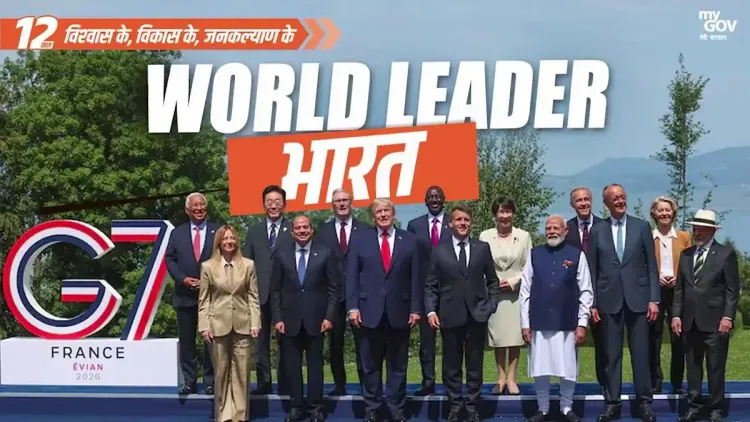
BJP MP Anurag Thakur on June 19, 2026, celebrated 12 years of the Modi government, asserting that India has emerged as a confident, decisive, and credible global leader through its 'India First' foreign policy and strengthened international relationships across multilateral and bilateral fronts.
Key Takeaways
BJP MP Anurag Thakur posted on June 19, 2026 , marking 12 years of the Modi government with the hashtag #12YearsOfIndiaFirst .
He described India as having emerged as a 'confident, decisive, and credible' global leader through successful foreign policy.
The Modi government introduced the 'Neighbourhood First' policy after coming to power in 2014 , later expanding to multi-alignment across Quad , BRICS , and SCO .
India 's G20 presidency in 2023 , hosted in New Delhi under the theme Vasudhaiva Kutumbakam , was a landmark in its global governance ambitions.
Upcoming BRICS and SCO summits and new bilateral agreements will serve as the next tests of the 'India First' foreign policy framework.
BJP MP Anurag Thakur on Friday, June 19, 2026, took to X to mark 12 years of the Modi government, asserting that India has emerged as a confident, decisive, and credible global leader on the strength of its foreign policy successes and strengthened international relationships.
Context
Thakur's post, carrying the hashtag #12YearsOfIndiaFirst, celebrated what he described as 'विदेशों में बजता नए भारत का डंका' — loosely translated as 'the new India making its mark across the world.' The former Union Minister framed the past decade-plus as a period in which India shed strategic hesitancy and stepped into a more assertive international role. The post was accompanied by a video, underlining the party's effort to use multimedia to amplify the government's foreign policy narrative.
The Bharatiya Janata Party has consistently promoted an 'India First' doctrine since coming to power in 2014, positioning every major diplomatic engagement as an expression of that principle. Thakur, who has served as Union Minister for both Information & Broadcasting and Youth Affairs & Sports, has been a prominent voice in projecting the government's achievements to a domestic and diaspora audience.
Policy Backdrop
The Modi government entered office in 2014 with a stated 'Neighbourhood First' policy, signalling a shift in how New Delhi would engage with South Asia. Over the following years, India deepened its participation in multilateral groupings including the Quad, BRICS, and the Shanghai Cooperation Organisation (SCO), while simultaneously expanding bilateral defence and trade partnerships with major powers across Europe, the Indo-Pacific, and the Americas.
A landmark moment in this trajectory was India's presidency of the G20 in 2023, when New Delhi hosted the Leaders' Summit under the theme Vasudhaiva Kutumbakam ('The World Is One Family'). The summit was widely seen as consolidating India's claim to a seat at the top table of global governance. Analysts have described the broader shift as a move from traditional non-alignment toward 'multi-alignment' — balancing ties with the United States, Russia, and the European Union simultaneously.
Stakeholders and Impact
India's growing diplomatic footprint has tangible consequences for its global partners, its strategic establishment, and millions of Indians living and working abroad. Stronger bilateral frameworks have facilitated easier mobility agreements, defence co-production arrangements, and expanded trade corridors. The government's foreign policy posture has also shaped domestic political discourse, with the ruling party regularly citing international recognition as evidence of effective governance.
Critics within the opposition have at times questioned whether the optics of high-profile summitry translate into durable strategic gains, particularly on sensitive bilateral fronts. However, Thakur's post reflects the ruling party's view that 12 years of consistent engagement have produced measurable credibility for India on the world stage.
What's Next
India's engagement in upcoming BRICS and SCO summits, along with any new bilateral defence or trade agreements, will be closely watched as indicators of whether the momentum Thakur describes continues to hold. The government's ability to navigate an increasingly complex multipolar environment — balancing relationships with rival powers — remains the central test of the 'India First' foreign policy framework going forward.
Point of View
Designed to consolidate the BJP's narrative that assertive diplomacy is a core electoral asset. The 'India First' framing connects domestic pride to foreign policy outcomes, a rhetorical arc the party has sustained since 2014. By invoking multi-alignment and global recognition, the post implicitly rebuts opposition arguments that India's foreign policy has been personality-driven rather than institutionally grounded. The forward-looking hashtag also signals that the party intends to carry this foreign policy record as a campaign pillar into future electoral cycles.
NationPress
21 Sept 2026
Frequently Asked Questions
What did Anurag Thakur say about India's foreign policy?
Anurag Thakur posted on June 19, 2026, that over 12 years of the Modi government, India has emerged as a confident, decisive, and credible global leader on the strength of its successful foreign policy and strengthened international relationships.
What is the 'India First' policy of the BJP?
'India First' is the BJP's overarching doctrine, introduced after the 2014 elections, that prioritises India's national interest across both domestic governance and foreign policy, including initiatives like 'Neighbourhood First' and active participation in Quad, BRICS, and SCO.
What was India's G20 presidency theme?
India hosted the G20 Leaders' Summit in New Delhi in 2023 under the theme 'Vasudhaiva Kutumbakam,' a Sanskrit phrase meaning 'The World Is One Family,' which underscored India's vision of inclusive global governance.
What is multi-alignment in Indian foreign policy?
Multi-alignment refers to India's strategy, developed since 2014, of simultaneously maintaining strong ties with rival global powers such as the United States, Russia, and the European Union, rather than aligning exclusively with any single bloc.
What multilateral groups is India part of?
India is an active member of several major multilateral groupings including the Quad (with the US, Japan, and Australia), BRICS, and the Shanghai Cooperation Organisation (SCO), reflecting its broad diplomatic engagement across regions.