Anurag Thakur pitches India's youth as global talent partner at Raisina Middle East 2026
Synopsis
At the Raisina Middle East 2026 conference in Abu Dhabi, BJP MP Anurag Thakur argued that India's 700 million youth under 25 become a strategic asset only through targeted skilling, NEP 2020, and Digital Public Infrastructure — and called for trust-based global talent mobility frameworks.
Key Takeaways
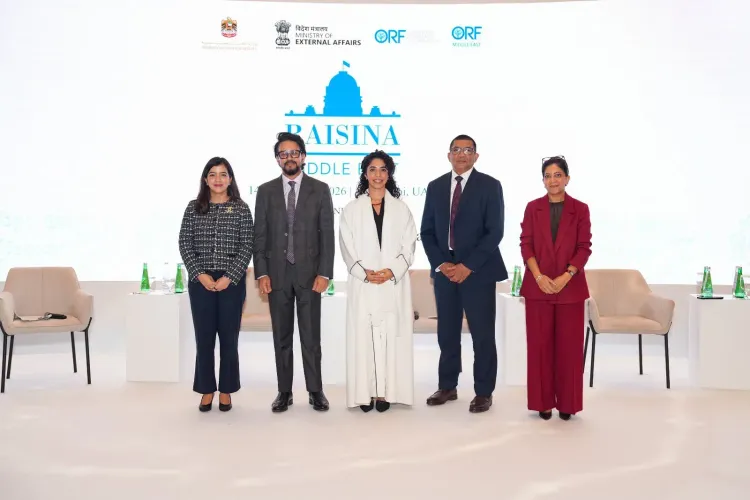
BJP MP Anurag Thakur participated in the #RaisinaMiddleEast2026 panel 'Demography is Destiny' in Abu Dhabi on 19 October 2026 .
He cited India's 700 million citizens under 25 as the country's 'greatest strategic asset,' conditional on targeted capability-building.
Three policy pillars were highlighted: Skill India (launched 2015), NEP 2020 , and India's Digital Public Infrastructure stack including Aadhaar and UPI.
Thakur called for replacing friction with 'trust-based, rules-based mobility frameworks' in international talent flows.
He positioned India as both a global talent partner and an emerging destination for innovation, not merely a labour exporter.
The conference was organised by the Observer Research Foundation (ORF) , which runs the Raisina Dialogue series since 2016 .
From a panel stage in Abu Dhabi, BJP MP Anurag Thakur delivered a pointed argument to an international audience on Monday, 19 October 2026: India's 700 million citizens under the age of 25 are not merely a demographic fact — they are a strategic asset, but only if backed by deliberate capability-building.
Thakur participated in the #RaisinaMiddleEast2026 panel discussion titled 'Demography is Destiny: People, Places, and Perceptions', organised by the Observer Research Foundation (ORF). He shared the stage with Nouf Ali Al Hameli, Srinarayan Sankaran, and Nadia Verjee, with the session moderated by Aakanksha Tewari. The setting — the UAE capital, a regional hub at the crossroads of South Asian labour flows and Gulf ambition — gave the conversation immediate geopolitical weight.
Demography without strategy is just a number
The core of Thakur's intervention was a crisp corrective to passive optimism. 'Demography only becomes destiny when backed by targeted capability-building,' he argued, pushing back against the notion that a large young population automatically translates into economic power. It is a distinction economists and policymakers have wrestled with for two decades — and one that has sharpened as competing nations race to attract and retain skilled workers.
To make the case that India is doing the work, Thakur pointed to three pillars under Prime Minister Narendra Modi's government: the Skill India Mission, launched in 2015 with an original target of training 400 million people by 2022; the National Education Policy 2020, which overhauled a framework untouched since 1986 by introducing multidisciplinary learning and vocational pathways; and India's Digital Public Infrastructure (DPI) stack — Aadhaar, UPI, and DigiLocker — built progressively from 2014 onwards and now cited globally as a model for scalable service delivery.
The mobility framework argument — and why Abu Dhabi is the right room to make it
Perhaps the sharpest line of the session was Thakur's call for 'trust-based, rules-based mobility frameworks' to replace friction in international talent flows. The framing matters: it positions India not as a country that exports labour out of economic necessity, but as a rules-abiding partner that demands reciprocal structure from destination countries.
The UAE is a natural interlocutor for that argument. The Gulf state hosts one of the world's largest Indian diaspora communities, and bilateral labour and investment ties have deepened significantly through the India-UAE Comprehensive Economic Partnership Agreement signed in recent years. A Raisina edition anchored in Abu Dhabi — ORF's flagship Raisina Dialogue was first launched in 2016 — signals India's intent to embed its foreign policy conversation directly in Middle Eastern capitals.
From talent exporter to innovation destination
Thakur's closing framing was the most ambitious: India, he said, is 'not just a source of world-class talent, but a key global talent partner and a thriving destination for innovation.' The pivot from exporter to destination is a recurring motif in current Indian diplomatic messaging, and its credibility rests heavily on whether the DPI stack, reformed universities, and skilling infrastructure can generate enough pull to match the long-standing push of outward migration.
The next stress-tests for that argument will come in the form of periodic implementation reports from the Ministry of Education and the Ministry of Skill Development — and in whether the Abu Dhabi conversations translate into concrete bilateral mobility agreements.
India has the numbers. The question the panel posed — and left open — is whether the architecture being built around those numbers is moving fast enough to matter in the decade ahead.
Point of View
Particularly in regions with large Indian diaspora presence. By tying domestic policy instruments — Skill India, NEP 2020, DPI — to international mobility arguments, the BJP is attempting to convert flagship welfare programmes into foreign policy credibility. The emphasis on 'trust-based' frameworks is also a subtle signal to Gulf and Western partners that India wants structured, reciprocal agreements rather than unregulated labour outflows. How much of this translates into binding bilateral commitments, rather than conference messaging, will determine the argument's durability.
NationPress
19 Oct 2026
Frequently Asked Questions
What is Raisina Middle East 2026?
Raisina Middle East 2026 is a regional edition of the Raisina Dialogue series organised by the Observer Research Foundation (ORF), held in Abu Dhabi. The Raisina Dialogue was first launched by ORF in 2016 as India's flagship annual geopolitical conference, with regional editions extending its reach to the Middle East.
What did Anurag Thakur say about India's youth at the Abu Dhabi panel?
Thakur said India's 700 million citizens under the age of 25 are the country's 'greatest strategic asset,' but stressed that demography only becomes destiny when backed by targeted capability-building through programmes like Skill India, NEP 2020, and Digital Public Infrastructure.
What is India's Digital Public Infrastructure (DPI)?
India's Digital Public Infrastructure is a stack of interoperable digital systems — including Aadhaar (biometric identity), UPI (payments), and DigiLocker (document storage) — built progressively from 2014 onwards. It is widely cited as a scalable model for digital service delivery and has become a key element of India's international tech diplomacy.
What is the Skill India Mission?
Skill India is a national mission launched in 2015 by the Modi government to provide vocational training and certification to millions of Indian youth for employment. Its original target was to train 400 million people by 2022, spanning sectors from manufacturing to digital services.
What did Anurag Thakur mean by 'trust-based, rules-based mobility frameworks'?
Thakur was calling for structured bilateral and multilateral agreements governing the movement of skilled workers across borders — replacing ad hoc or friction-heavy processes with transparent, reciprocal frameworks. The argument positions India as a partner that expects orderly, rules-governed talent mobility rather than unregulated outward migration.