Arunachal CMO: APFRA 1978 Rules Panel Submits Report
Synopsis
The High-Powered Committee chaired by retired Gauhati High Court judge Justice Brojendra Prasad Katakey has submitted its report on draft rules for the Arunachal Pradesh Freedom of Religion Act, 1978 — a law that has remained without enforceable rules for nearly five decades.
Key Takeaways
The High-Powered Committee on draft rules for the Arunachal Pradesh Freedom of Religion Act, 1978 has submitted its report to the State Government.
The committee was chaired by Justice (Retd.) Brojendra Prasad Katakey , a retired judge of the Gauhati High Court.
The APFRA, 1978 prohibits religious conversions by force, fraud, or inducement but has lacked notified rules for enforcement for nearly 50 years .
The announcement was made by the Chief Minister's Office of Arunachal Pradesh on June 9, 2026 .
The next step is the State Government's review and potential notification of the rules, with possible debate in the Arunachal Pradesh Legislative Assembly .
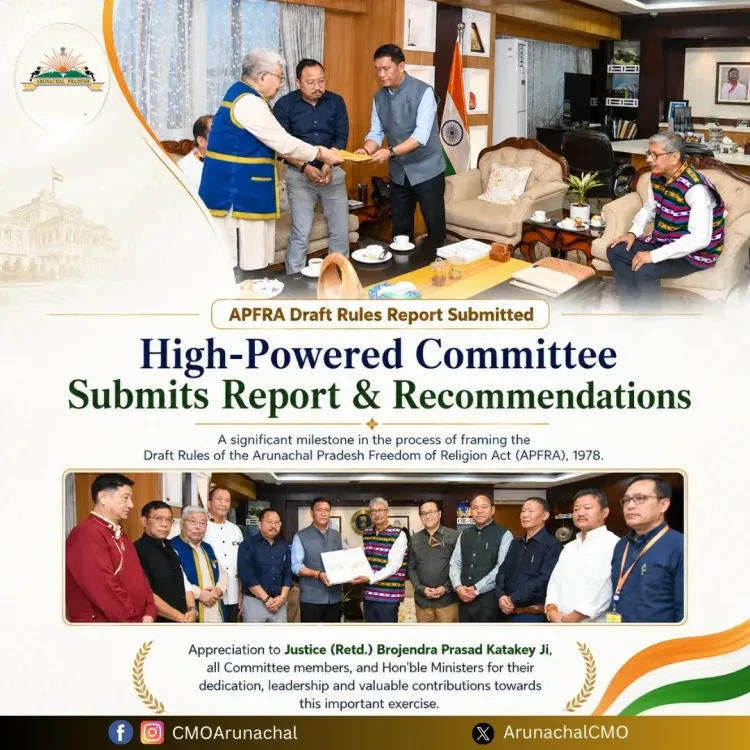
The Chief Minister's Office of Arunachal Pradesh announced on Tuesday, June 9, 2026, that the High-Powered Committee constituted to draft rules under the Arunachal Pradesh Freedom of Religion Act (APFRA), 1978 has formally submitted its report to the State Government. The CMO also extended appreciation to the committee's chair, Justice (Retd.) Brojendra Prasad Katakey, and all members for their contributions.
Context
The Arunachal Pradesh Freedom of Religion Act, 1978 was enacted to prohibit religious conversions carried out through force, fraud, or inducement — a concern particularly acute in the state's predominantly tribal areas. Despite being on the books for nearly five decades, the Act had never been operationalised due to the absence of notified rules. The submission of this committee report marks a significant step toward giving the legislation practical effect.
The High-Powered Committee was chaired by Justice (Retd.) Brojendra Prasad Katakey, a retired judge of the Gauhati High Court, lending the review process judicial credibility and institutional weight. The committee's mandate was to draft rules that would allow the State Government to implement and enforce the 1978 Act.
Policy Backdrop
Multiple Indian states — including Madhya Pradesh, Odisha, and Chhattisgarh — enacted freedom-of-religion laws between the 1960s and 1970s. Several have since revisited these statutes, forming expert committees to frame or update enforcement rules amid renewed national debate on religious conversion, particularly in tribal-majority regions. Arunachal Pradesh's move fits squarely within this broader pattern.
The Northeast has historically been a focal point of conversion-related discourse, given its diverse tribal demographics and the active presence of missionary organisations over the past century. The APFRA was a legislative response to community concerns at the time, and the push to operationalise it reflects the state government's current governance priorities.
Stakeholders and Impact
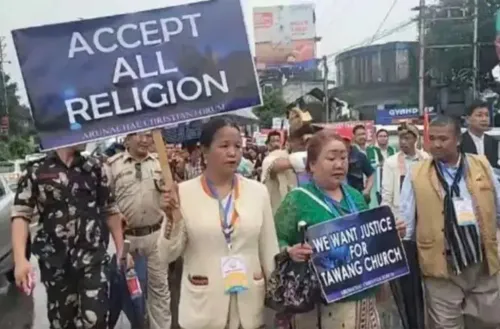
The most directly affected stakeholders are Arunachal Pradesh's tribal communities, whose cultural and religious identities the 1978 Act was originally designed to protect. Religious organisations — both indigenous and those engaged in conversion activities — will also be closely watching the final shape of the rules.
Civil society groups and legal scholars have long debated the constitutional boundaries of such legislation, particularly around Articles 25 and 26 of the Constitution, which guarantee freedom of religion. The rules framed on the basis of this committee's report will determine how the State Government navigates those boundaries in practice.
What's Next
The State Government must now review the committee's report and decide whether to notify the rules as submitted or revise them before formal notification. A subsequent discussion in the Arunachal Pradesh Legislative Assembly remains a possibility, particularly if the rules generate political or community debate. The exact timeline for notification has not been announced. How swiftly the government moves from report to enforceable rules will signal the administration's seriousness about closing a nearly 50-year governance gap — and will set a precedent for how other northeastern states handle dormant legislation of similar sensitivity.
Point of View
Likely anticipating constitutional challenges. This move aligns with a broader pattern of BJP-governed states revisiting dormant conversion-related legislation, making the content and tone of the final rules politically consequential well beyond Arunachal Pradesh's borders. The speed and fidelity with which the government translates the committee's report into notified rules will be the real test of administrative intent.
NationPress
24 Oct 2026
Frequently Asked Questions
What is the Arunachal Pradesh Freedom of Religion Act 1978?
The Arunachal Pradesh Freedom of Religion Act, 1978 is a state law that prohibits religious conversions carried out through force, fraud, or inducement, enacted primarily to protect the tribal communities of Arunachal Pradesh.
Why did APFRA 1978 not have rules for so long?
The Act was enacted in 1978 but the State Government never notified the implementing rules required to enforce it, leaving the legislation dormant for nearly five decades.
Who chaired the High-Powered Committee on APFRA rules?
Justice (Retd.) Brojendra Prasad Katakey, a retired judge of the Gauhati High Court, chaired the High-Powered Committee constituted to draft rules under the APFRA, 1978.
What happens after the committee submits its report?
The State Government will review the report and may notify the draft rules, after which they could be debated in the Arunachal Pradesh Legislative Assembly before coming into force.
Which other Indian states have similar freedom of religion laws?
States including Madhya Pradesh, Odisha, and Chhattisgarh enacted similar freedom-of-religion laws between the 1960s and 1970s, and several have since updated or sought to enforce those statutes.