CM Pema Khandu: APFRA Draft Rules Committee Submits Report

Synopsis
The High-Powered Committee on draft rules for the Arunachal Pradesh Freedom of Religion Act, 1978, has submitted its report to the State Government. Chief Minister Pema Khandu credited retired judge Justice B.P. Katakey and three cabinet ministers for leading the process. Cabinet approval and gazette notification are the next steps.
Key Takeaways
The High-Powered Committee on the APFRA, 1978 draft rules has officially submitted its report and recommendations to the Arunachal Pradesh State Government.
The committee was chaired by Justice (Retd.) Brojendra Prasad Katakey , a former Gauhati High Court judge.
Cabinet ministers Mama Natung , Balo Raja , and Kento Jini were specially recognised by CM Pema Khandu for their contributions.
The APFRA, 1978 is one of India's oldest state-level anti-conversion statutes, prohibiting conversions by force, inducement, or fraud.
The report must now clear state cabinet approval before final rules are notified in the official gazette.
The development aligns with a broader national trend of BJP-governed states revisiting and strengthening anti-conversion legal frameworks.
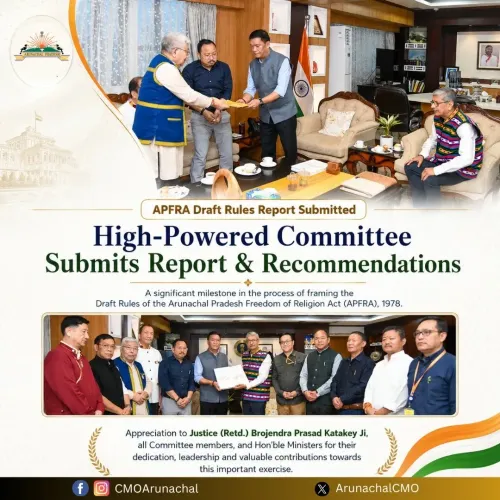
Arunachal Pradesh Chief Minister Pema Khandu announced on Monday, June 8, 2026, that the High-Powered Committee on the Draft Rules of the Arunachal Pradesh Freedom of Religion Act (APFRA), 1978, has officially submitted its report and recommendations to the State Government. The committee was chaired by retired judge Justice Brojendra Prasad Katakey and included senior cabinet ministers.
Context
The Arunachal Pradesh Freedom of Religion Act, 1978, is one of India's earliest state-level statutes regulating religious conversions, specifically prohibiting conversions carried out by force, inducement, or fraud. Despite being on the books for nearly five decades, the Act had long lacked operational rules — a gap that the High-Powered Committee was constituted to address by drafting a comprehensive regulatory framework.
Chief Minister Khandu extended congratulations to Justice (Retd.) Brojendra Prasad Katakey, the committee chairman, and all its members for what he described as 'tremendous work, commitment, and dedication.' He offered special appreciation to three cabinet ministers — Mama Natung, Balo Raja, and Kento Jini — for their 'leadership and valuable contributions throughout the process.'
Policy Backdrop
The APFRA, 1978, was enacted at a time when Arunachal Pradesh's predominantly tribal communities were at the centre of debates over religious identity and missionary activity in the northeastern frontier. The law predates similar anti-conversion statutes in several other Indian states, making Arunachal Pradesh a pioneer in this legislative domain.
Over the past decade, multiple Indian states have revisited or strengthened their anti-conversion frameworks, citing concerns over demographic change and unregulated proselytisation in tribal regions. States such as Himachal Pradesh and Uttarakhand have undertaken comparable rule-framing exercises, particularly after BJP governments assumed office. The committee's report in Arunachal Pradesh fits within this broader national pattern of renewed regulatory attention to conversion-related legislation.
Stakeholders and Impact
Arunachal Pradesh's tribal communities — who constitute the majority of the state's population — are the primary stakeholders in any rules framed under the APFRA. Religious minorities and civil society groups active in the state will also watch the recommendations closely, as the final rules will define the procedural and enforcement architecture of the Act.
The committee's composition — chaired by a retired Gauhati High Court judge and supported by three serving cabinet ministers — signals that the State Government has treated this exercise as a high-priority legal and administrative undertaking. The involvement of Justice Katakey lends judicial credibility to the recommendations that will eventually go before the state cabinet.
What's Next
The report now moves to the Arunachal Pradesh State Government for review and deliberation. The next critical step is cabinet approval of the committee's recommendations, after which the final rules would be notified in the official gazette to bring the APFRA's enforcement mechanism into full legal effect.
How the government balances the rights of tribal communities with constitutional protections for religious minorities will determine the political and legal reception of the final rules — both within the state and at the national level, where anti-conversion legislation remains a closely watched policy area.
Point of View
Converting a nearly five-decade-old statute from a largely symbolic law into one with an enforceable procedural framework. By anchoring the process in a retired High Court judge's committee and involving three cabinet ministers, the government has insulated the exercise from easy legal challenge while signalling political seriousness. This move fits squarely within the BJP's broader governance pattern across northeastern and hill states, where tribal identity and religious demography intersect as potent political issues. The real test will come at the gazette notification stage, when the specifics of the rules will face scrutiny from constitutional courts and civil society alike.
NationPress
22 Oct 2026
Frequently Asked Questions
What is the Arunachal Pradesh Freedom of Religion Act 1978?
The Arunachal Pradesh Freedom of Religion Act, 1978, is a state law that prohibits religious conversions carried out by force, inducement, or fraud. It is one of India's earliest state-level anti-conversion statutes, enacted to protect the religious identity of the state's predominantly tribal communities.
Who chaired the High-Powered Committee on APFRA draft rules?
Retired judge Justice Brojendra Prasad Katakey, a former Gauhati High Court judge, was appointed to chair the High-Powered Committee on the draft rules of the Arunachal Pradesh Freedom of Religion Act, 1978.
What happens after the APFRA committee submits its report?
After submission, the report goes to the Arunachal Pradesh State Government for review. The next step is cabinet approval of the recommendations, following which the final rules would be notified in the official gazette to make the Act fully operational.
Why does the APFRA need draft rules if it was passed in 1978?
While the APFRA was enacted in 1978, the Act had long lacked the operational rules needed to implement and enforce its provisions. The High-Powered Committee was constituted specifically to draft these rules, bridging a decades-long regulatory gap.
Which ministers were involved in the APFRA rules committee?
Cabinet ministers Mama Natung, Balo Raja, and Kento Jini were part of the High-Powered Committee process. Chief Minister Pema Khandu specifically recognised their leadership and contributions alongside committee chairman Justice (Retd.) Brojendra Prasad Katakey.