CM Pema Khandu: Arunachal cabinet amends land rules
Synopsis
The Arunachal Pradesh cabinet has amended the state's 2012 Land Settlement and Records Rules to allow automatic land-use conversion in Master Plan zones, simplify regulations for farmers and landowners, and introduce digital-ready land records — a significant governance reform for the complex-tenure northeastern state.
Key Takeaways
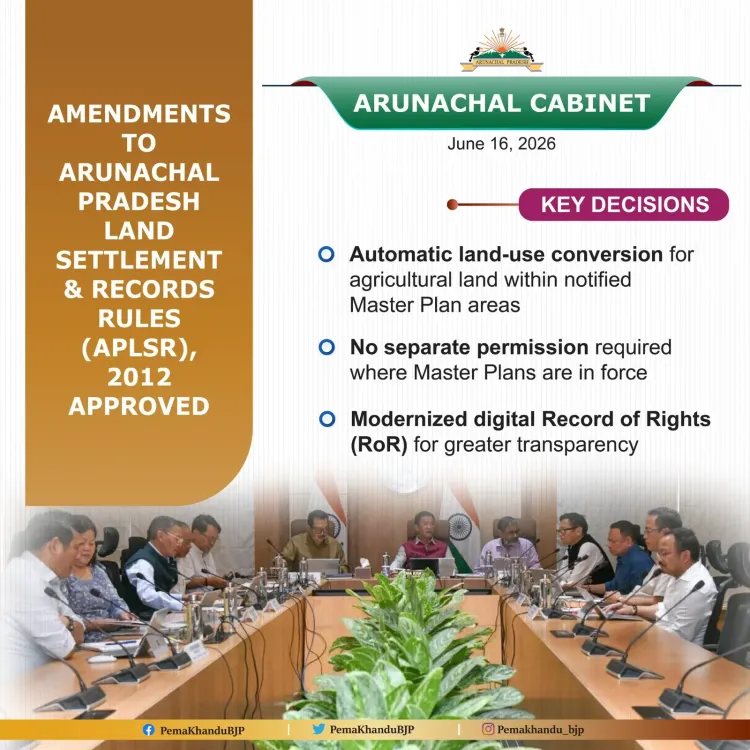
The Arunachal Pradesh State Cabinet approved amendments to the Arunachal Pradesh Land Settlement and Records Rules, 2012 on June 16, 2026 .
The amendments introduce automatic land-use conversion within notified Master Plan areas , removing the need for case-by-case discretionary approvals.
New rules aim to simplify land regulations for landowners and farmers , reducing procedural burden.
The reforms mandate digital-ready land records to improve transparency and reduce disputes.
The move aligns with the national Digital India Land Records Modernisation Programme (DILRMP) framework.
Arunachal Pradesh's unique tribal land tenure and Inner Line Permit framework makes such reforms more complex — and more consequential — than in most other states.
Arunachal Pradesh Chief Minister Pema Khandu announced on Tuesday, June 16, 2026, that the state cabinet has approved key amendments to the Arunachal Pradesh Land Settlement and Records Rules, 2012, aimed at simplifying land-use conversion and modernising land administration across the state.
Context
The cabinet decision introduces three significant changes: automatic land-use conversion within notified Master Plan areas, simpler regulations for landowners and farmers, and the creation of modernised, digital-ready land records for greater transparency. Chief Minister Khandu shared the decisions directly on social media, framing them as a step toward streamlining governance in the state.
The 2012 Rules have governed land settlement, record-keeping, and use-conversion procedures in Arunachal Pradesh for over a decade. The amendments signal the state government's intent to reduce procedural bottlenecks that have long required discretionary approvals for routine land-use changes inside planned urban and peri-urban zones.
Policy Backdrop
The push to modernise land records in Arunachal Pradesh aligns with the national Digital India Land Records Modernisation Programme (DILRMP), which succeeded the earlier National Land Records Modernisation Programme (NLRMP) launched by the Government of India in 2008. The central programme has encouraged states to computerise records, enable online mutation, and reduce human discretion in routine land transactions.
Arunachal Pradesh presents a uniquely complex land governance landscape. The state's predominantly tribal land tenure systems, customary rights, and Inner Line Permit (ILP) restrictions add layers of legal complexity that do not exist in most other Indian states. Reforming even procedural rules here carries significant implications for how land is accessed, recorded, and converted.
Across India, states including Telangana, Maharashtra, and Rajasthan have progressively amended colonial-era land laws to allow automatic conversions within master-plan zones, reducing the scope for arbitrary official decisions. The northeastern states have generally lagged in such reforms, making Arunachal Pradesh's move notable in a regional context.
Stakeholders and Impact
The most immediate beneficiaries are landowners and farmers in areas covered by notified Master Plans, who previously had to navigate multi-step approval processes to convert agricultural or other land to residential or commercial use. Automatic conversion within these zones is expected to cut processing time and reduce opportunities for rent-seeking.
Digital-ready land records will also matter for financial inclusion: clear, computerised title records make it easier for landowners to use land as collateral for institutional credit. For a state where land records have historically been paper-based and susceptible to disputes, the shift to digital formats could reduce litigation and improve tenure security for tribal communities.
What's Next
The state government is expected to issue detailed notifications specifying which areas fall under notified Master Plans and the exact timelines for digitising existing records. Observers will watch whether Arunachal Pradesh integrates its updated records with the national DILRMP portal, which would enable inter-agency data sharing and improve the state's land governance ranking. The practical impact of the amendments will depend heavily on the pace of implementation and the capacity of district-level land administration offices to handle the digital transition.
Point of View
Paper-based records, and discretionary official powers. By embedding automatic conversion within notified Master Plan zones, the government is reducing a key source of procedural delay and potential corruption. The move fits a broader national pattern of states aligning land administration with digital-India frameworks, but its real test will be in implementation — particularly whether district-level offices can absorb the digital transition. For CM Pema Khandu, the reform also carries political utility: visible, process-oriented governance improvements are a credible deliverable ahead of any electoral cycle.
NationPress
15 Sept 2026
Frequently Asked Questions
What changes did the Arunachal Pradesh cabinet make to land rules in 2026?
The cabinet approved amendments to the Arunachal Pradesh Land Settlement and Records Rules, 2012 to allow automatic land-use conversion in notified Master Plan areas, simplify regulations for landowners and farmers, and introduce digital-ready land records.
What is automatic land-use conversion in Master Plan areas?
Automatic land-use conversion means that landowners in areas covered by a notified Master Plan can convert their land from one use category to another — such as agricultural to residential — without requiring separate discretionary approval from officials, reducing delays and paperwork.
How does this affect farmers and landowners in Arunachal Pradesh?
Farmers and landowners in notified Master Plan zones will face fewer procedural hurdles for land-use conversion. Digital land records will also make it easier to establish clear title, which can help in accessing institutional credit and resolving disputes.
What is the DILRMP and how does it relate to this reform?
The Digital India Land Records Modernisation Programme (DILRMP) is a central government initiative to computerise and modernise land records across India. Arunachal Pradesh's move to create digital-ready land records aligns with this national framework.
Why is land reform more complex in Arunachal Pradesh than in other states?
Arunachal Pradesh has predominantly tribal land tenure systems, customary rights, and Inner Line Permit (ILP) restrictions that add legal complexity not found in most other Indian states, making any amendment to land rules more consequential and requiring careful implementation.