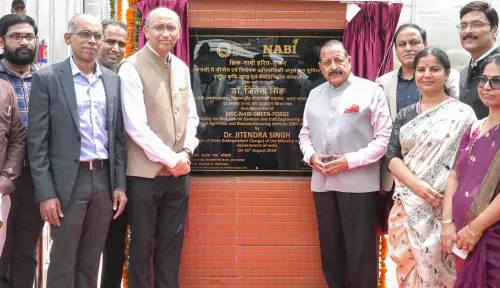
SPROUT facility launched at NIPGR to boost genomics-led crop improvement

Synopsis
India has launched SPROUT, a season-independent phenotyping facility at BRIC-NIPGR, that — paired with the SpeedSeed technology cutting chickpea breeding cycles to just 40 days — could fundamentally compress the timeline from gene discovery to field-ready climate-resilient varieties.
Key Takeaways
Jitendra Singh inaugurated the SPROUT facility at BRIC-NIPGR, New Delhi on 15 September 2026 .
SPROUT enables year-round, controlled-environment high-throughput phenotyping and precision stress screening of crop lines.
Chickpea is the primary crop focus; the facility will connect genomics advances to trait evaluation and applied breeding.
Companion technology SpeedSeed can reduce the chickpea generation cycle to approximately 40 days , shortening conventional breeding timelines significantly.
The initiative is anchored in the government's BioE3 policy , which prioritises climate-resilient agriculture as a strategic sector.
Improved varieties from agricultural biotechnology research already cover crops including rice, wheat, pulses, millets, and vegetables .
Union Minister of State for Science and Technology and Earth Sciences Dr. Jitendra Singh on Tuesday, 15 September 2026, inaugurated the SPROUT (SpeedSeed Phenotyping and Resource Optimization for Unified Trait Analysis) facility at the BRIC-National Institute of Plant Genome Research (BRIC-NIPGR) in New Delhi, marking a significant step toward developing climate-resilient crops through precision genomics.
What SPROUT Is and How It Works
The SPROUT facility is a season-independent, controlled-environment infrastructure designed for high-throughput phenotyping, precision stress screening, and the evaluation of germplasm, breeding populations, mutants, transgenic lines, and genome-edited varieties. By operating independent of seasonal cycles, the facility allows researchers to study crop traits year-round under precisely controlled conditions.
With a major focus on chickpea, SPROUT is intended to bridge the gap between advances in genomics and genome editing on one hand, and precise trait evaluation and applied breeding on the other. The goal is a faster, more reliable pipeline from gene discovery to crop improvement.
SpeedSeed Technology: Cutting Breeding Timelines
BRIC-NIPGR has also developed SpeedSeed, a complementary technology for accelerated generation advancement. Optimised protocols under this system can reduce the generation cycle in chickpea to approximately 40 days — considerably shorter than conventional breeding timelines. The technology can be deployed within the SPROUT facility or adapted to other suitable controlled-environment setups.
According to the Ministry of Science and Technology, together, SPROUT and SpeedSeed can accelerate the evaluation of promising crop traits and shorten the journey from laboratory research to improved field varieties.
Policy Context: BioE3 and Agricultural Biotechnology
The SPROUT initiative is part of the government's broader BioE3 policy — a strategic biotechnology framework that lists climate-resilient agriculture among its priority thematic sectors. Dr. Singh highlighted that the facility represents a convergence of the government's simultaneous push in both plant biotechnology and human biotechnology.
The Ministry noted that agricultural biotechnology research has already yielded improved plant varieties and genotypes across economically important crops — including rice, wheat, oilseeds, pulses, millets, fruits, and vegetables. Work on plant-microbiome interactions, it added, is opening new possibilities for beneficial microorganisms to support sustainable crop productivity, soil health, and nutrient availability.
Why India Needs This Infrastructure
India's vast geographical and agro-climatic diversity makes the ability to evaluate crops under varied environmental conditions especially critical. A single crop variety performing well under one climatic regime may underperform in another, making controlled-environment phenotyping a key tool for agricultural resilience.
Dr. Singh stressed that modern biotechnology must increasingly be translated into technologies that address real agricultural challenges and deliver tangible benefits to farmers — a recurring theme in the government's science policy articulations over recent years.
What Comes Next
With SPROUT now operational, researchers at BRIC-NIPGR are expected to advance trait evaluation work across multiple crop species, with chickpea as the initial focus. The integration of SpeedSeed protocols is anticipated to sharply reduce the time between gene identification and the release of improved varieties — a bottleneck that has historically slowed agricultural innovation in India.
Point of View
But the harder challenge — translating controlled-environment breakthroughs into adoption at the farm level — remains largely unaddressed in the announcement. India has a long history of producing impressive laboratory-stage crop varieties that stall somewhere between the research station and the smallholder farmer. The 40-day chickpea cycle under SpeedSeed is genuinely promising given India's pulse import dependence, but the path from phenotyping facility to seed-system integration involves regulatory, extension and supply-chain hurdles that no single facility can resolve. The real test will be whether BioE3's implementation framework closes that gap or whether SPROUT becomes another well-equipped facility whose outputs don't reach the fields.
NationPress
15 Sept 2026
Frequently Asked Questions
What is the SPROUT facility inaugurated at BRIC-NIPGR?
SPROUT (SpeedSeed Phenotyping and Resource Optimization for Unified Trait Analysis) is a season-independent, controlled-environment facility at BRIC-National Institute of Plant Genome Research in New Delhi, inaugurated on 15 September 2026. It enables high-throughput phenotyping, precision stress screening, and evaluation of crop lines including germplasm, mutants, and genome-edited varieties, with a primary focus on chickpea.
What is SpeedSeed and how does it differ from SPROUT?
SpeedSeed is a separate technology developed by BRIC-NIPGR for accelerated generation advancement in crops. It can reduce the breeding generation cycle in chickpea to approximately 40 days. While SPROUT is the physical controlled-environment facility for phenotyping and trait evaluation, SpeedSeed is a protocol that can be used within SPROUT or adapted to other suitable facilities to speed up the overall breeding pipeline.
Why is a controlled-environment phenotyping facility important for Indian agriculture?
India's wide geographical and agro-climatic diversity means crop varieties must perform across vastly different conditions. A season-independent facility like SPROUT allows researchers to study and screen crop traits year-round without dependence on specific growing seasons, making trait evaluation faster and more reliable — critical for building agricultural resilience to climate variability.
What is the BioE3 policy and how does SPROUT relate to it?
BioE3 is the Indian government's strategic biotechnology policy framework that includes climate-resilient agriculture as one of its priority sectors. The SPROUT facility is positioned as part of this broader policy push, which the Ministry of Science and Technology says is driving simultaneous advances in both plant and human biotechnology.
Which crops will benefit from the SPROUT facility?
Chickpea is the primary focus of the SPROUT facility, but the initiative is part of a wider agricultural biotechnology effort that has already produced improved varieties across rice, wheat, oilseeds, pulses, millets, fruits, and vegetables. The facility's evaluation capabilities are expected to be extended to other economically important crops over time.