Dr. Jitendra Singh Presents Certificates at CSIR-IIIM Jammu BioNEST
Synopsis
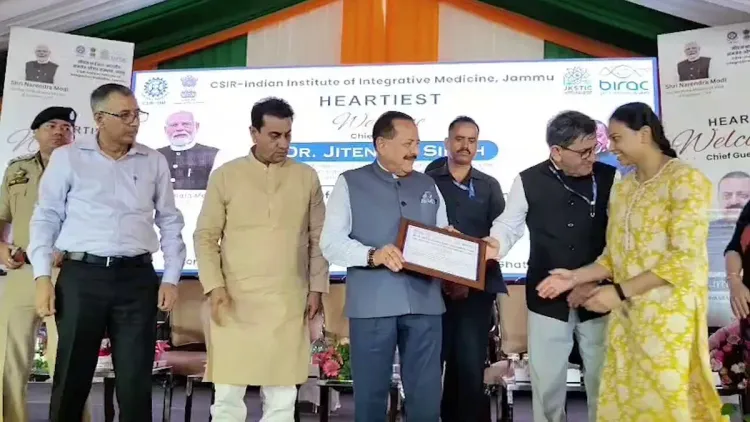
Union Minister Dr. Jitendra Singh presented certificates to Gen Z graduates of a 690-hour Skill Development Programme at CSIR-IIIM's BioNEST Bioincubation Centre in Ghatti, Kathua, linking the milestone to PM Modi's Viksit Bharat vision on 1 August 2026.
Key Takeaways
Jitendra Singh presented certificates at the BioNEST Bioincubation Centre, Ghatti, Kathua on 1 August 2026 .
Students completed a 690-hour, six-month Skill Development Programme run by CSIR-IIIM Jammu .
The BioNEST network was launched by BIRAC in 2014 to build biotech incubation infrastructure nationwide.
The programme sits at the intersection of Skill India (2015) and Startup India (2016) policy frameworks.
The minister framed the graduates as contributors to PM Modi's Viksit Bharat@2047 development roadmap.
The Ghatti facility is a potential model for scale-up across other CSIR national laboratories .
A cohort of Gen Z students from Jammu and Kashmir crossed a significant threshold on 1 August 2026, completing a gruelling 690-hour, six-month Skill Development Programme — and it was Union Science and Technology Minister Dr. Jitendra Singh who handed them their certificates at the BioNEST Bioincubation Centre in Ghatti, Kathua.
The ceremony, held at the CSIR–Indian Institute of Integrative Medicine (CSIR-IIIM), Jammu, marked the culmination of an intensive training cycle designed to bridge the gap between laboratory science and real-world entrepreneurship. Dr. Singh congratulated the graduates, calling them young achievers whose 'skill to drive innovation, StartUp and entrepreneurship holds promise to the making of PM Narendra Modi's Viksit Bharat.'
What the BioNEST Programme Actually Delivers
The BioNEST Bioincubation Centre at Ghatti is part of a national network backed by BIRAC (Biotechnology Industry Research Assistance Council), which launched the BioNEST programme in 2014 to seed biotech incubation infrastructure across India. The Ghatti facility gives early-stage founders and trainees access to lab space, mentorship, and hands-on exposure to the full startup lifecycle — from ideation to prototype.
The 690-hour curriculum is one of the more intensive short-cycle offerings in India's public science ecosystem, sitting at the intersection of the Skill India Mission (launched 2015) and the Startup India initiative (announced 2016). Together, those two flagship programmes created the policy scaffolding that now allows CSIR institutes to run vocationally-oriented tracks inside active research campuses.
CSIR-IIIM's Expanding Role Beyond the Lab
CSIR-IIIM Jammu is primarily known for natural-product research — drug discovery from plant and microbial sources. Its pivot toward structured skill programmes reflects a broader directive to make CSIR's 37 national laboratories more directly useful to the regional economy. Kathua, the district that houses the Ghatti centre, sits on the Jammu–Pathankot corridor, giving it logistical and symbolic importance as a node of development activity in the Union Territory.
Dr. Singh's ministry has repeatedly positioned CSIR institutes as engines of the Viksit Bharat@2047 vision — Prime Minister Modi's roadmap for India to become a developed nation by the centenary of independence. Skill-linked bioincubation programmes are one of the more concrete expressions of that ambition at the district level.
Why Gen Z at the Centre of the Narrative Matters
The minister's explicit call-out of Gen Z participants is deliberate framing. India has roughly 600 million people under the age of 25, and policymakers have consistently argued that channelling that demographic into science-backed entrepreneurship — rather than conventional employment — is the structural bet behind both Startup India and the Skill India Mission. Programmes like the one at Ghatti are small in scale but serve as proof-of-concept models that can be replicated across other CSIR campuses.
With the next Science and Technology budget cycle and BIRAC review meetings on the horizon, the Ghatti ceremony could foreshadow scale-up announcements for BioNEST centres at additional CSIR labs — turning a certificate distribution event into a data point in a much larger policy argument.
Point of View
Dr. Singh signals that district-level bioincubation events now carry ministerial visibility — a deliberate messaging choice ahead of budget and BIRAC review cycles. The Gen Z framing also reflects a calculated political investment: if even a fraction of these graduates launch viable biotech ventures, they become living proof-points for a policy architecture that spans three flagship programmes. The real test will be whether BioNEST Ghatti's model is systematically replicated or remains a showcase outlier.
NationPress
16 Sept 2026
Frequently Asked Questions
What is the BioNEST Bioincubation Centre in Kathua?
The BioNEST Bioincubation Centre at Ghatti, Kathua is a BIRAC-supported facility housed within CSIR-IIIM Jammu that provides lab space, mentorship, and startup training to early-stage biotech entrepreneurs and students.
What was the 690-hour skill programme at CSIR-IIIM Jammu?
It was a six-month, 690-hour Skill Development Programme conducted at the BioNEST Bioincubation Centre in Ghatti, Kathua, designed to train students in innovation and entrepreneurship within a biotech research environment.
What is the Viksit Bharat vision that Dr. Jitendra Singh mentioned?
Viksit Bharat@2047 is PM Narendra Modi's roadmap for India to achieve developed-nation status by 2047, the centenary of independence, with science, technology, and startup-driven growth as key pillars.
What is CSIR-IIIM Jammu known for?
CSIR–Indian Institute of Integrative Medicine in Jammu is primarily a natural-product research institution focused on drug discovery from plant and microbial sources, and has expanded into skill and entrepreneurship programmes.
How does the Skill India Mission relate to programmes like the one at Ghatti?
The Skill India Mission, launched in 2015, created the policy and funding framework for short-cycle vocational training in science sectors, enabling CSIR institutes to run structured skill programmes inside active research campuses like BioNEST Ghatti.