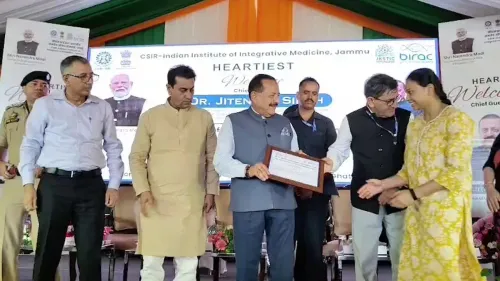
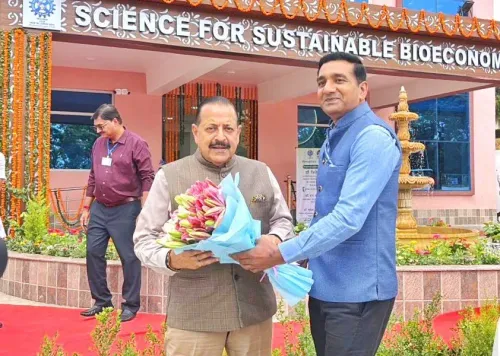
Dr. Jitendra Singh addresses MoU signing for Kathua Biotech Park

Synopsis
Union Minister Dr. Jitendra Singh addressed the MoU signing between CSIR-IIIM and JKST&IC to operationalise the Industrial Biotech Park at Ghatti, Kathua — North India's first such park, already incubating 15 startups and anchored in the region's Purple Revolution lavender economy.
Key Takeaways
An MoU was signed between CSIR-IIIM and JKST&IC to formally operationalise the Industrial Biotech Park at Ghatti, Kathua — North India's first industrial biotech park.
The park's BIRAC BioNEST Incubator is currently supporting 15 startups , with CSIR-IIIM running job-oriented skill development programmes alongside.
The facility is equipped with herbal extraction, fermentation, distillation, and tissue culture infrastructure, with a focus on medicinal and aromatic plants of J&K and Ladakh .
The park is the institutional extension of CSIR's Aroma Mission (launched 2016) and the Purple Revolution lavender drive, which earned a Republic Day tableau on Kartavya Path and a mention in PM Modi's Mann Ki Baat .
The park prioritises green-category industries and environmentally sustainable enterprises, with facilitation for commercial technology transfer.
Jammu and Kashmir is being actively positioned as a biotechnology and innovation destination under the Startup India and Atmanirbhar Bharat frameworks.
North India's first Industrial Biotech Park just got a formal operational mandate — and it is rooted in lavender fields, startup dreams, and a decade of quiet policy work. Union Science and Technology Minister Dr. Jitendra Singh addressed the MoU signing ceremony between CSIR-Indian Institute of Integrative Medicine (CSIR-IIIM) and the Jammu and Kashmir Science, Technology and Innovation Council (JKST&IC) on Saturday, August 1, 2026, marking a formal step toward operationalising the Industrial Biotech Park at Ghatti, Kathua.
What the MoU unlocks at Ghatti
The Kathua Biotech Park is already live in parts. It houses a BIRAC BioNEST Incubator that is currently supporting 15 startups, and CSIR-IIIM has been running job-oriented skill development programmes to prime young entrepreneurs for the biotechnology sector. The MoU between CSIR-IIIM and JKST&IC now provides the institutional backbone for full operationalisation — covering technology transfer, commercial licensing, and green-category industry facilitation.
The park's infrastructure is built for serious work: herbal extraction, fermentation, distillation, tissue culture, and facilitation for commercial transfer are all in place. The focus is firmly on medicinal and aromatic plants of Jammu and Kashmir and Ladakh — a natural fit given the region's biodiversity and the decade-long policy push behind it.
The Purple Revolution's long road to Kartavya Path
The Kathua park does not exist in isolation. It is the institutional culmination of India's Aroma Mission, launched by CSIR in 2016 to scale cultivation of aromatic crops — most visibly lavender — across Jammu and Kashmir. That lavender drive, branded the Purple Revolution, earned the region national visibility: Prime Minister Narendra Modi cited it on Mann Ki Baat, and a dedicated tableau rolled down Kartavya Path during the Republic Day parade.
From field to factory floor, the arc is now complete. Farmers who cultivated lavender under the Aroma Mission now have a proximate industrial ecosystem to supply — and startups incubated at Kathua can build on that raw material base with proper lab infrastructure behind them.
J&K as a biotech destination, not just a conflict zone
The broader signal from the signing is deliberate: Jammu and Kashmir is being positioned as a biotechnology and innovation destination. India's National Biotechnology Development Strategy has promoted regional biotech parks since the early 2000s, but the Kathua park is the first of its kind in the north — a gap that has long sat in contrast to the biotech clusters of Bengaluru, Hyderabad, and Pune.
The Startup India and Atmanirbhar Bharat frameworks provide the policy scaffolding, but the Kathua park's edge is specificity: it is built around what the region actually grows and knows — aromatic and medicinal plants — rather than importing a generic biotech template from elsewhere. That alignment between local ecology and industrial design is what makes the model worth watching.
With 15 startups already incubated and a full MoU now in place, the next test is whether technology transfer agreements and commercial deals follow at scale — and whether Kathua becomes the template for more biotech parks across India's northern states.
Point of View
The government is attempting a model of industrial development that links farm-level cultivation directly to startup incubation and commercial technology transfer. If it works, Kathua becomes a replicable template for other biodiversity-rich but industrially underserved regions. The real proof will come in the next phase: whether technology transfer deals and commercial agreements materialise at scale, or whether the park remains an incubation showcase without downstream industrial density.
NationPress
16 Sept 2026
Frequently Asked Questions
What is the Industrial Biotech Park at Kathua?
The Industrial Biotech Park at Ghatti, Kathua in Jammu and Kashmir is North India's first industrial biotech park. It is equipped with herbal extraction, fermentation, distillation, and tissue culture facilities, and houses a BIRAC BioNEST Incubator currently supporting 15 startups.
What was the MoU signed between CSIR-IIIM and JKST&IC about?
The MoU between CSIR-IIIM and the Jammu and Kashmir Science, Technology and Innovation Council (JKST&IC) was signed to formally operationalise the Industrial Biotech Park at Ghatti, Kathua, enabling technology transfer, commercial licensing, and green-industry facilitation.
What is the Purple Revolution in Jammu and Kashmir?
The Purple Revolution is a lavender cultivation drive in Jammu and Kashmir promoted under CSIR's Aroma Mission. It gained national recognition through a mention in PM Modi's Mann Ki Baat and a dedicated tableau at the Republic Day parade on Kartavya Path .
What is the CSIR Aroma Mission?
The CSIR Aroma Mission , launched in 2016 , promotes the cultivation and value addition of aromatic and medicinal plants — including lavender in Jammu and Kashmir — to boost farmer incomes and build a domestic aroma industry.
How many startups does the Kathua Biotech Park support?
The BIRAC BioNEST Incubator at the Kathua Biotech Park is currently supporting 15 startups , alongside job-oriented skill development programmes run by CSIR-IIIM for young entrepreneurs and professionals.