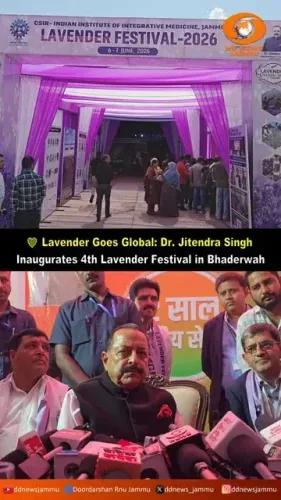
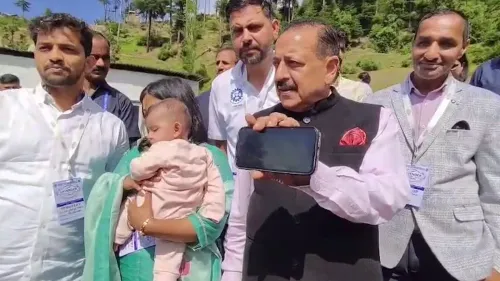
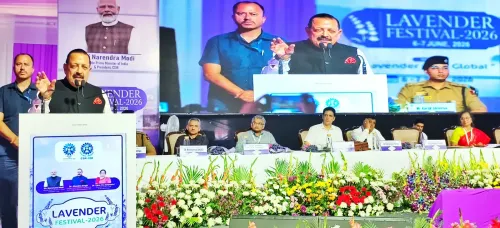
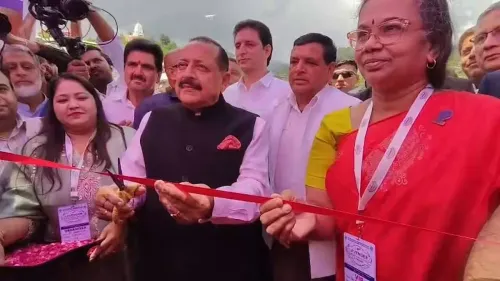
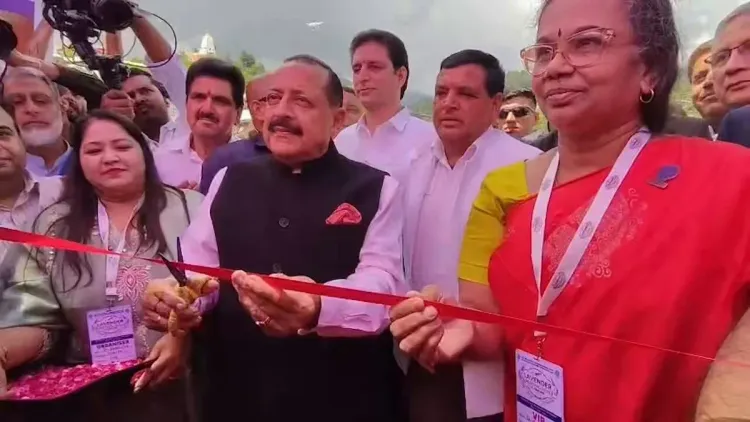
Dr. Jitendra Singh at Lavender Festival 2026, Bhaderwah
Synopsis
Union Science and Technology Minister Dr. Jitendra Singh attended the Lavender Festival 2026 in Bhaderwah, where CSIR-IIIM's exhibition 'Lavender Goes Global' presented the Purple Revolution as a replicable national model for agri-entrepreneurship, backed by PM Modi's Mann Ki Baat mentions and the Rashtriya Vigyan Puruskar.
Key Takeaways
Union Science and Technology Minister Dr.
Jitendra Singh attended Lavender Festival 2026 in Bhaderwah , Jammu and Kashmir, on June 6, 2026 .
CSIR-IIIM organised the exhibition on the theme 'Lavender Goes Global' , positioning the Purple Revolution as a national model for agri-entrepreneurship.
The initiative has received recognition through PM Modi's Mann Ki Baat , the Rashtriya Vigyan Puruskar awarded by the President of India, and a Republic Day tableau slot.
BCCI President Mithun Manhas , local MLAs, and senior CSIR officials were present at the event.
The CSIR Aroma Mission , launched in 2016 , forms the policy backbone of the lavender cultivation and value-addition drive in Jammu and Kashmir.
The Purple Revolution has generated livelihood opportunities for farmers and rural youth, with agri-startups emerging around lavender oil and related products.
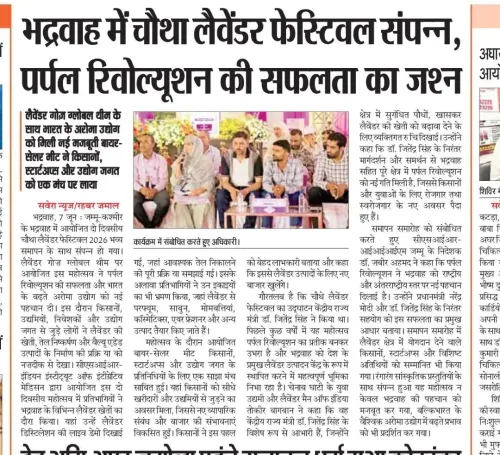
Union Science and Technology Minister Dr. Jitendra Singh attended the Lavender Festival 2026 in Bhaderwah, Jammu and Kashmir, on Saturday, June 6, 2026, where an exhibition organised by CSIR-IIIM on the theme 'Lavender Goes Global' showcased India's Purple Revolution as a national model for agri-entrepreneurship.
Context
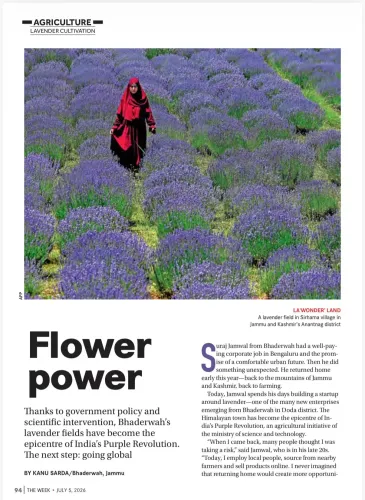
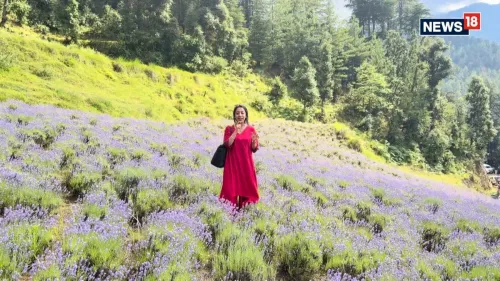
The exhibition at Bhaderwah — widely recognised as the cradle of commercial lavender farming in India — presented the journey of the Purple Revolution from a localised CSIR experiment to an inspiration for farmers and startups across the country. Dr. Singh noted in his post that the initiative has been boosted by Prime Minister Narendra Modi's mention in Mann Ki Baat, the award of the Rashtriya Vigyan Puruskar by the President of India, and a dedicated slot in the Republic Day tableau. These recognitions at the highest symbolic levels of the Indian state have amplified the model's national visibility.
Accompanying the minister at the event were BCCI President Mithun Manhas, a son of the soil from Jammu and Kashmir; MLAs Sh Dalip Singh Parihar and Sh Shakti Raj Parihar; DG Dr Kalaiselvi; and Director Dr Zaheer Ahmed, among others. The cross-sectoral attendance — spanning science administration, elected representatives, and sports administration — underscored the broad institutional support behind the initiative.
Policy Backdrop
The Purple Revolution draws its institutional roots from the CSIR Aroma Mission, launched in 2016, which promoted the cultivation and processing of aromatic crops — including lavender — across Jammu and Kashmir and other states. CSIR-IIIM, headquartered in Jammu, has been the scientific anchor of the mission, providing farmers with planting material, technical know-how, and market linkages.
Post-2019, with the reorganisation of Jammu and Kashmir as a Union Territory, the central government placed renewed emphasis on harnessing CSIR institutes for livelihood generation in the region. The lavender model — combining high-value crop cultivation, distillation technology, and startup-led value addition — became a flagship example of science-and-technology-driven rural enterprise, regularly cited in policy communications from the Science Ministry.
Stakeholders and Impact
The primary beneficiaries of the Purple Revolution are farmers in Jammu and Kashmir's Doda and Kishtwar districts, many of whom have transitioned from subsistence agriculture to commercial aromatic crop cultivation. Agri-startups have emerged around lavender oil extraction, cosmetics, and aromatherapy products, creating downstream employment for rural youth. The 'Lavender Goes Global' theme at this year's festival signals an ambition to move beyond domestic markets and position Indian lavender on international value chains.
The Rashtriya Vigyan Puruskar recognition and the Republic Day tableau have served as powerful demand-generation tools, drawing attention from entrepreneurs and state governments in other parts of India seeking to replicate the model with region-specific aromatic crops.
What's Next
The ministry and CSIR-IIIM are expected to pursue further technology transfer agreements and the expansion of lavender clusters to new geographies, with state agriculture departments in other Himalayan states watching the Bhaderwah model closely. Any new CSIR partnerships or export agreements announced at forthcoming science ministry events or state agriculture fairs will indicate how seriously the 'Lavender Goes Global' ambition is being operationalised. The continued political and institutional patronage visible at the 2026 festival suggests the Purple Revolution will remain a centrepiece of India's science-for-rural-development narrative in the near term.
Point of View
A region of high political salience since its reorganisation in 2019. The presence of BCCI President Mithun Manhas alongside elected representatives and CSIR leadership reflects a calculated effort to give the Purple Revolution cross-sector credibility beyond the science establishment. The 'Lavender Goes Global' theme marks an escalation in ambition, suggesting the ministry is now staking reputational capital on export outcomes, not just domestic adoption. If those export linkages do not materialise, the gap between the festival's branding and ground reality could invite scrutiny.
NationPress
21 Oct 2026
Frequently Asked Questions
What is the Purple Revolution in India?
The Purple Revolution refers to the lavender-based agri-entrepreneurship model promoted by CSIR-IIIM in Jammu and Kashmir, under which farmers cultivate lavender for essential oil and value-added products, supported by the CSIR Aroma Mission launched in 2016.
What is the Lavender Festival 2026 in Bhaderwah?
The Lavender Festival 2026 is an annual event held in Bhaderwah, Doda district, Jammu and Kashmir, organised to showcase the progress of lavender cultivation and the Purple Revolution, featuring exhibitions, farmer participation, and policy outreach.
What is CSIR-IIIM and its role in lavender farming?
CSIR-IIIM, the Indian Institute of Integrative Medicine under the Council of Scientific and Industrial Research, is the scientific anchor of India's lavender cultivation programme, providing planting material, technical support, and market linkages to farmers in Jammu and Kashmir.
Has PM Modi spoken about the Purple Revolution?
Yes, Prime Minister Narendra Modi has mentioned the lavender initiative and its rural livelihood impact in his Mann Ki Baat radio address, which significantly raised national awareness of the Purple Revolution.
What is the Rashtriya Vigyan Puruskar and why was it given for lavender?
The Rashtriya Vigyan Puruskar is a national science award conferred by the President of India. The lavender-related work under the CSIR Aroma Mission received this recognition for its contribution to science-led rural enterprise and farmer welfare.