Dr. Jitendra Singh Hails Bhaderwah Lavender Going Global

Synopsis
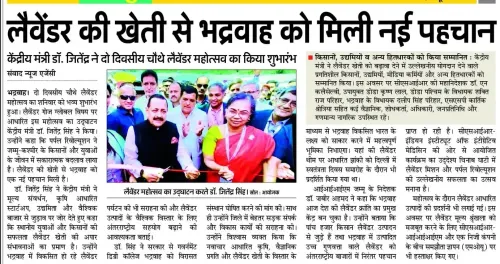
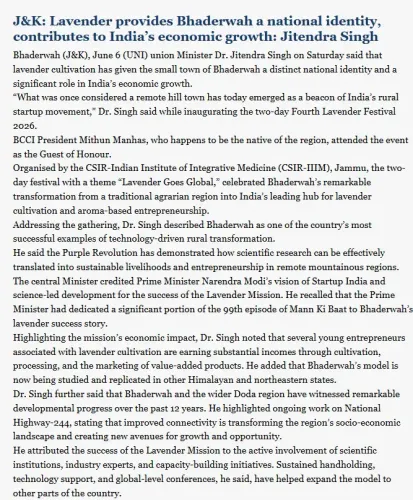
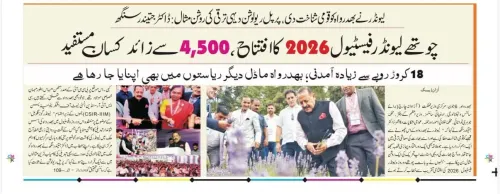
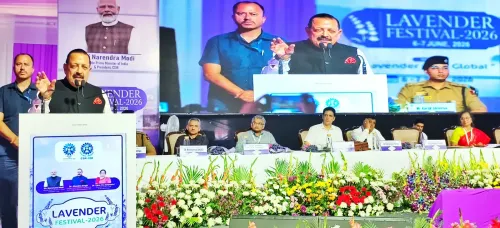
Union Minister Dr. Jitendra Singh on 7 June 2026 spotlighted Lavender Festival 2026 in Bhaderwah, declaring Indian lavender has gone global — a milestone for the CSIR Aroma Mission launched in 2016 to transform aromatic crop farming and essential oil production in Jammu and Kashmir.
Key Takeaways
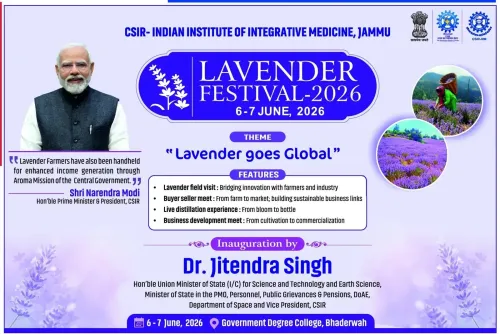
Jitendra Singh posted about Lavender Festival 2026 in Bhaderwah on 7 June 2026 , declaring Indian lavender has gone global.
The CSIR Aroma Mission , launched in 2016 , targeted 6,000 hectares under aromatic crops including lavender across India.
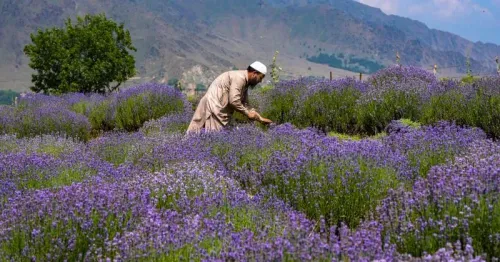
Bhaderwah in Doda district, Jammu and Kashmir is India's flagship lavender cultivation site, selected for its Provence-like altitude and climate.
The first Lavender Festival in Bhaderwah was held in 2019 to showcase CSIR agro-technology and connect farmers with buyers.
CSIR transferred tissue-culture and distillation technologies from laboratories to farmers, enabling domestic production of lavender essential oil previously imported.
The 'Goes Global' milestone signals that Bhaderwah lavender oil is now being positioned for international fragrance, pharmaceutical, and cosmetics markets.
Union Science and Technology Minister Dr. Jitendra Singh on Sunday, 7 June 2026 flagged the Lavender Festival 2026 in Bhaderwah, highlighting the milestone of Indian lavender reaching global markets — a landmark in the CSIR Aroma Mission's decade-long push to transform aromatic crop cultivation in Jammu and Kashmir.
Context
The minister's post, captioned 'Lavender Goes Global', underscores a significant shift in the narrative around Bhaderwah's lavender economy — from a domestic agri-technology experiment to an internationally recognised aromatic crop cluster. Bhaderwah, a hill town in Doda district of Jammu and Kashmir, has been at the centre of India's lavender cultivation story since CSIR introduced large-scale trials there under the Aroma Mission.
The Lavender Festival, first held in Bhaderwah in 2019, was conceived as an annual showcase of CSIR-developed agro-technology, bringing together farmers, distillers, and buyers. The 2026 edition carries the added weight of a global dimension, signalling that the essential oils and produce from this Himalayan cluster are now being positioned for export markets.
Policy Backdrop
The CSIR Aroma Mission, formally launched in 2016, set out to bring 6,000 hectares under aromatic crops — including lavender, lemongrass, and mint — across India, with a particular focus on the Himalayan belt. The mission transferred tissue-culture propagation and distillation technologies directly from CSIR laboratories to farming communities, enabling smallholders to produce high-value essential oils that were previously imported.
Bhaderwah emerged as a flagship site because its altitude, soil, and climate closely mirror the lavender-growing conditions of Provence, France. Dr. Jitendra Singh, who holds independent charge of the Ministry of Science and Technology, has consistently championed the mission as a model for science-to-farm technology transfer and rural income diversification in Jammu and Kashmir.
The push for import substitution of essential oils has been a recurring theme: India historically imported significant quantities of lavender oil, and domestically produced Bhaderwah lavender oil has been positioned as a quality alternative for the fragrance, pharmaceutical, and cosmetics industries.
Stakeholders and Impact
The primary beneficiaries of the CSIR Aroma Mission in Bhaderwah are the farming households of Doda district, many of whom have shifted from subsistence staple crops to lavender and other aromatics as a higher-income alternative. Essential oil processors and distillery operators in the region have also seen expanded activity as raw material supply has grown.
The 'Goes Global' framing points to a new layer of stakeholders: international buyers in the fragrance, wellness, and pharmaceutical supply chains who are now sourcing or evaluating Indian lavender oil. For Jammu and Kashmir's broader agricultural economy, a successful export corridor for lavender oil would reinforce the case for scaling aromatic crop cultivation to additional districts beyond Doda.
What's Next
Attention will now turn to whether the Lavender Festival 2026 produces concrete export agreements or new partnerships that institutionalise the global linkage the minister has highlighted. Expansion of the CSIR Aroma Mission to additional districts in Jammu and Kashmir and other Himalayan states remains a stated policy priority, with the Bhaderwah cluster serving as the proof-of-concept model.
If the 'Goes Global' momentum translates into verifiable export volumes and market linkages, it could accelerate the government's broader agenda of making science-backed agri-innovation a driver of rural economic transformation across India's hill regions.
Point of View
The global framing serves a dual purpose: validating a decade of CSIR investment and reinforcing the narrative that post-reorganisation J&K is open for international agricultural commerce. The Bhaderwah model, if it produces measurable export volumes, could become a template for replicating high-value aromatic crop clusters in other hill districts, strengthening the government's science-to-farm technology transfer agenda at scale.
NationPress
22 Oct 2026
Frequently Asked Questions
What is the CSIR Aroma Mission and how does it relate to Bhaderwah lavender?
The CSIR Aroma Mission, launched in 2016, is a national programme to bring 6,000 hectares under aromatic crops including lavender for essential oil production. Bhaderwah in Doda district, Jammu and Kashmir, became its flagship lavender site because of its Provence-like climate and altitude.
When did the Bhaderwah Lavender Festival start?
The first Lavender Festival in Bhaderwah was organised in 2019 to showcase CSIR-developed agro-technology and connect farmers with buyers and processors.
What does 'Lavender Goes Global' mean for Indian farmers?
It signals that lavender essential oil produced by farmers in Bhaderwah is now being positioned for international markets in the fragrance, pharmaceutical, and cosmetics industries, potentially opening export revenue streams for smallholder cultivators in Jammu and Kashmir.
Why is Bhaderwah suited for lavender cultivation?
Bhaderwah's high altitude, soil composition, and climate closely mirror the conditions of lavender-growing regions in southern France, making it naturally suited for producing high-quality lavender essential oil.
What role does Dr. Jitendra Singh play in the CSIR Aroma Mission?
As Union Minister holding independent charge of Science and Technology, Dr. Jitendra Singh oversees CSIR and has been a prominent advocate for the Aroma Mission, frequently highlighting Bhaderwah lavender as a model of science-backed rural income diversification in Jammu and Kashmir.