Jitendra Singh: Lavender Gives Bhaderwah National Identity
Synopsis
Union Minister Dr. Jitendra Singh on June 7, 2026, said lavender has given Bhaderwah in Jammu and Kashmir a national identity and contributes to India's economic growth, marking Lavender Festival 2026. The crop is central to the CSIR Aroma Mission's push for high-value Himalayan agriculture.
Key Takeaways
Jitendra Singh stated that lavender gives Bhaderwah a national identity and contributes to India's economic growth on June 7, 2026 .
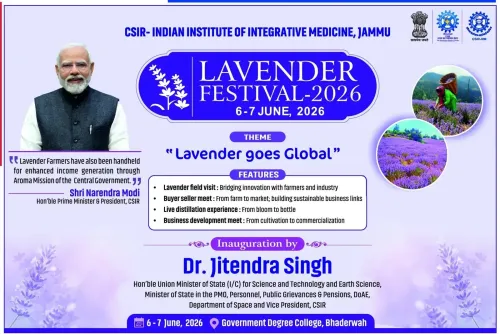
The remarks were made in the context of Lavender Festival 2026 , an annual event in Doda district, Jammu and Kashmir .
The CSIR Aroma Mission , launched in 2016 , underpins lavender cultivation by providing farmers with planting material, training, and distillation access.
Primary beneficiaries include lavender farmers in Doda district and the Jammu and Kashmir tourism sector .
The government's 'Purple Revolution' branding positions Bhaderwah lavender as a model for agri-economic transformation in Himalayan regions.
Future policy attention will focus on processing infrastructure expansion and possible new cultivation targets under state horticulture budgets or CSIR follow-on projects.
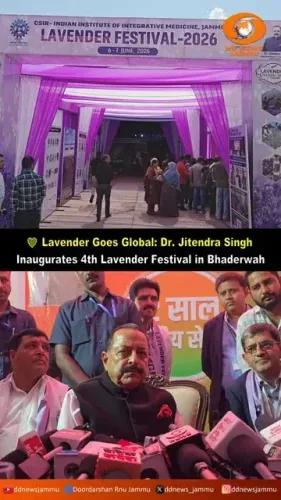
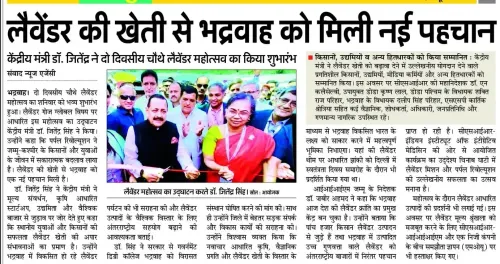
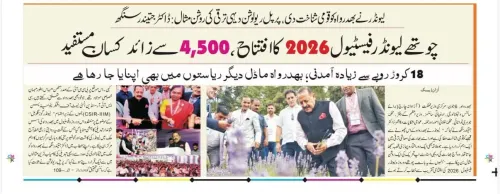
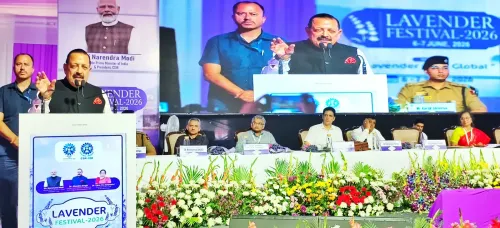
Union Science and Technology Minister Dr. Jitendra Singh on Sunday, June 7, 2026, highlighted that lavender cultivation has given Bhaderwah in Jammu and Kashmir a distinct national identity while contributing to India's economic growth, marking the occasion of Lavender Festival 2026.
Context
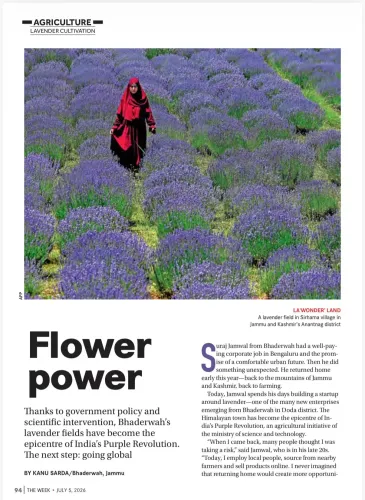
Bhaderwah, a town in Doda district of Jammu and Kashmir, has emerged as the focal point of India's commercial lavender farming push over the past decade. Dr. Jitendra Singh stated that lavender 'provides Bhaderwah a national identity' and 'contributes to India's economic growth,' framing the aromatic crop as both a cultural anchor and an economic driver for the region. The remarks came in the context of Lavender Festival 2026, an annual event that celebrates the crop's role in local livelihoods and agri-tourism.
Policy Backdrop
The lavender push in Jammu and Kashmir is rooted in the CSIR Aroma Mission, launched in 2016 as a national programme to scale cultivation, distillation, and marketing of aromatic crops across Himalayan states. The mission provided farmers in Doda district with planting material, technical training, and access to distillation units, transforming what was once a niche crop into a commercially viable enterprise. Post-2019 administrative changes in Jammu and Kashmir gave further impetus to such schemes, with the central government accelerating integration of remote districts into national agricultural value chains.
The broader policy pattern has been to deploy high-value aromatic and medicinal crops as alternatives to traditional low-return agriculture in Himalayan districts, combining scientific inputs with agri-tourism to generate multiple income streams for rural communities. Lavender branding — through festivals and identity-linked marketing — reflects a deliberate strategy to create a geographic identity for the produce similar to GI-tagged goods, enhancing its premium positioning in domestic and export markets.
Stakeholders and Impact
The primary beneficiaries of the lavender economy are lavender farmers in Doda district, who have seen income diversification through both raw crop sales and value-added products such as essential oils, soaps, and floral extracts. The Jammu and Kashmir tourism sector has also gained, with lavender fields drawing visitors during the bloom season and the annual festival serving as a regional tourism event. Dr. Jitendra Singh, who has been a consistent advocate for the CSIR Aroma Mission in his ministerial capacity, has repeatedly positioned Bhaderwah's lavender as a model for replicating agri-economic transformation in other Himalayan regions.
The festival format amplifies this impact by creating a platform for farmers, processors, and buyers to connect, while media attention reinforces the 'Purple Revolution' branding that the government has cultivated around Bhaderwah's lavender landscape.
What's Next
Attention will now turn to whether Lavender Festival 2026 yields concrete announcements on expanding lavender processing infrastructure or new cultivation targets for Jammu and Kashmir. Possible inclusion of lavender in state horticulture budgets or follow-on projects under the CSIR Aroma Mission would signal deeper institutional commitment. The festival's outcomes could also influence whether other Himalayan districts adopt similar aromatic-crop-led economic models, with Bhaderwah serving as the benchmark case for policy replication.
Point of View
The minister reinforces the government's argument that administrative restructuring has delivered tangible rural dividends. The Lavender Festival format itself functions as soft political communication — converting agrarian policy into a visible, media-friendly event that generates positive optics for the central government in a sensitive region. The recurring emphasis on the CSIR Aroma Mission suggests the government intends to use Bhaderwah as a replicable template rather than a one-off showcase.
NationPress
21 Oct 2026
Frequently Asked Questions
What is the Lavender Festival in Bhaderwah?
The Lavender Festival in Bhaderwah, Doda district, Jammu and Kashmir, is an annual event celebrating the region's lavender cultivation, connecting farmers, processors, and buyers while promoting agri-tourism in the area.
What is the CSIR Aroma Mission and how does it help lavender farmers?
The CSIR Aroma Mission, launched in 2016, is a national programme that supports cultivation, distillation, and marketing of aromatic crops including lavender. It provides farmers in Jammu and Kashmir with planting material, technical training, and access to distillation units.
Why is Bhaderwah called the lavender capital of India?
Bhaderwah in Doda district has become synonymous with commercial lavender farming in India, driven by the CSIR Aroma Mission and central government support, earning it a 'Purple Revolution' identity that Dr. Jitendra Singh has repeatedly promoted.
How does lavender contribute to Jammu and Kashmir's economy?
Lavender generates income for farmers through raw crop sales and value-added products like essential oils and floral extracts, while also boosting the tourism sector through bloom-season visits and the annual Lavender Festival.
What did Dr. Jitendra Singh say about Bhaderwah lavender in 2026?
On June 7, 2026, Dr. Jitendra Singh stated that lavender 'provides Bhaderwah a national identity' and 'contributes to India's economic growth,' speaking in the context of Lavender Festival 2026.